The SusChem News Blog is now hosted on the SusChem website in the News Room. You will be redirected there in 10 seconds
.

Showing posts with label eu2020. Show all posts

Wednesday, 9 July 2014

Bio Based Industries JTI: A Major Advance towards the Bioeconomy

Today (July 9) the European Technology Platform (ETP) for Sustainable Chemistry (SusChem) welcomes the launch of the Bio Based Industries Joint Technology Initiative (BBI JTI). This major Public-Private-Partnership (PPP) represents a significant step forward to the realisation of a European bioeconomy.

SusChem has actively supported the development of the BBI JTI and looks forward to working with the initiative to deliver a sustainable, competitive economy for Europe able to tackle some of our biggest societal challenges and bioeconomy opportunities.

The BBI JTI is being launched with six other JTIs (including JTI on ‘Fuel Cells and Hydrogen’ and ‘Innovative Medicines’) at an event with European Commission President Barroso, Vice Presidents Neelie Kroes and Siim Kallas, and Máire Geoghegan-Quinn, European Commissioner for Research, Innovation and Science (all pictured below at the BBI JTI stand). Together, the JTIs represent a significant joint public-private investment in research and innovation for Europe’s future.
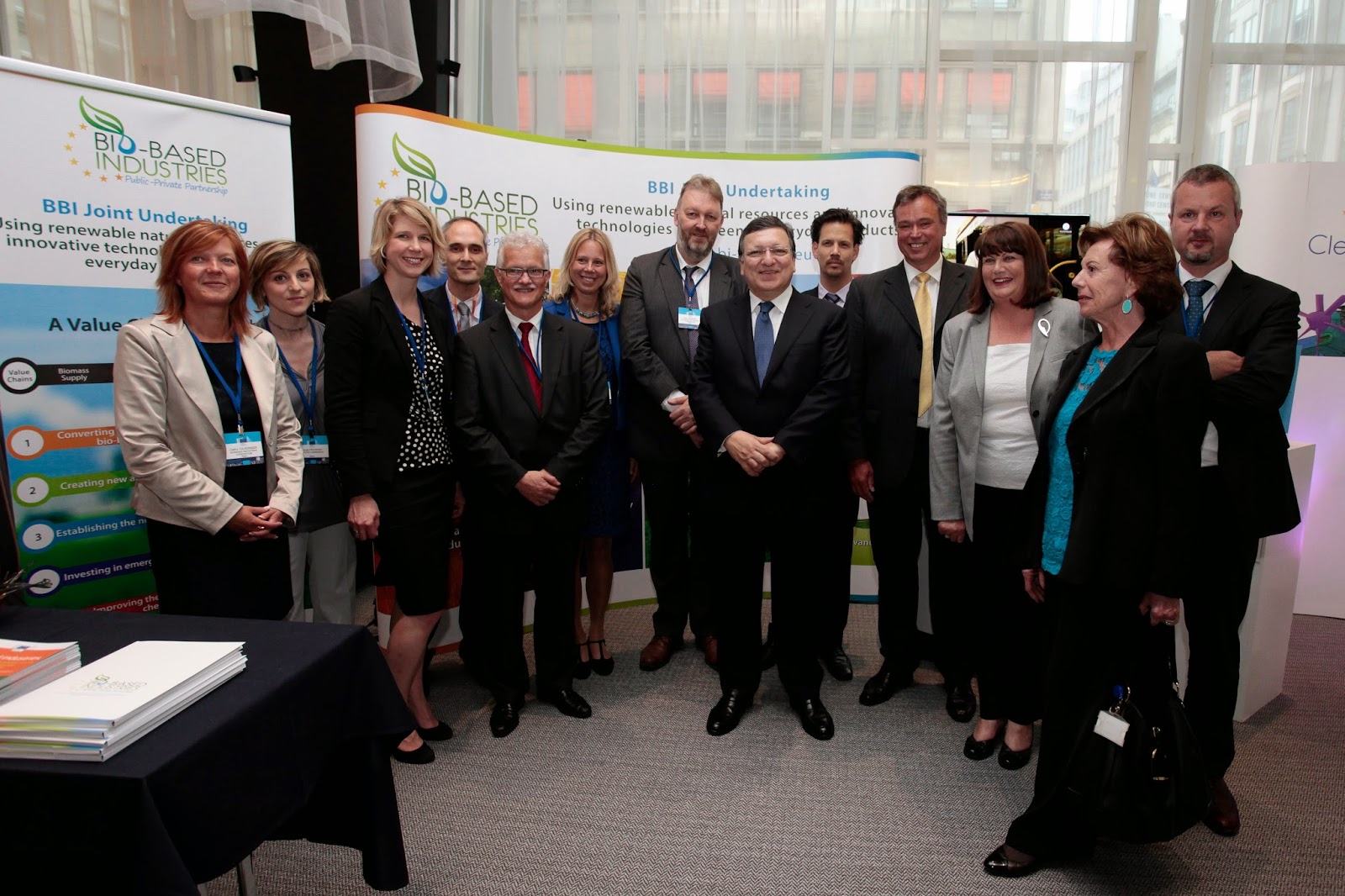

Bio Based Innovation
The BBI JTI will enable a €3.7 billion injection into the European economy between 2014 and 2024, with €975 million provided by the European Commission and €2.7 billion from the Bio-based Industries Consortium (BIC), to develop the emerging bioeconomy. The JTI will finance research and innovation projects and create new and novel partnerships across industry sectors (including agriculture, technology providers, forestry/pulp and paper, chemicals and energy).

The aim of the BBI is to use Europe's untapped biomass and wastes as feedstock to make greener, sustainable everyday products and renewable feedstock.

“At the heart of this initiative are advanced biorefineries and innovative technologies that use sustainable chemistry to convert renewable resources into sustainable chemicals, materials and fuels,” says Dr Gernot Klotz, Executive Director Research at Cefic and SusChem board member.

“The BBI JTI can help develop the building blocks needed to shift from a fossil- and imports-based society to increase the EU’s rate of economic growth, boost jobs – especially in rural areas, rejuvenate industries and reduce greenhouse gas emissions,” he continues. “New bio-based industries can increase the competitiveness of the European economy through re-industrialisation and sustainable growth along with other Key Enabling Technologies.”

Four of the six main Key Enabling Technologies (KETs) identified to be critical to strengthening Europe’s industrial and innovation capacity are from the chemical sector: advanced materials, industrial biotechnology, nanotechnology and advanced manufacturing.

BBI launch


Opening the launch of the JTIs this afternoon José Manuel Barroso (above), President of the European Commission, said: "Only if the best brains from academia, industry, SMEs, research institutes and other organisations come together can we successfully tackle the huge challenges that we are facing. This is what public-private partnerships are about, the joining of forces to make the lives of Europeans better, create jobs and boost our competitiveness. We are committed to prioritising the impact of the European budget on the recovery, and these partnerships are doing just that, with first calls for proposals for € 1.1 billion to be matched by industry, within a package representing an overall € 22 billion boost to growth and jobs creation over seven years. They will continue delivering results that no single country, company or even the European Union as such would achieve alone."

The launch of first calls comes almost exactly one year after the European Commission put forward the Innovation Investment Package, a set of proposals to establish seven public-private and four public-public partnerships (including SPIRE, see below).

Commenting on the BBI launch today Máire Geoghegan-Quinn, European Commissioner for Research, Innovation and Science, said: "The bioeconomy has huge potential that is attracting investments all around the world. With this new partnership, we want to harness innovative technologies to convert Europe’s untapped renewable resources and waste into greener everyday products such as food, feed, chemicals, materials and fuels, all sourced and made in Europe."

Peder Holk Nielsen, CEO of Novozymes, added on behalf of the industry partner, the Bio-based Industries Consortium (BIC): “The BBI is an unprecedented public-private commitment because of its focus on bringing bio-based solutions to the market. It is an opportunity to deliver sustainable growth in European regions and to reverse the investment trend currently going to other regions of the world.”


Concluding the launch event Commissioner Máire Geoghegan-Quinn (above) said: "As we heard earlier today, only through joint investments in developing our research and innovation capacity can we create the new jobs and growth to overcome the current economic crisis. The challenge is, of course, to make sure that such investments deliver tangible impacts: to help accelerate the development of new technologies and innovations, to generate new markets for innovative products and services; and to deliver good jobs and major benefits to society. I am confident that the JTIs presented here will live up to this challenge. The first calls for proposals illustrate the kind of activities that JTIs will support in our goal of accelerating the deployment of great ideas from the lab into the market – for example large scale demonstrators, testing and prototyping."

BBI and SPIRE together
The BBI JTI builds on ‘SusChem inspired’ projects such as EUROBIOREF: one of three large FP7 projects in a joint call on advanced biorefineries that responded to SusChem’s visionary project: ‘The Integrated Biorefinery’. Innovations from other SusChem FP7 projects such as the F3 Factory will also contribute to the integration of bio based processes into the economy.

“The BBI JTI is one of two major PPPs that SusChem is proud to have inspired: the other being the Sustainable Process Industry through Resource and Energy Efficiency (SPIRE) PPP,” says Dr Klotz. “SPIRE and the BBI JTI will work closely together along defined areas of common interest and will use their synergies to help deliver high resource and energy efficiency that can lay the foundation of the circular economy in Europe, alongside the materials programme of SusChem.”

BBI explained 
The BBI JTI is a €3.7 billion Public-Private Partnership (PPP) between the EU and the Bio-based Industries Consortium (BIC). The BBI is dedicated to realising the European bioeconomy potential, turning biological residues and wastes into greener everyday products through innovative technologies and biorefineries, which are at the heart of the bioeconomy. The Bio-based Industries Consortium - the industrial partner in the PPP - is constituted by a unique mix of sectors including agriculture, agro-food, technology providers, forestry/pulp and paper, chemicals and energy. A short video  explaining what the BBI JTI is all ablout has also been published (see below).


A fact sheet on the BBI and its activities is available and more information can be found at the BBI website.

An Info Day on the BBI will take place on 2 September 2014 in Brussels and will be a 'must-attend' event for all stakeholders interested in understanding the BBI rules for participation.

Five value chains
Organised in five value chains – that range from primary production to consumer markets – the BBI will help fill the innovation gap between technology development and commercialisation, sustainably realising the potential of bio-based industries in Europe.

The BBI is a shift from a fossil- and imports-based society to increase Europe’s share of sustainable economic growth, and is expected to create tens of thousands of jobs (80% in rural areas), revitalise industries, diversify farmers’ incomes, and reduce GHG emissions by at least 50% in comparison to fossil-based applications.

The aim of the BBI is to use Europe's untapped biomass and wastes as feedstock to make fossil-free and greener everyday products. At the heart of it are advanced biorefineries and innovative technologies that will convert renewable resources into sustainable bio-based chemicals, materials and fuels.

The BBI will manage the investments in the form of research and innovation projects that are defined in annual Calls for Proposals and implemented across European regions. In line with Horizon 2020 rules, all stakeholders are invited to submit innovative proposals and demonstrate progress beyond state-of-the-art.

The BBI is dedicated to realising the European bioeconomy potential, turning biological residues and wastes into greener everyday products through innovative technologies and biorefineries, which are at the heart of the bioeconomy.

The BBI is about connecting key sectors, creating new value chains and producing a range of innovative bio-based products to ultimately form a new bio-based community and economy.

Bio-based Industries: using renewable natural resources and innovative technologies for greener everyday products developing new value chains for bio-based industries, from primary production to consumer markets;
  • Using innovative technologies to turn biological residues and wastes into greener everyday products;
  • Moving from fossil-based to biobased products: planting the seeds for the European circular economy;
  • Supporting regional development by diversifying the local economy;
  • Promoting the opening of new markets for bio-based products and applications “Made in Europe”.
The BBI JTI will help create new jobs, especially in rural regions, and offer Europeans new and sustainable products sourced and produced locally. New bio-based industries can increase the
competitiveness of the European economy through re-industrialisation and sustainable growth.

The development of new bio-based products and markets based on smart and efficient use of resources will diversify industries’ revenue streams.

The BBI is expected to bridge European research knowledge with commercial scale bio-based products, making full use of European scientific and technological knowledge. The BBI should benefit all Member States where regions can play an important role through their Smart Specialisation Strategies.

Seven JTIs
The BBI was one of seven JTIs launched at a special event in Brussels on 9 July. Fact sheets on all seven JTI are available via the links below:
For more information, please visit the SusChem website or contact Esther Agyeman-Budu, Cefic communication manager for research and innovation.

An extended SusChem 10th Anniversary video describing the platform, its achievements and its contribution to BBI has also been published on YouTube.

Wednesday, 12 March 2014

Convention highlights innovation challenges

The European Commission held its second Innovation Convention on 10 and 11 March in Brussels. The Innovation Convention is an essential (and fun) part of the Innovation Union flagship initiative that aims to create an innovation-friendly environment in Europe. The convention provides a platform for debate, workshops, award ceremonies and a showcase for some of Europe’s most innovative ideas and people.

The convention was organised by Research and Innovation Commissioner Máire Geoghegan-Quinn (pictured below trying out Google Glass) and opened by Commission President José Manuel Barroso. He praised the Commissioner for her efforts and enthusiasm in driving forward an ambitious European agenda on innovation in the context of the overall Europe 2020 agenda.


President Barroso said: “Innovation has a vital role to play in the [EU’s] recovery and in shaping our societies of tomorrow. Europe has a good story to tell, but we still need to do more to foster innovation and we want to do it with our partners.”

“Innovation and skills go to the very heart of what we, in Europe, should be about in the 21st Century, in our knowledge, in our values and in our way of living,” he continued.

Key messages
SusChem contributed to a session on the ‘Key innovation messages from 2013’ as a follow up to the Vilnius Innovation Forum and the 5th European Innovation Summit. This fringe session was organised by Knowledge4Innovation (K4I) and the Lithuanian Presidency of the Council of the European Union 2013 on the afternoon of the first day of the conference.

In 2013 the two major innovation summits were organised in Vilnius and Brussels respectively and both resulted in a series of new messages and actions that were presented and discussed at this meeting. Speakers included Mr Lambert van Nistelrooij, MEP, Chairman of the Knowledge4innovation Forum Governing Board, Dr. Albertas Žalys from the Lithuanian Ministry of Education and Science, and Mr Dimitrijus Kucevicius from the Ministry of Economy.


Dr. Gernot Klotz, Executive Director Research and Innovation, Cefic (above) gave the view from SusChem. He noted that Europe produced around 30% of the world’s patents but only a few percent of the global manufacturing. He emphasised the difference between research and innovation: innovation is about change, doing things differently and at the appropriate speed – it is not only about more money.

The EU needs to build on its innovation strengths. This meant that we needed to not only focus on brand new industries, but also on existing leading innovative industries such as chemicals and the process sectors. He noted the role of SPIRE PPP in connecting innovation across the process sectors under Horizon 2020.

He concluded that Europe needed to decide if it was only interested in knowledge creation or also the benefit, in terms of jobs and growth, which came from serious implementation of knowledge. He believes that Europe needs a strong manufacturing as basis for whole economy and that to succeed at innovation would require clear and strong leadership from all parts of society including both government and business.

Perception
Another highlight was an early evening ‘Global Leader’ session, moderated by Clara de la Torre who now heads the Key Enabling Technologies Directorate at the European Commission’s DG Research and Innovation, that saw Marijn E. Dekkers, Chairman of the board of Management of Bayer AG in conversation with Professor Anne Glover, Chief Scientific Advisor to President Barroso (pictured below).


Their conversation discussed the role and the perception of science and innovation in society – in particular how to strengthen an evidence-based approach for policy-makers, thus ensuring transparency and an effective involvement of the public.

The SusChem News team also enjoyed a Science Communication workshop organised by the BBC featuring (below from left to right) BBC presenter Vivienne Parry, BBC Science producers Jacqui Smith and Helen Thomas and comedian and BBC Science Club presenter Dara O’ Briain.


Showcase area
The exhibition area of the Innovation Convention provided a space to showcase a range of innovative prducts and enterprises from Google Glass to fuel-cell powered cars and rapid cooling for drinks!


Two of our favourites with a sustainable chemistry elements were the Algae Lamp – pictured above being described by Nicolas Hue (on the right) - and the Confederation of European Paper Industries (CEPI) stand (below) which highlighted the winners of its ‘Two Team‘ projects that looked at breakthrough technologies for a low carbon economy including the use of Deep Eutectic Solvents to process biomass – an extremely energy and resource efficient concept.


A huge number of photos from the two days can be found here on the Innovation Convention's flickr web page and video summaries of the two days of the Convention can be viewed below and are also available on the Innovation Convention website along with lots more information on all the events that took place.

Innovation Convention Day One


Innovation Convention Day Two


We are looking forward to the third event already!

Monday, 14 October 2013

Chemical Innovation to play a critical role in Smart Cities

Today (October 14) the High-level Group (HLG) of the Smart Cities and Communities (SCC) European Innovation Partnership (EIP) presented its Strategic Implementation Plan (SIP) to the European Commission. Chemical innovation can provide a range of concrete solutions to the challenges of improving our urban built environment and infrastructure and enable the realization of the truly Smart Cities of tomorrow.

With about three-quarters of European citizens living in or around cities, it is essential that Europe gets this right. “We need more structured EU dialogue on how to balance the diversity and complexity of city requirements with the industrial needs for a broader market scale of integrated technological concepts, from the retrofitting of buildings to ICT-enabled buildings to create a European market of affordable solutions,” said Dr. Gernot Klotz, Executive Director for Research and Innovation at Cefic and a SusChem board member. “A potential 50 000 individual solutions for the needs of 50 000 individual cities is an unsustainable path. There is a clear need to bring cities together to enable industry to supply broader affordable solutions.”

Strategic plan
The Strategic Implementation Plan (SIP) marks a major milestone achievement for the Smart Cities and Communities High-level Group. The group brings together cities, industries and stakeholders across Europe to discuss ways to improve the standardization of innovative new solutions for urban districts and to accelerate their deployment across European cities.


The meeting (above) was hosted by Commissioner Neelie Kroes (Digital Agenda) and statements were made by Commissioners Siim Kallas (Transport), Günther H. Oettinger (Energy) and Johannes Hahn (Regional Policy). The chemical industry is represented on this important policy group by Giorgio Squinzi, CEO of Maipei and recent past president of Cefic.

The SIP outlines eleven ambitious targets in three specific areas that are expected to contribute to the broader development of sustainable mobility, sustainable districts and built environments, and integrated infrastructures and processes across Energy, information and communication technologies (ICT) and Transport.

“We appreciate the efforts and the result of the High Level Group in having a strategic implementation plan delivered within six months, on an extremely diverse and complex topic such as the future of cities in Europe” continued Dr. Klotz.

Chemistry: concrete contributions
Chemistry lies at the very heart of the built environment in every city and provides the fundamental building blocks for ICT, Energy and Transport. For example, new advanced materials for housing such as smart coatings and insulations are making houses more energy efficient, while advanced light-weight materials and printed electronics for mobility are making cars more connected, safer and more energy efficient.

These applications are expected to make a significant contribution towards the EIP’s goals. It is hoped that the SIP proposals will be implemented in full to address the full scale of “smart” city enabling technologies and to prioritize the creation of jobs and growth in Europe.

The Chemical Industry is ready to engage longer-term in the work of the EIP and has offered five concrete solutions for Chemistry-based initiatives for energy efficiency in buildings, which were selected as top key innovation by city officials at the last Smart Cities and Communities Stakeholder Platform conference.

The five key chemistry-based products proposed by SusChem to help improve building efficiency and help reach the EU 20-20-20 targets are:

  • High-reflectance indoor coatings
  • High-reflectance and durable outdoor coatings
  • High-performance insulation foams 
  • High-performance vacuum insulation panels
  • Phase-change materials (PCM)

These five key chemistry-based products have been adopted as a Key Innovation by the Smart Cities and Communities Stakeholder Platform. Combined these products can offer substantial energy savings of up to 40% at an acceptable investment.

“All these solutions are assessed for technical feasibility and impact. What remains is the real life testing of these technologies in European cities and the chemical Industry is ready for this next step,” said Dr. Klotz.

Urban opportunity 
This Smart Cities and Communities EIP offers a great opportunity to reduce the complexity of city requirements and creates a market pull along industrial value chains as well as accelerating the creation of jobs and growth in Europe.

“It is only by working together that we can bridge the innovation gaps and stimulate the convergence of industrial value chains in the Energy, Transport and ICT sectors to find and implement the best solutions for smart cities. This is Europe’s unique strength and competitive edge over other regions of the world” concluded Dr. Klotz.

The EIP still has to improve its potential by including manufacturing as well as services in order to stimulate innovation for a broader European economy. This can happen through creating market pull and improvement to the SIP by giving manufacturing a more prominent role.

A public launch event for the SIP is being planned for 26 November in Brussels that will outline European funding and business commitments.

This is just the beginning of a large scale programme of work by all the partners and many others. An important part of that work will be the "Lighthouse Projects" - cities which will demonstrate and deliver Smart City solutions on a large scale. These Projects will be partly financed by the European Commission's Horizon 2002 Research Funds. Further business and public funding will help to spread these new solutions to other cities and economies of scale will help to make these "innovative" and "high tech" solutions the norm and available more easily to all cities and neighbourhoods.

The Commission is expected to invest around €200 million to create Smart Cities projects in the next two years.

Smart Cities
The Smart Cities and Communities EIP (SCC) is a partnership across the areas of energy, transport, and ICT with the objective of catalyzing progress in areas where energy production, distribution and use; mobility and transport; and ICT are intimately linked and offer new interdisciplinary opportunities to improve services while reducing energy and resource consumption and greenhouse gas (GHG) and other polluting emissions.

The HLG acts in an advisory role to the Commission and consists of senior representatives of industry, cities, civil society, relevant EU initiatives in this area and member s of the European Commission as members. The group is led by the three European Commissioners for Energy, Transport and the Digital Agenda.

For more information on SusChem activities in support of the Smart Cities and Communities initiative, or to discuss potential collaborations in this area, please contact SusChem Coordinator Jacques Komornicki at Cefic. The new SusChem report can be downloaded here.

Wednesday, 29 May 2013

Smart Chemistry at Smart Cities Stakeholder


SusChem will be at the Smart Cities Stakeholder event in Budapest on 5 and 6 June demonstrating how chemistry can provide Key Innovations for improving energy efficiency in the urban environment and addressing other Smart Cities issues. SusChem has just published a new report - ‘Innovative Chemistry for Energy Efficiency of Buildings in Smart Cities’ - outlining where Key Innovations in chemistry can make an immediate impact to improve energy efficiency during the refurbishment of buildings.

SusChem coordinator and Innovation Manager at Cefic Jacques Komornicki will be attending the Smart Cities Stakeholder Platform Annual Conference in the Hungarian capital with a clear message on how chemistry can provide a range of sustainable solutions for Smart Cities.

“The Chemical Industry is a leading provider of innovative solutions for energy efficiency and construction in Europe,” says Jacques. “And these Key Innovations are available right now providing substantial savings for building owners and users.”

Efficient innovation
The Key Innovations described in the new SusChem report are:
  • High Performance Insulation Foams and Vacuum Insulation Panels that can reduce energy heating costs from 30% up to 80%.
  • Phase Change Materials (PCM) that enable walls and ceilings to absorb and store excess heat during the day and dissipate it at night, enabling further savings of energy on heating and cooling.
  • High Reflectance and Durable Outdoor Coatings that if applied to roofs and walls reflect radiation from sunlight and reduce roof and wall temperatures, leading to energy savings on cooling.
  • High Reflectance Indoor Coatings that reflect light better than normal paints and maximize the feeling of space and illumination.
“Overall using these tested energy efficiency solutions can reduce primary energy use in buildings by up to 70%,” claims Jacques.  Today 40% of primary energy n Europe is used for heating and cooling buildings.

These innovative solutions from chemistry combined with an annual urban building refurbishment rate of around 3% could result in direct savings for building owners and users, make a significant contribution to achieving EU energy targets, and generate jobs.

Tool-box, ballot box
“Clearly the chemical industry has a tool-box of solutions that can contribute to drastically decreasing the energy consumption of buildings,” continues Jacques. “These innovations are particularly suited to the renovation market and this market in turn has the potential to create growth and jobs in Smart Cities that adopt them whilst also contributing significantly to their emissions reduction goals - a double win!”

The conference is the first in a series of Annual Conferences of the Smart Cities Stakeholder Platform and follows a ‘bottom-up’ process conceived to allow matchmaking and active exchange between industry and city partners as well as other stakeholders on the best Key Innovations, which have emerged from the Platform’s stakeholders.

Key Innovations are right at the core of debate as these are what interest the cities as well as the solution providers. The first day is fully devoted to discuss all Key Innovations following which delegates will vote for a ‘Top Three’ to be presented at the plenary session on day two. Day two will also provide stakeholder perspectives on the achievements of the Smart Cities Stakeholder Platform.

The chemistry industry’s Key Innovations will be presented at the stakeholder event by Rinske van Heiningen of Akzo Nobel in his presentation on Advanced Materials for Energy Services on day one.

We are confident that the Chemistry Key Innovations will contribute to reach the Smart Cities targets,” concludes Jacques.

What are ‘Smart Cities’?
 
Smart cities go beyond the EU’s “20-20-20” objectives (20% reduction in CO2 emissions, a 20% share of energy from low carbon sources and a 20% reduction in the use of primary energy through energy efficiency measures) for the deployment of cost-effective low carbon technologies with a particular focus on energy, ICT and transport sectors.

Many cities across Europe are already committed to building tomorrow’s cities today - in particular those involved with the Covenant of Mayors organisation to which Cefic and SusChem are affiliated . This group of city authorities is developing a sustainable development framework that will allow them to voluntarily go beyond the 2020 targets.

The chemistry industry is represented on the European Commission’s High Level Group for Smart Cities and Communities (HLG) by GiorgioSquinzi, CEO of Maipei and recent past president of Cefic. The HLG acts as an advisory body for the Commission on the Smart Cities Stakeholder Platform and the European Innovation Partnership. The Commission has recently launched its own website for the EIP on Smart Cities and Communities.

For more information on SusChem activities in support of the Smart Cities and Communities initiative, or to discuss potential collaborations in this area, please contact SusChem Coordinator Jacques Komornicki at Cefic.

Tuesday, 14 May 2013

Smart Cities need Smart Chemistry


The European Commission’s High Level Group for Smart Cities and Communities (HLG) has convened for the first time on 14 May in Brussels. The chemical industry was represented on this important policy group by Giorgio Squinzi, CEO of Maipei and recent past president of Cefic. Chemistry-based products and services are key enablers for improving energy efficiency in the urban environment and addressing other Smart Cities issues. SusChem is working hard to maximize chemical innovation in this area and has just published a new report outlining where chemistry can make an immediate impact.

About three-quarters of the EU’s citizens live in or around cities and the trend is for increasing urbanization. Cities are therefore crucial for the social, economic and entrepreneurial development of the EU. From an energy perspective urban areas consume 70% of energy output and account for 75% of the EU's total greenhouse gas emissions.

Policy issues in urban areas represent a microcosm of the general issues facing society, but intensified and accelerated. These issues include reducing energy consumption, encouraging greater use of renewable energy sources, adaptations of transport and other infrastructure such as ICT to meet changing needs whilst improving mobility of the population, amongst other objectives on health and education. And this must be achieved at competitive cost and in an environmentally sustainable manner.

To achieve true ‘smart living’ in the future will require major joint public and private efforts to tackle the significant technical and societal issues. To help address these issues a Smart Cities and Communities European Innovation Partnership (EIP) has been proposed by the European Commission. The initiative is supported by a Smart Cities Stakeholder platform. Cefic will be participating in the Smart Cities Stakeholder Platform Annual Conference that takes place in Budapest on 5 and 6 June.

Truly smart and innovative cities will need to make the best use of Europe's great capacity for research and innovation to improve the urban environment. The HLG consists of a selected group of senior CEOs, mayors and finance experts (see photo below). Their role is to formulate a technological transformation agenda that can be implemented via the new EIP during Horizon 2020. And chemistry has a key role to play.


What are ‘Smart Cities’?
Smart cities go beyond the EU’s “20-20-20” objectives (20% reduction in CO2 emissions, a 20% share of energy from low carbon sources and a 20% reduction in the use of primary energy through energy efficiency measures) for the deployment of cost-effective low carbon technologies with a particular focus on energy, ICT and transport sectors.

Many cities across Europe are already committed to building tomorrow’s cities today - in particular those involved with the Covenant of Mayors organisation to which Cefic and SusChem are affiliated . This group of city authorities is developing a sustainable development framework that will allow them to voluntarily go beyond the 2020 targets.


Chemical innovation
The role of chemical innovation in realizing Smart Cities challenges may not be well recognized but it is a key innovation area. This is highlighted in a new SusChem report: ‘Innovative Chemistry for Energy Efficiency of Buildings in Smart Cities’.

SusChem’s wide stakeholder representation from the chemical sector and associated value chains make it well placed to identify currently available chemistry-enabled products that can make an immediate impact on energy efficiency – in particular in terms of refurbishing the current building stock – at an affordable cost.

The report analyses the nature of Europe’s building stock – comprising some 1.6 million structures in the EU-27 – and concludes that substantial gains in energy efficiency can be gained through refurbishment solutions.

The report highlights five solutions that together represent a Key Innovation area for Smart Cities and Communities:

  • Reflective Indoor Coatings to reduce energy for lighting 
  • High Reflectance and durable outdoor coatings to reduce air conditioning costs 
  • Phase Change Materials (PCM) for temperature control
  • New Insulation foams for significant heating savings
  • Other insulation modules such as Vacuum Insulation

All these solutions are assessed for technical feasibility and impact. What is required to deploy the solutions, the infrastructure required and possible interfaces with other Smart Cities technologies are considered. Financial requirements and possible funding sources are also discussed.

SusChem has a substantial track record with ‘smart living’ projects that connect research and industrial groups along relevant value chains. These include its Smart Energy Home initiative, the Energy Efficient Buildings PPP and the Building UP FP7 project. Chemical research and innovation are essential to achieving smart living and smart cities will benefit from the early and in-depth involvement of the chemicals sector.

For more information on SusChem activities in support of the Smart Cities and Communities initiative, or to discuss potential collaborations in this area, please contact SusChem Coordinator Jacques Komornicki at Cefic. The new SusChem report can be downloaded here.

Wednesday, 3 April 2013

Wake Up Europe!

On 26 March, key MEPs and Innovations leaders discussed the future of Europe at a special event organised by Knowledge4Innovation (K4I) at the European Parliament. “Wake up Europe: A Call for Action” aimed to deliver a 'Wake-up Call' to European policy-makers, highlighting the main problems for the future of innovation in Europe and drawing up proposals for immediate actions. Of course, SusChem was there!

The event coincided with the publication of several European Commission reports on aspects of innovation that confirm many issues that Europe is struggling with in this vital policy area. The reports show sharp drops in living standards in some Member States, high unemployment rates especially among the younger generations, large disparities in innovation performance among the Member States and declining investment.

K4I President Friedhelm Schmider, Director General of ECPA acknowledged that Europe used to be at the forefront of science, technology and innovation, but is now lagging behind with serious consequences. Europe should therefore create a business climate that boosts innovation, productivity and sustainability, and reverses the anti-technology and risk-averse sentiment of European society and politics. “We need to build trust in society about science and technology and finally shape EU policies and supportive tools to strengthen entrepreneurship, scientific research, development and innovation across Europe,” explained Mr Schmider.

Innovation ecosystem
SusChem board member Dr. Gernot Klotz, representing the European Chemical Industry Council (CEFIC) - a K4I Founding Member, stressed that the European Union needs to have an innovation model, based on its strengths - value chains, “ecosystems” of big and small companies and experience to deal with complex solutions. He pointed out that the EU needs instruments in order to set innovation priorities according to the capacities and interests in the different Member States.

Responding to the proposals put forward, Mr Jerzy Buzek, MEP and former President of the European Parliament said that after the Lisbon and the Europe 2020 Strategies, this is the third Wake up call. Mr Buzek also stated: “The Europe 2020 Strategy is not working because of the crisis, but during the fifth European Innovation Summit, we will send a strong signal that it is still alive”. He emphasized that building an Innovation spirit in Europe requires crucial changes in the education system.

K4I Forum President Mr Lambert van Nistelrooij, MEP pointed out that this Wakeup call is meant to show that there are a lot of possibilities coming with the new funding programmes such as Horizon 2020 and the Structural funds. “The [national] governments however do not present these opportunities enough and much better communication is needed from their side” stated Mr van Nistelrooij. Fortunately organisations such as K4I and SusChem succeed in stimulating communication on these issues in Europe.

The Wake-up Call event is the starting point of series of events, which will culminate at the Fifth European Innovation Summit (EIS), which will take place at the European Parliament in Brussels on 30 September to 2 October. The Summit will bring together MEPs, high level EC officials and Innovation stakeholders. The 5th EIS will address new perspectives for innovation for the period 2014-2020. For more information contact the K4I secretariat.

Friday, 22 March 2013

Advanced Manufacturing goes Public


On 19 March the European Commission’s Advanced Manufacturing Technology task force held its first public hearing in Brussels on how advanced manufacturing technologies for clean production can boost the competitiveness of EU industry. SusChem, the chemical sector and its partners in the SPIRE PPP (Sustainable Process Industry through Resource and Energy Efficiency Public-Private-Partnership) initiative were well represented and fully engaged in this key discussion on Europe’s industrial future.

Opening the hearing, the Director General of DG Enterprise, Mr. Daniel Calleja, identified the manufacturing-related issues which the Europe needs to address to increase its competitiveness: access to finance, the skills mismatch in education, unfilled jobs and investment in innovation.

He noted that manufacturing represents 75% of exports in the EU and 80% of all innovation. “If we neglect manufacturing it will not be possible to emerge from the current crisis,” he concluded.

Peter Marsh of the Financial Times (who also has a first degree in chemistry) provided a keynote address focusing on the new industrial revolution and how to build upon Europe’s existing strengths through supporting good businesses, encouraging technology take-up and promoting science and engineering to tackle the skills-shortage.

SPIRE
The first of three panel discussions addressed the question: How to accelerate the dissemination and commercialisation of advanced manufacturing technologies?

Gernot Klotz, Executive Director Research and Innovation at Cefic (below left), represented the SPIRE PPP in this session and emphasised that successful innovation was not just about technology but also often requires a change of mindset. He also underlined European strengths.


“We have an excellent research basis, a highly evolved ecosystem of big and small companies that work together, the proximity of value chains is a major advantage, and we have the skills to deal with complex (high added value) products and a very demanding market,” he stated.

The SPIRE PPP can yield dramatic improvements in resource and energy efficiency for the process sectors but can also provide improvements beyond these areas to associated manufacturing sectors and along the majority of European value chains.

After lunch the discussion moved onto a second question: How to boost the market uptake of advanced manufacturing technologies?

Skills needed
The final panel discussion looked at initiatives to reduce skills shortages and competence deficits. Here Sue Fleet of Britest Ltd represented SusChem and described its Educate to Innovate programme that is working to develop education materials from current FP7 research projects – specifically the SusChem inspired F3 factory project.

“The aim is to develop attractive context-based learning materials and to act as a promotional platform showing that engineering and science are exciting,” said Sue (below). A small group of innovative university educators will meet in April at the F3 factory demonstrator facility to start the practical development.


“There is a need to raise expectations,” commented Sue. “And we should use the opportunities of the forthcoming PPP initiatives – such as SPIRE - to do this. Skills and educational activities must be part of their agenda.”

The hearing was summed up by Carlo Pettinelli, European Commission, Director, Sustainable Growth and EU2020. He believes that the task force is a cornerstone in the implementation of industrial policy and rediscovering growth and he noted a number of promising ideas already. These included the need for improved dissemination and analysis of output from Commission research projects, the essential role of cross sector collaboration (highlighting the success of Factories of the Future and SPIRE programmes in this area), and the need to produce engineers for industry with entrepreneurial skills via initiatives such as SusChem’s Educate to Innovate.

Your input
The public hearing is the start of the process of consultation on how to increase the industrial competitiveness of Europe following the publication of the updated communication on Industrial Policy issued in October 2012. A series of workshops will be held in Brussels on 27 and 28 May workshops and a second public hearing is currently scheduled for 19 September.

In addition a structured questionnaire can be found on theDG Enterprise Industrial Policy website, where stakeholders are encouraged to make a formal input to the proceedings. All input will be considered in formulating a final report.

You can find more information on European Industrial policy and the consultation here.


Wednesday, 2 January 2013

SPIRE Goes To Parliament

A date for your 2013 diary. On Thursday 24 January 2013 MEPs will be talking SPIRE at a lunch time debate on innovation for resource efficiency at the European Parliament in Brussels. The meeting is hosted by Amalia Sartori, MEP and Chair of the ITRE (Industry, Research and Energy) Committee of Parliament in association with A.SPIRE (the European Association for Sustainable Process Industry through Resource and Energy Efficiency) and registration is open now.

The debate is entitled a “new industrial (R)evolution through the SPIRE Public Private Partnership’ starts at 13h00 and will include contributions from Madame Sartori (pictured left), A.SPIRE President Klaus Sommer of Bayer and Waldemar Kütt from Commissioner Geoghegan-Quinn cabinet among others.

Compelling arguments and a remarkable consensus exist between policy makers and industry about the need to improve the way we manage resources and energy, especially when these resources are rare or finite.

Industry has a responsibility and a unique ability to respond to these challenges. Through an ambitious research and innovation agenda, the proposal for a public-private partnership for Sustainable Process Industry through Resource and energy Efficiency (SPIRE) is one of the instruments that can help achieve Europe’s aspirations in this area.

Commitment for competitiveness
SPIRE’s high ambitions are matched by strong industrial commitment on an unprecedented scale (at least 20% of total European manufacturing industry, both in terms of employment and turnover, are represented in the SPIRE consortium) and, through it, Europe could significantly enhance its competitiveness and sustainability and achieve its goals for smart, inclusive and sustainable growth.

The lunch debate will be an ideal opportunity to hear more about the proposed SPIRE PPP, discuss its aims and ambitions with leading members of the eight major European industry sectors that are support and developing the SPIRE initiative.

The ITRE Committee is meeting on 23 – 24 January and the latest study requested by the committee is ‘Resource Efficiency in European Industry’ so the lunch time debate is well timed.

For more information on SPIRE visit its website. To find out more about the lunch debate including registration possibilities contact the SPIRE secretariat.

Monday, 10 December 2012

2013 SusChem Stakeholder Event

The dates for the 2013 SusChem Stakeholder event have just been announced. The event entitled ‘The root of EU Growth and Jobs: Innovative Materials and Processes’ will take place on 14 – 15 May 2013 in Brussels. The meeting will primarily address the benefits of partnerships to boost EU growth and improve its competitiveness and how SusChem will play a part in this. Join us at our eleventh stakeholder event and get the latest insights!

SusChem has evolved into a Europe-wide platform that captures the full benefit of Europe’s strengths in research and provides a well-connected network for innovation in the chemical and biotechnology value chain. As a result, its strategy has evolved too.

The new SusChem 2020 strategy retains research, innovation and education actions at the heart of our activities. These three activities are important to engage with policy makers and partner organizations to shape research and innovation policies and deliver truly sustainable innovation that creates value in and for European society.

To achieve its ambitious objectives, the platform’s partnership activities will also need to expand strategically. This means a substantial increase in multidisciplinary and cross-sector working along value chains. The new strategy is also designed to strengthen cooperation between SusChem Europe and our network of National Technology Platforms.

With this new strategy and its broad and growing stakeholder base, SusChem aims to ensure that research is effectively turned into innovative products and services that will shape Europe’s future.

Where and when?
Join us at the SusChem Stakeholder Event next year in Brussels to see examples of the new strategy in action!

The event will take place at the Hotel Sofitel Europe on Place Jourdan in the heart of the European Quarter in Brussels.

More information on speakers and the programme will be available in the New Year. In the meantime reserve the dates in your diary!

For more information on SusChem activities, please contact the SusChem secretariat.

Thursday, 29 November 2012

Consultation supports SPIRE Roadmap

The revised roadmap for the proposed Public Private Partnership (PPP) for Sustainable Process Industry through Resource and Energy Efficiency (SPIRE) has been recently published on the SPIRE website. This document was the result of over 450 responses to the consultation on the draft roadmap and showed highly positive support for the initiative from a wide range of industry sectors, value chains and stakeholder communities.

The initial roadmap was first presented at the European Commission Info Days on 9 – 10 July and was widely disseminated with the official launch of the consultation on 27 July. The consultation period was open until 1st October 2012.

This public consultation allowed opportunities for submission of comments, requests for clarification and to suggest additional ideas not only from members of the process industry community but also from other bodies and actors across the European Research Area (ERA).

Positive feedback, high acceptance
More than 450 responses were received to the online questionnaire part of the consultation and showed a wide coverage along many different value chains (upstream industry included) as well as across the SPIRE core sectors and other organizations including SMEs, large industry, research and technology organizations, academia and NGOs.

Analysis of the responses from all the different sectors and communities showed high levels of acceptance of the SPIRE roadmap with particularly high scores for the contribution that SPIRE’s vision can make to tackling the challenges listed in the European Commission’s Europe 2020 strategy and its ability to address sustainability issues in the process industries. The responses also indicated that SPIRE will add value to sustainable innovation across the various sectors.

“Overall the consultation process showed an overarching positive feedback across many actors in the ERA,” commented A.SPIRE aisbl Executive Director Loredana Ghinea. A.SPIRE is the legal entity established to manage and implement the SPIRE PPP.

“The highly positive acceptance levels for the contents and structure of the SPIRE roadmap shown in the consultation demonstrates that it reflects the main challenges and interests of the process industry stakeholders,” she added.

More information
The revised post-consultation Roadmap is available to download now on the SPIRE website and will also be published on the European Commission PPP website. A period of validation will now take place until 15 December before formal submission to the European Commission.

For more information on the SPIRE initiative and how you can get involved please visit the SPIRE website or email the SPIRE secretariat.

Wednesday, 28 November 2012

A.SPIRE GA hears SPIRE Progress

The first full General Assembly of A.SPIRE aisbl, the legal entity established to manage and implement the proposed Sustainable Process Industry through Resource and Energy Efficiency (SPIRE) Public-Private-Partnership (PPP), was held on Tuesday 20 November at the Sheraton Airport Hotel in Brussels.

Member companies and research and technology organisations (RTOs) heard about the development of the organisation, progress on the SPIRE initiative, including work on the SPIRE Roadmap document, and future plans.

SPIRE roadmap
Following the recent public consultation the new version of the SPIRE Roadmap has been published on the SPIRE website. A period of validation will now take place until 15 December and will be the last chance for input to the document before formal submission to the European Commission. The new post-consultation Roadmap is available now on the SPIRE website and will also be published on the European Commission PPP website.

SPIRE needs you!
A.SPIRE President, Klaus Sommer, and Executive Director, Loredana Ghinea, emphasised the tight schedule for developing the SPIRE PPP and making sure it made the desired impact with decision-makers. The six working groups established to develop the roadmap would continue to work on detailed proposals and support the work of the A.SPIRE board and the Ad-hoc Industry Advisory Group (AIAG).

“It is imperative that all of SPIRE’s members and supporters are fully engaged in developing the PPP and promoting it whenever the opportunity arises at European, national and regional level,” said Klaus Sommer.

Membership of A.SPIRE now stands at 59 member companies, associations or institutions from eight process sectors and 14 countries. New members of his important European initiative are always welcome.

For more information on the SPIRE initiative and how you can get involved please visit the SPIRE website or email the SPIRE secretariat.

Thursday, 22 November 2012

SusChem finalises strategy for Horizon 2020

SusChem has just published its enhanced strategy document: ‘Meeting the Challenges of Europe 2020’. The new refined strategy for the European Technology Platform (ETP) is squarely aimed at enabling SusChem to be fully equipped to meet the challenges that are implicit in the Europe 2020 strategy for growth. It sets a consistent basis for SusChem’s engagement with the forthcoming European Commission Horizon 2020 framework programme for research and innovation.

The enhanced strategy is the result of a consultative process launched at SusChem’s 10th Stakeholder Conference in April and was led by former SusChem Chairman Prof Rodney Townsend (below).

SusChem Chairman Dr. Klaus Sommer comments: “This document will set SusChem strategy for the next few years and will guide our efforts to make a very significant contribution to achieving smart, sustainable growth in Europe. SusChem will be fully engaged in Horizon 2020, and other elements of the Europe 2020 agenda, to ensure that chemistry and biotechnology continue to drive the innovative, truly sustainable technology solutions that are needed to address the challenges facing society today.”

“I thank Rodney for his hard work and dedication in leading the consultation process and preparing the strategy,” continues Dr. Sommer. “The final document also fits very well in terms of both content and in timing with the recent position paper from the European Commission of the future of ETPs.”

The consultation process on the document was exhaustive. “Over the past six months the strategy has evolved as the result of a wide range of inputs from stakeholders,” says Prof. Townsend. “Like so many of SusChem’s activities this has been a highly collaborative effort and the result is a strategy which provides a clear path forward for the platform.”

Key elements
The key elements of the SusChem 2020 strategy can be summarized in two paragraphs:

The new SusChem strategy retains research, innovation and education actions at the heart of its activities. There is a new commitment to engage with policy makers and partner organisations to shape research and innovation policies and deliver truly sustainable innovation that creates value in and for European society.

To achieve its objectives the platform’s partnership activities will be expanded strategically, by increasing substantially multidisciplinary and cross-sector working along value chains. In addition, cooperation between SusChem Europe and its National Technology Platforms will be strengthened.

To download the new Strategy document, please visit the SusChem website. For more information on the new SusChem strategy, please contact the secretariat.

Wednesday, 10 October 2012

Sustainable Chemistry Future in an Uncertain Europe

SusChem board member and former Chairman Prof Rodney Townsend has written a feature article on SusChem, research, innovation and the future of Europe for the Finnish chemistry magazine Kemia.

Prof Townsend was invited to write the article following lectures at Helsinki University and at the Helsinki Chemicals Forum earlier in the year.

The article entitled ‘Building a Sustainable Chemistry Future in an Uncertain Europe’ was published in Kemia (the Finnish Chemical Magazine) and can be accessed here. The article covers the increasing importance of sustainable chemistry and the way new chemical technologies can make a tangible difference to all our futures. According to Kemia’s editor the article has attracted a lot of reader response and interest already.

Readers of the article are strongly encouraged to learn more about SusChem and to actively join in with SusChem’s activities. Prof Townsend hopes that the article will prompt interest in Finland forming its own National Technology Platform – a development that SusChem would welcome.

Kemi is a professional magazine dedicated to chemistry and first published in 1974. It is the membership magazine of the Association of Finnish Chemical Societies and the Biobio Society with a total readership of over 10 000.

Monday, 30 July 2012

Get involved with the SPIRE Roadmap Consultation!

The European Process Industry, through its newly-created Association SPIRE (A.SPIRE), has launched a public consultation on the strategic multi-annual research and innovation roadmap developed for the proposed SPIRE Public-Private Partnership (PPP). SusChem is a major supporter and contributor to the SPIRE initiative.

This public consultation is a unique opportunity for all interested parties to have their say on this initial 92 page, cross-sectorial research and innovation roadmap. The document provides the pathway for Europe to decouple resource consumption from human well-being and achieve increased competitiveness in the European process industry. The consultation process will run until 1 October 2012.

The consultation survey must be undertaken online but a pdf preview of the questions can be downloaded here.

The consultation on the proposed SPIRE PPP is also accessible via the European Commission’s Industrial Technologies webpage on Public Private Partnerships in Research together with other open consultations on current PPPs Factories of the Future and Energy-efficient Buildings.

What is SPIRE about?
The realisation of SPIRE is essential in order to rejuvenate the European process industry and to ensure that economic growth is decoupled from resource impact – a key factor to enable sustainable economic growth.

The sectors, including the chemical industry, united in the SPIRE initiative represent a major part of the manufacturing base in the European Union involving more than 450,000 individual enterprises with over 6.8 million employees and generating more than €1.6 trillion annual turnover.

The cross-sectorial research and innovation roadmap produced by SPIRE provides the pathway for the European Process Industry to decouple resource consumption from human wellbeing and achieve increased competitiveness in the Europe. The roadmap is the result of an extensive process of collecting input from the eight process industry sectors actively participating in SPIRE, in consultation with other sectors such as glass, paper and pulp, and the European Commission through a provisional Ad hoc Industrial Advisory Group (AIAG).

The roadmap represents the collaborative efforts of public research and technology organisations and academia as well as industry stakeholders throughout Europe, along and across the value chain.

The SPIRE research and innovation roadmap was developed with two key resource and energy efficiency targets in mind and a time horizon of 2030:

  • A reduction in fossil energy intensity of up to 30% from current levels by 2030 through a combination of, for example, cogeneration-heat-power, process intensification, introduction of novel energy-saving processes, energy recovery, and progressive introduction of alternative (renewable) energy sources within the process cycle, and
  • Upto 20% reduction in non-renewable, primary raw material intensity compared to current levels, by increasing chemical and physical transformation yields and/ or using secondary (through optimised recycling processes) and renewable raw materials.

For both targets a full life cycle cost analysis is required to consider all effects along the value chain and to prove the sustainability advantage. In addition both targets will make a significant contribution to the political and societal objectives of drastic efficiency improvement in CO2-equivalent footprints of up to 40% by 2030.

Key components, key actions
SPIRE will implement its research and innovation roadmap through six Key Components that are at the core for a resource and energy efficient process industry:

  1. Feed: Increased energy and resource efficiency through better preparation and product mix of raw materials, higher levels of alternative and renewable feedstock (including waste and waste water), as well as better managing increased quality variations in material resources.
  2. Process: Solutions for more efficient processing and energy systems for the process industry, including industrial symbiosis.
  3. Applications: New processes to produce materials for market applications that boost energy and resource efficiency up and down the value chain.
  4. Waste2Resource: Valorisation and re-use of waste streams within and across sectors, including recycling of post-consumer waste streams and new business models for eco-innovation.
  5. Horizontal: underpinning the accelerated deployment of the R&D&I opportunities identified within SPIRE through sustainability evaluation tools and skills and education programmes as well as enhance the sharing of knowledge and best practices.
  6. Outreach: Reach out to the process industry, policy makers and citizens to support the realisation of impact through awareness, stimulating societal responsible behaviour.

Key Actions have been developed for each Key Component, enabling an ambitious, realistic and measurable agenda driven approach towards fulfilling the SPIRE objectives and consequently achieving impact overcoming technological and non-technological barriers.

The SPIRE roadmap will be updated through an open and consultative process during the lifetime of the PPP to reflect progress as well as possible changes in priorities. You can take part in the initial public consultation by clicking the survey button below.