The SusChem News Blog is now hosted on the SusChem website in the News Room. You will be redirected there in 10 seconds
.

Showing posts with label suschem board. Show all posts

Thursday, 22 November 2012

SusChem finalises strategy for Horizon 2020

SusChem has just published its enhanced strategy document: ‘Meeting the Challenges of Europe 2020’. The new refined strategy for the European Technology Platform (ETP) is squarely aimed at enabling SusChem to be fully equipped to meet the challenges that are implicit in the Europe 2020 strategy for growth. It sets a consistent basis for SusChem’s engagement with the forthcoming European Commission Horizon 2020 framework programme for research and innovation.

The enhanced strategy is the result of a consultative process launched at SusChem’s 10th Stakeholder Conference in April and was led by former SusChem Chairman Prof Rodney Townsend (below).

SusChem Chairman Dr. Klaus Sommer comments: “This document will set SusChem strategy for the next few years and will guide our efforts to make a very significant contribution to achieving smart, sustainable growth in Europe. SusChem will be fully engaged in Horizon 2020, and other elements of the Europe 2020 agenda, to ensure that chemistry and biotechnology continue to drive the innovative, truly sustainable technology solutions that are needed to address the challenges facing society today.”

“I thank Rodney for his hard work and dedication in leading the consultation process and preparing the strategy,” continues Dr. Sommer. “The final document also fits very well in terms of both content and in timing with the recent position paper from the European Commission of the future of ETPs.”

The consultation process on the document was exhaustive. “Over the past six months the strategy has evolved as the result of a wide range of inputs from stakeholders,” says Prof. Townsend. “Like so many of SusChem’s activities this has been a highly collaborative effort and the result is a strategy which provides a clear path forward for the platform.”

Key elements
The key elements of the SusChem 2020 strategy can be summarized in two paragraphs:

The new SusChem strategy retains research, innovation and education actions at the heart of its activities. There is a new commitment to engage with policy makers and partner organisations to shape research and innovation policies and deliver truly sustainable innovation that creates value in and for European society.

To achieve its objectives the platform’s partnership activities will be expanded strategically, by increasing substantially multidisciplinary and cross-sector working along value chains. In addition, cooperation between SusChem Europe and its National Technology Platforms will be strengthened.

To download the new Strategy document, please visit the SusChem website. For more information on the new SusChem strategy, please contact the secretariat.

Friday, 5 October 2012

SusChem and SPIRE thank Ger and Ed

At the latest SusChem Board meeting (October 5) SusChem Chairman Dr. Klaus Sommer thanked Ger Spork and Ed d'Hooghe for their contributions to SusChem's achievements and wished them both good luck on their return from secondment at Cefic R&I to Dow. And the entire SusChem team wishes them all the best for the future.

Klaus Sommer thanked Ger for being the "good spirit of SusChem" for the past four years. He praised Ger's self motivation, loyalty and ability to coordinate the diverse stakeholder community that was SusChem - a task he described as being akin to "herding cats". Klaus also thanked Ger for being "great fun to work with" and hoped that he would "not be a stranger" to SusChem in his role as New Business Development Manger in Dow Benelux.

Klaus Sommer introduced Dr. Jacques Komornicki as Ger's successor at Cefic. You can read an extended interview with Jacques and Ger here.

SPIRE success
Klaus was also full of praise for Ed d'Hooghe who is returning to Dow to be Human Resources Director for the Benelux region. Klaus described Ed as the very "visible spearhead for SPIRE" and thanked him for his drive, tenacity and stamina in establishing, what he believed to be, "the basis for success for SPIRE" going forward.

Klaus Sommer is President of A.SPIRE aisbl the legal entity established to develop the SPIRE Public Private Partnership.

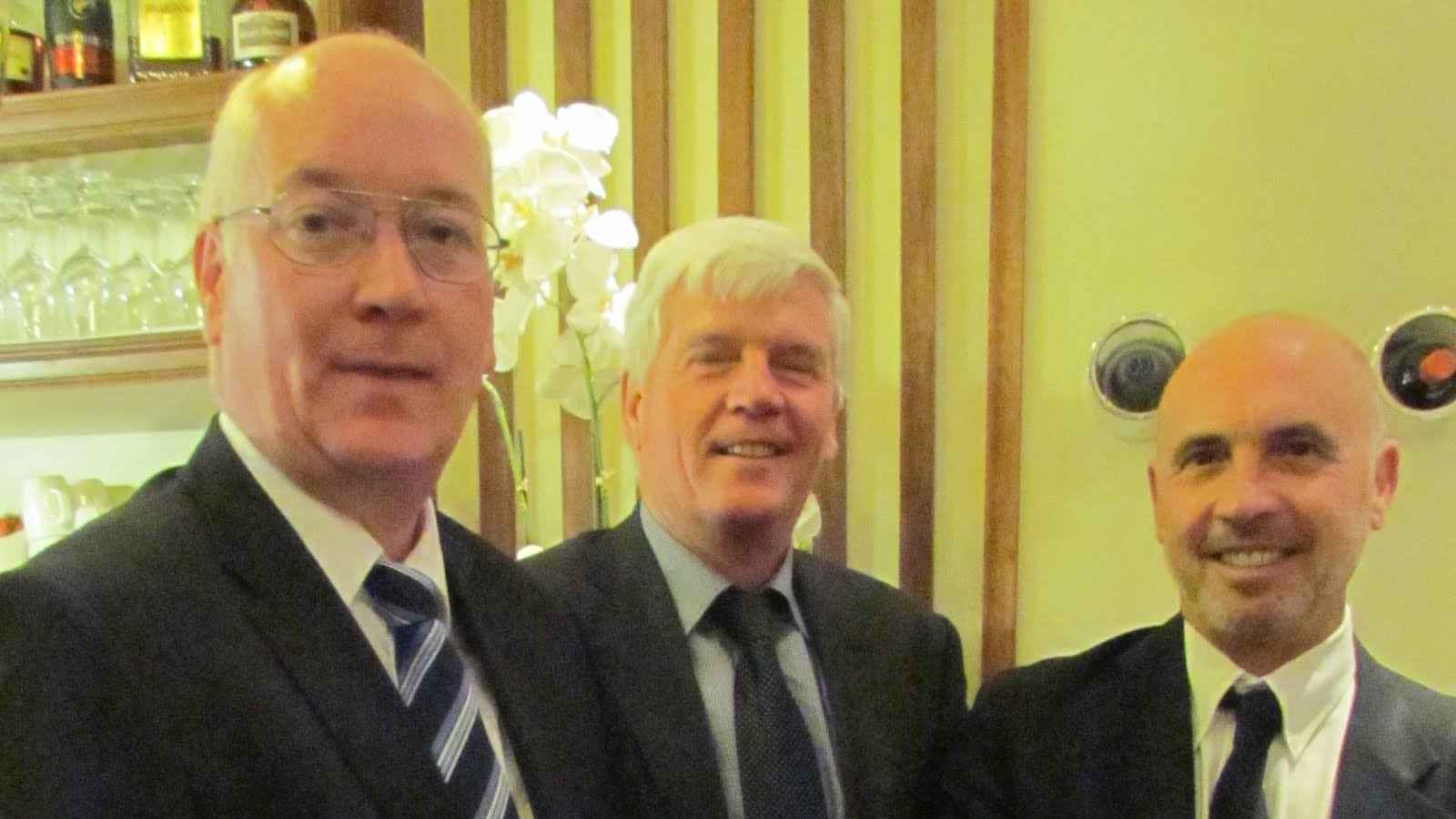
Ed's duties as Executive Director of A.SPIRE have now been assumed by Loredana Ghinea from the Cefic R&I team who has been working on the SPIRE concept since its inception. Klaus, Loredana and Ed are pictured above.

Consultation closed
Loredana's main task at the moment is the analysis of the responses to the SPIRE Roadmap Consultation document. The consultation period closed on 1 October and several hundred responses were received.

These will be used to inform a final version of the Roadmap which should be available by the end of October.

For more information on SPIRE activities or to become a member of the PPP consortium, please contact Loredana or visit the SPIRE website.

SusChem: Some Future Perspectives

Jacques Komornicki is taking over the reins of the SusChem secretariat now that Ger Spork is returning to Dow after a successful four year secondment as the ‘face’ of SusChem. SusChem News caught up with Ger and Jacques, pictured below with SusChem chairman Klaus Sommer (left), to review the recent achievements of the platform and discuss what the future may hold.

Dr. Jacques Komornicki has a chemical and materials research background and is joining Cefic from French company Arkema where he was recently R&D Director for oxygenated products. His career to date has been very much in research areas working with various materials development initiatives including high performance polymers. He describes himself as a “Research and Innovation fan”, which is why he was attracted to the secondment to Cefic and SusChem.

“It is a very different job, with a steep learning curve,” he admits. “I will need to understand the context and environment in which SusChem works in Brussels – understand the acronyms and language used in the European Commission and Parliament. I need to get to know who the key people are - who does what. My understanding, which corresponds to my personal philosophy and gives me a high motivation, is that we are working in a highly collaborative mode whether we are talking about industry partners or European Institutions.”

Fortunately he and Ger have had some time for a handover period that has helped introduce Jacques to the world of SusChem.

Value chain
Jacques comes from an area of the Chemical industry, Performance Products, where working along the value chain is natural. “To be successful the chemical industry you cannot work in isolation,” says Jacques. “You really have to collaborate with partners – both downstream and upstream – to get the best solutions. In general within the chemical industry to get the best out of R&D you need to embrace open innovation.” He also has good experience of working in EU projects and has experienced first hand the value of pan European collaborative research.

Improving the public’s perception of chemistry and the chemical industry is also very important to Jacques. “Generally in France the chemical industry is still seen by many people as polluters - the bad guys,” says Jacques. “The image does not match reality and people do not value the industry enough. I hope that working in Cefic I can help to put chemical industry back in its right place as a genuine solution provider for societal needs.”

Ger agrees and his experience indicates things are moving in the right direction. “SusChem has made a great evolution in the last years, bringing it in much better position for public and private partners,” he says. “The industry has got a stronger profile and the current environment gives a better position for our solution provider role: and a great opportunity for SusChem.”

Platform for sustainability
Looking back Ger sees many changes during his time with SusChem. “Suschem was well established as a research platform and we could build from that,” he says. “I was impressed with how things were run but had one question: what is our impact?”

Finding out what the impact was a revelation and allowed SusChem to step up a gear and consider a wider ambition. “When the early impact analysis was done in 2009 the numbers were fantastic: €600 million worth of granted projects that were SusChem inspired in the first 18 months of FP7,” boasts Ger. “And on average we are still looking at around €300 million per year. These sorts of figures made the industry take notice of the value position of our Industry platform.”

And chemistry and the chemical industry can still do better than this. “If you look at relative contribution to GDP then our sector should get nearer one billion Euros,” claims Ger. "This level of funding would be in line with our fundamental contributions to society and help to bring the support together to create full programme proposals like in a Public Private Partnerships (PPPs) with large-scale collaborative research and elements of demonstration. Now that is real impact to my mind.”

These concepts will be important in the new framework programme (Horizon 2020) to ensure that innovation gives Europe a real competitive edge.

SusChem has moved from a pure research platform to become a research and innovation platform targeting societal needs. The chemical sector has a lot to do as the solution provider for societal challenges such as producing novel lightweight materials, improving resource and energy efficiency. Challenges such as using CO2 as a feedstock for useful products are areas where the chemical industry will be the key solution provider.

Leading collaboration
Ger is keen to highlight another change in SusChem's approach. "Previously we always stepped away from the content of projects," he says. "SusChem acted as a catalyst enabling others to build projects. Now SusChem is also involved in the process of contributing to projects and driving initiatives where necessary."

This trend is highlighted over the past four years by the willingness of Cefic and other SusChem partner organisations to make a greater content contribution to projects and programme. “This is very positive,” says Ger. “The willingness to do more than just run the technology platforms is a big plus. Cefic is now willing to become a concrete partner in projects, for example E4Water, which adds great value.”

“So change is very important," continues Ger. "It is important to regularly get a new perspective."

Jacques recognises the value of these initiatives. “SusChem is now involved with a lot of other platforms and projects: for example A4M, E4Water and of course SPIRE. The industry is an actor in all value chains: an important actor, but not the only one. This means that collaboration is essential,” he says. “And it goes beyond research. To do good research, get good results, to set up a pilot line is useful but how does this translate into jobs in the EU? That is the essential question today.”

Ger agrees. “Public engagement to cross the so-called innovation ‘valley of death’ is key to address societal challenges, which are excellent growth creation opportunities and what we are doing is important here,” he believes. “This will ensure we achieve something truly sustainable and again this means that we need to know what is the impact. We need to be able to demonstrate that we are creating a sustainable future. We must be able to demonstrate the capability to generate jobs by 2020.”

Both Jacques and Ger are enthusiastic about the role of the platform leading open innovation in the chemical industry. “This is an area of great future interest for the industry,” concludes Ger. “At present a lot of people talk about open innovation, but not many actually do it. SusChem has a huge potential role to promote open innovation.”

You can contact Jacques Komornicki at the SusChem secretariat.

Friday, 8 June 2012

SusChem Board Update

Three new members were recently welcomed to the board by SusChem chairman Dr. Klaus Sommer. Prof. Dr. Klaus Kümmerer succeeded Prof Matthias Beller as representative for GDCh, the German Chemical Society, and Dr. Nico Kos has replaced Dr. Louis Vertegaal to represent Dutch Research organisation NWO on the board. Dr Peter Jansens of DSM has also recently joined the board.


Peter Jansens (left) has enjoyed a career in academia and industry. He is now Director of DSM’s Chemtech Centre having previously worked with Shell and as Professor of Separation Technology at Delft Technology University.


Nico Kos (right) is Senior Manager working on international innovation programmes at NWO. He has broad experience of international collaboration and including the development of programmes such as ERA-nets and European infrastructure projects, and most recently the Euro-Chemistry initiative.


Klaus Kümmerer (left) is Professor of Sustainable Chemistry and Resources at Leuphana University Luneburg. Since 2007 he has chaired the GDCh’s Sustainable Chemistry division. He has wide knowledge of both chemistry and the ecological impact of chemicals.


Strategy role
The SusChem Board manages the technology platform’s overall strategy and activities. Its members are drawn from SusChem’s main stakeholder groups. The SusChem board currently consists of 15 individuals including the chairman and details of all board members can be found here.

The full board meets at least four times a year, usually in Brussels. In addition there are regular teleconferences and other virtual meetings of board members involved in specific tasks.

Friday, 30 September 2011

Klaus Sommer, new SusChem Chairman

At the SusChem Board meeting on 22 September Dr. Klaus Sommer, Head of Business Management at Bayer Technology Services was appointed as the new Chairman of the board. He succeeded Dr Paul-Joël Derian who has recently moved from Rhodia to a new position with Suez Environnement.

Klaus has been intimately involved in the founding and evolution of SusChem – in particular through leading the Reaction and Process Engineering workgroup and working to realize the SusChem F3 Factory visionary project and several other strategic initiatives for SusChem.

SusChem News caught up with Dr. Sommer after the board meeting to find out his thoughts on the future direction of SusChem and his immediate goals for the technology platform.

SN: What are your plans for SusChem as its new chairman?

KS: As you know SusChem is a multi-stakeholder organization and relies on the work of many committed members, including the board members, from industry, academia and other research institutions. Over the years SusChem has managed to increase its visibility and its effectiveness by defining positions for the Chemical and Biotechnology Industry with respect to programmes and projects based on European Commission funding.

The ultimate aim for SusChem is to contribute to strengthening the competitiveness of Europe. Innovation and Technology are the two key elements in maintaining and improving competitiveness and SusChem has highlighted the critical role of sustainable chemistry and industrial biotechnology in delivering new technological solutions and innovations along the value chain.

We are now at a crucial point since the new Common Strategic Framework for research and Innovation – Horizon 2020 - is currently being defined by the European Commission and the European Parliament. SusChem has two main focus points in this context.

First, to continuously give input for the content and the calls of the Common Strategic Framework and, secondly, to launch significant programmes such as Public Private Partnerships (PPP) or make a significant contribution to European Innovation Partnerships (EIP) in collaboration with other European Technology Platforms. It is my priority to support SusChem in both focus areas.

SN: Do you have some specific programmes in mind?

KS: As I already indicated SusChem will have to develop a strategic plan for Horizon 2020. This would be similar in spirit to the original SusChem Strategic Research Agenda but adapted to recognise the new Societal Challenges like resource and energy efficiency

SusChem is strongly supporting PPPs and EIPs, such as “Sustainable Process Industry through Resource and Energy Efficiency”, “Water Efficient Europe”, “Critical Raw Materials” and “Smart Cities”. These set our priorities for the near- and mid-term.

SN: Do you have any specific expectations from the policy makers?

KS: I can say that SusChem has – over the years – established a very effective dialogue with the policy makers. This goes right back to the original reason why this European Technology Platform was set up namely to establish a body that can coordinate, align and deliver positions in Research, Development and Innovation for the Chemical and Biotechnology Industry. Our expectation is that the dialogue continues and that our positions, together with that of others, are recognized and considered in shaping future policies.

One additional specific point is that tools and workflows need to be continuously simplified so that it becomes even easier to have access to the European Commission Programmes. The formal requirements to engage with European programmes are still often considered to be too high and this acts as a barrier to participation. We have recently seen some encouraging communication and commitments; Horizon 2020 is a great opportunity to implement steps in the right direction.

SusChem has raised the profile of the sustainable chemistry, biotechnology and process engineering over the past few years. It has had a tremendous success in developing a specific research agenda and initiating a range of related projects. I believe that it has even greater opportunities ahead with the innovation agenda and I look forward to leading our technology platform, jointly with the SusChem board members, in these challenging times.