The SusChem News Blog is now hosted on the SusChem website in the News Room. You will be redirected there in 10 seconds
.

Showing posts with label BIO-PPP. Show all posts

Tuesday, 12 May 2015

Bio-based Industries Info day 2015

The Bio-based Industries Joint Undertaking (BBI JU) will be holding an Info Day session on the morning of 26 June followed by a networking and brokerage session in the afternoon. The Info Day will take place from 09:00 to 12:30 at the Charlemagne Building, Rue de la Loi 170, B-1000 Brussels.

The Info day session will address the following questions:

  • What benefits does the Bio based Joint Undertaking offer you?
  • What is included in the new Call?
  • How can you apply for funding? 

The BBI Info Day 2015 in Brussels on 26 June will give you first-hand information on this new EU funding instrument. The Info Day is organised by the BBI JU to provide full information on the 2015 Call for Proposals. Participation is free of charge but registration is compulsory.

Registration is open until 19 June 2015 via the BBI website on the "Events" section or via the link below. To attend the conference please fill in the on-line registration form as soon as possible. When registering please specify the organisation you belong to. All applications will be considered on a “first come, first served” basis.

To register for the BBI Partnering Platform visit http://www.bbi-europe.eu/participate/bbi-partnering-platform.

What is the BBI JU?
The Bio-Based Industries Joint Undertaking is a €3.7 billion Public-Private Partnership (PPP) between the EU and the Bio-based Industries Consortium (BIC). It is dedicated to realising the European bioeconomy potential, turning biological residues and wastes into greener everyday products through innovative technologies and biorefineries, which are at the heart of the bioeconomy. The BBI is about connecting key sectors, creating new value chains and producing a range of innovative bio-based products to ultimately form a new bio-based community and economy.

Wednesday, 4 February 2015

Bioeconomy Alliance calls for EU action

Creating a world-leading bioeconomy in the European Union requires bold political moves. At its launch today (4 February) at the European Parliament the European Bioeconomy Alliance (EBA) called for more predictable policies leading to a long-term strategy for a competitive, dynamic and sustainable bioeconomy in Europe.

Successfully developing the European bioeconomy is only feasible if the European Union provides a holistic, coherent and harmonised framework in a range of policy fields including: agriculture, forestry, marine, industrial, climate, environment, energy, research, innovation and regional development. The EBA believes that the EU needs to act on four main fronts to help Europe become a leader in the bioeconomy:

  • Implement priority recommendations from the Lead Market Initiative on bio-based products. This will not only create new markets and jobs but also stimulate economic recovery, focusing on: access to feedstock, research, development and innovation, access to markets, public procurement and communication. 
  • Encourage member states to implement measures to i) increase agricultural and forestry productivity and soil fertility in a sustainable way and ii) facilitate mobilisation and access to renewable feedstock at competitive prices.
  • Address barriers to investment in first commercial operations, such as biorefineries in Europe. The Public Private Partnership on Bio-based Industries is a first step in the right direction and should facilitate and catalyse other European and national and regional financing sources.
  • Engage with civil society, together with farmers, forest owners and industry, to encourage the debate on shaping a more competitive, sustainable bioeconomy for Europe.

EBA Vision
EBA’s vision is to help establish a more competitive, innovative, energy-secure and sustainable Europe, separating economic growth from a reliance on imported fossil sources, resource depletion, and environmental impact. EBA fully supports both the European Commission’s work on developing an EU bioeconomy as well as on-going efforts at member state and regional level to implement local strategies. In addition, EBA entirely supports the recent establishment of the European Parliament intergroup on “climate change, biodiversity and sustainable development” and its subgroup on the bioeconomy.

Over the coming years, the bioeconomy will play an increasingly important role in boosting Europe’s economy by revitalising rural and coastal areas and disused industrialised sites while providing more growth and jobs. According to the European Commission, the European bioeconomy is worth nearly €2 trillion and provides more than 22 million jobs for EU citizens.

The bioeconomy is not a niche sector; it encompasses the sustainable production of renewable resources and their conversion into food, feed, fibres, materials, chemicals and bioenergy through efficient and/or innovative technologies, which provides widespread economic, environmental and societal benefits. Therefore, the EBA calls for the bioeconomy development to be set as a priority in the Commission’s new €315 billion investment plan as well as in national and regional measures, to help ensure Europe’s sustainable economic recovery

More about the EBA
The EBA is an informal alliance of leading European organisations active in the bioeconomy. Its members are:


For more information, please contact the EBA secretariat or visit the EBA website.

Wednesday, 9 July 2014

Bio Based Industries JTI: A Major Advance towards the Bioeconomy

Today (July 9) the European Technology Platform (ETP) for Sustainable Chemistry (SusChem) welcomes the launch of the Bio Based Industries Joint Technology Initiative (BBI JTI). This major Public-Private-Partnership (PPP) represents a significant step forward to the realisation of a European bioeconomy.

SusChem has actively supported the development of the BBI JTI and looks forward to working with the initiative to deliver a sustainable, competitive economy for Europe able to tackle some of our biggest societal challenges and bioeconomy opportunities.

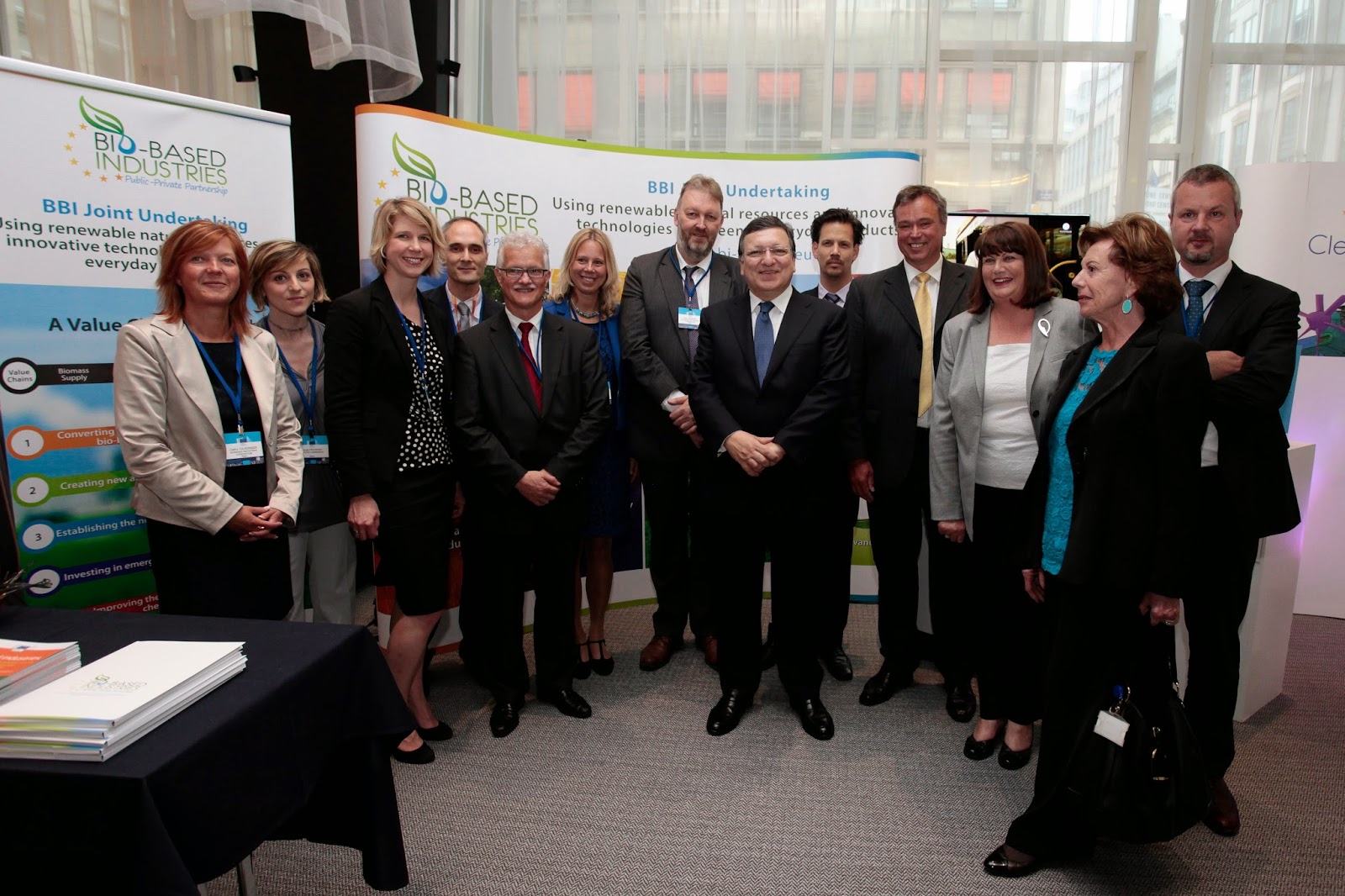
The BBI JTI is being launched with six other JTIs (including JTI on ‘Fuel Cells and Hydrogen’ and ‘Innovative Medicines’) at an event with European Commission President Barroso, Vice Presidents Neelie Kroes and Siim Kallas, and Máire Geoghegan-Quinn, European Commissioner for Research, Innovation and Science (all pictured below at the BBI JTI stand). Together, the JTIs represent a significant joint public-private investment in research and innovation for Europe’s future.


Bio Based Innovation
The BBI JTI will enable a €3.7 billion injection into the European economy between 2014 and 2024, with €975 million provided by the European Commission and €2.7 billion from the Bio-based Industries Consortium (BIC), to develop the emerging bioeconomy. The JTI will finance research and innovation projects and create new and novel partnerships across industry sectors (including agriculture, technology providers, forestry/pulp and paper, chemicals and energy).

The aim of the BBI is to use Europe's untapped biomass and wastes as feedstock to make greener, sustainable everyday products and renewable feedstock.

“At the heart of this initiative are advanced biorefineries and innovative technologies that use sustainable chemistry to convert renewable resources into sustainable chemicals, materials and fuels,” says Dr Gernot Klotz, Executive Director Research at Cefic and SusChem board member.

“The BBI JTI can help develop the building blocks needed to shift from a fossil- and imports-based society to increase the EU’s rate of economic growth, boost jobs – especially in rural areas, rejuvenate industries and reduce greenhouse gas emissions,” he continues. “New bio-based industries can increase the competitiveness of the European economy through re-industrialisation and sustainable growth along with other Key Enabling Technologies.”

Four of the six main Key Enabling Technologies (KETs) identified to be critical to strengthening Europe’s industrial and innovation capacity are from the chemical sector: advanced materials, industrial biotechnology, nanotechnology and advanced manufacturing.

BBI launch


Opening the launch of the JTIs this afternoon José Manuel Barroso (above), President of the European Commission, said: "Only if the best brains from academia, industry, SMEs, research institutes and other organisations come together can we successfully tackle the huge challenges that we are facing. This is what public-private partnerships are about, the joining of forces to make the lives of Europeans better, create jobs and boost our competitiveness. We are committed to prioritising the impact of the European budget on the recovery, and these partnerships are doing just that, with first calls for proposals for € 1.1 billion to be matched by industry, within a package representing an overall € 22 billion boost to growth and jobs creation over seven years. They will continue delivering results that no single country, company or even the European Union as such would achieve alone."

The launch of first calls comes almost exactly one year after the European Commission put forward the Innovation Investment Package, a set of proposals to establish seven public-private and four public-public partnerships (including SPIRE, see below).

Commenting on the BBI launch today Máire Geoghegan-Quinn, European Commissioner for Research, Innovation and Science, said: "The bioeconomy has huge potential that is attracting investments all around the world. With this new partnership, we want to harness innovative technologies to convert Europe’s untapped renewable resources and waste into greener everyday products such as food, feed, chemicals, materials and fuels, all sourced and made in Europe."

Peder Holk Nielsen, CEO of Novozymes, added on behalf of the industry partner, the Bio-based Industries Consortium (BIC): “The BBI is an unprecedented public-private commitment because of its focus on bringing bio-based solutions to the market. It is an opportunity to deliver sustainable growth in European regions and to reverse the investment trend currently going to other regions of the world.”


Concluding the launch event Commissioner Máire Geoghegan-Quinn (above) said: "As we heard earlier today, only through joint investments in developing our research and innovation capacity can we create the new jobs and growth to overcome the current economic crisis. The challenge is, of course, to make sure that such investments deliver tangible impacts: to help accelerate the development of new technologies and innovations, to generate new markets for innovative products and services; and to deliver good jobs and major benefits to society. I am confident that the JTIs presented here will live up to this challenge. The first calls for proposals illustrate the kind of activities that JTIs will support in our goal of accelerating the deployment of great ideas from the lab into the market – for example large scale demonstrators, testing and prototyping."

BBI and SPIRE together
The BBI JTI builds on ‘SusChem inspired’ projects such as EUROBIOREF: one of three large FP7 projects in a joint call on advanced biorefineries that responded to SusChem’s visionary project: ‘The Integrated Biorefinery’. Innovations from other SusChem FP7 projects such as the F3 Factory will also contribute to the integration of bio based processes into the economy.

“The BBI JTI is one of two major PPPs that SusChem is proud to have inspired: the other being the Sustainable Process Industry through Resource and Energy Efficiency (SPIRE) PPP,” says Dr Klotz. “SPIRE and the BBI JTI will work closely together along defined areas of common interest and will use their synergies to help deliver high resource and energy efficiency that can lay the foundation of the circular economy in Europe, alongside the materials programme of SusChem.”

BBI explained 
The BBI JTI is a €3.7 billion Public-Private Partnership (PPP) between the EU and the Bio-based Industries Consortium (BIC). The BBI is dedicated to realising the European bioeconomy potential, turning biological residues and wastes into greener everyday products through innovative technologies and biorefineries, which are at the heart of the bioeconomy. The Bio-based Industries Consortium - the industrial partner in the PPP - is constituted by a unique mix of sectors including agriculture, agro-food, technology providers, forestry/pulp and paper, chemicals and energy. A short video  explaining what the BBI JTI is all ablout has also been published (see below).


A fact sheet on the BBI and its activities is available and more information can be found at the BBI website.

An Info Day on the BBI will take place on 2 September 2014 in Brussels and will be a 'must-attend' event for all stakeholders interested in understanding the BBI rules for participation.

Five value chains
Organised in five value chains – that range from primary production to consumer markets – the BBI will help fill the innovation gap between technology development and commercialisation, sustainably realising the potential of bio-based industries in Europe.

The BBI is a shift from a fossil- and imports-based society to increase Europe’s share of sustainable economic growth, and is expected to create tens of thousands of jobs (80% in rural areas), revitalise industries, diversify farmers’ incomes, and reduce GHG emissions by at least 50% in comparison to fossil-based applications.

The aim of the BBI is to use Europe's untapped biomass and wastes as feedstock to make fossil-free and greener everyday products. At the heart of it are advanced biorefineries and innovative technologies that will convert renewable resources into sustainable bio-based chemicals, materials and fuels.

The BBI will manage the investments in the form of research and innovation projects that are defined in annual Calls for Proposals and implemented across European regions. In line with Horizon 2020 rules, all stakeholders are invited to submit innovative proposals and demonstrate progress beyond state-of-the-art.

The BBI is dedicated to realising the European bioeconomy potential, turning biological residues and wastes into greener everyday products through innovative technologies and biorefineries, which are at the heart of the bioeconomy.

The BBI is about connecting key sectors, creating new value chains and producing a range of innovative bio-based products to ultimately form a new bio-based community and economy.

Bio-based Industries: using renewable natural resources and innovative technologies for greener everyday products developing new value chains for bio-based industries, from primary production to consumer markets;
  • Using innovative technologies to turn biological residues and wastes into greener everyday products;
  • Moving from fossil-based to biobased products: planting the seeds for the European circular economy;
  • Supporting regional development by diversifying the local economy;
  • Promoting the opening of new markets for bio-based products and applications “Made in Europe”.
The BBI JTI will help create new jobs, especially in rural regions, and offer Europeans new and sustainable products sourced and produced locally. New bio-based industries can increase the
competitiveness of the European economy through re-industrialisation and sustainable growth.

The development of new bio-based products and markets based on smart and efficient use of resources will diversify industries’ revenue streams.

The BBI is expected to bridge European research knowledge with commercial scale bio-based products, making full use of European scientific and technological knowledge. The BBI should benefit all Member States where regions can play an important role through their Smart Specialisation Strategies.

Seven JTIs
The BBI was one of seven JTIs launched at a special event in Brussels on 9 July. Fact sheets on all seven JTI are available via the links below:
For more information, please visit the SusChem website or contact Esther Agyeman-Budu, Cefic communication manager for research and innovation.

An extended SusChem 10th Anniversary video describing the platform, its achievements and its contribution to BBI has also been published on YouTube.

Thursday, 24 October 2013

SusChem starts Horizon 2020 project prep!

SusChem started its preparations for Horizon 2020 with a brokerage event that attracted almost 200 participants to the Crown Plaza Le Palace Hotel, Brussels yesterday (October 23). Horizon 2020 is scheduled to kick-off on 1 January 2014 and SusChem, as the most prominent European Technology Platform (ETP), is ready to support the programme and ensure it achieves its goals of boosting competitiveness, jobs and growth in Europe.

Following on from briefings on the scope of the new European Commission programme, delegates spent the brokerage day outlining project proposals, describing their skills and experience, and meeting in 150 scheduled one-to-one meeting plus more informal and spontaneous networking.

Commenting on the event Jacques Kormornicki, SusChem Programme Manager at Cefic (left) said: "I want to thank all the participants for their involvement in this active participation from the industry which is key in the future success of Horizon 2020."

"We are now focusing on turning this success into the building of consortia to submit proposals when the calls come out in December 2013," he continued. "We will be organizing either webinars or another brokerage event in January 2014.

The final decision on this will be taken when the calls are out and based on the feed-back from participants. The new Grant-iT tool, which is designed to help SusChem stakeholders to participate to the calls and find partners will also be ready end 2013."

The event continued the atmosphere of intense collaboration and innovative zeal that had been evident at the SPIRE PPP brokerage event on 22 October and is typical of the vision and innovation leadership that SusChem has shown since its foundation in mid-2004.

SusChem success
SusChem board member Prof Rodney Townsend got things started with an outline of SusChem’s achievements. He praised the dedicated support work of SusChem’s national technology platforms (NTPs) that have mobilised stakeholders in 12 Member States and he welcomed SusChem Switzerland as our latest NTP.

He noted the success that SusChem had achieved in FP7 with an estimated €300 million of EU public funding per annum for projects that aligned with the SusChem strategic roadmap. He looked for similar achievements in Horizon 2020. He said that SusChem had been actively engaged in discussions on Horizon2020 since 2011 to ensure that sustainable chemistry and industrial biotechnology remain a major part of it, to successfully work with key European Innovation Partnerships (EIPs), and in particular to help launch two public-private-partnerships in Horizon 2020: SPIRE and the BioBased Industries JTI.

SusChem was also actively involved in identifying areas in the Future Emerging Technologies theme for sustainable chemistry and biotechnology. The full scope of SusChem activities is illustrated below.


The starting point for the brokerage activities was the draft Horizon 2020 work programme for the first two years. With the first calls to be published in December it was now time to start preparations! And there was also a need to think about calls for 2015. Rodney wished everyone a fruitful meeting and indicated that, if stakeholders required it, SusChem will organise another brokerage event early in 2014.

Prominent ETP
Soren Bowadt of the European Commission DG Research and Innovation also praised SusChem for its success with major projects such as the F3 factory project and its ability to set up two PPPs for Horizon 2020 describing SusChem as “the most prominent of the ETPs.”

He then outlined the Horizon 2020 programme with its emphasis on innovation and demonstration activities. A key part was the deployment of Key Enabling Technologies (KETS) that were strategic technologies that could drive competitiveness and growth based on knowledge.

He described the Commission’s wish for an impact orientated approach and their likely focus on Technology Readiness Levels (TRLs) in the range 3 - 8 for projects to be funded under Horizon 2020. A set of definitions of TRLs to be used under Horizon 2020 is given below.


In Horizon 2020 KETs would be used to address the whole innovation chain from research to TRLs preceding commercialisation. He said that the PPPs would be important. It was important to promote the involvement of industry and also ensure synergies between research and industry. The PPPs would be used to implement KETs in many areas.

He concluded by thanking SusChem for its contributions to the development of the work programme saying: “this would not have been possible without the vision of SusChem and your intense and constructive collaboration with the Commission.”

Impact
The plenary briefing session was completed by Jacques Kormornicki. He also praised SusChem’s impact, for example, SusChem priorities were found in 30% of the NMP calls in FP7 and SusChem also had significant impact in two other fields: KBBE and Energy.

In addition to SusChem’s energetic direct activity in EIPs (Water, Smart-Cities and Communities, Raw Materials) and the SPIRE PPP, it was supporting the Bio-Based Industries JTI and the Energy Efficient Buildings PPP. There was also strong activity in Materials Technology along the “value chain” including membership of the umbrella Alliance for Materials (A4M). SusChem had also taken up the role of promoting innovation early on and had been heavily involved in the formulation of the KET concept that is the basis of the Horizon 2020 pillar on Industrial leadership.

Jacques showed an analysis of the draft Horizon 2020 work packages from its societal challenges and industrial leadership pillars (see below). Some 200 work packages already mapped onto SusChem priority areas.


This showed the opportunity in Horizon 2020 said. Jacques. Delegates had the full analysis ‘matrix’ of the Horizon 2020 work programmes versus SusChem priorities and a full list of participants and presentations in today’s meeting – it was now up to participants to identify relevant topics and find partners for fruitful collaborative work.

Brokerage bonanza
Esther Agyeman-Budu of Cefic outlined how the various brokerage activities during the day. A first plenary set of project presentation was made before lunch and then three parallel sessions were organised after lunch on Materials, Resource and Energy Efficiency, and Water and Biotechnology.

In total 45 Project Idea or Areas of Interest presentations were made including 12 presentations from the chemical industry including two made via through SusChem NTPs.

After project presentations an intense session of ‘speed-dating’, one-to-one meetings and other networking opportunities took place.

To complete the day and wrap up proceedings Jacques Komornicki described the likely process and the tools available to SusChem stakeholders to assist project formation.

He highlighted the SusChem – PNO ‘matrix’ tool to check for relevant Horizon 2020 call topics and the revised GRANT-IT service for Horizon 2020 that would be launched at the end of 2013. This would be freely available for the whole SusChem community following registration.

The GRANT-IT tool will provide a searchable database of relevant funding programmes, project searching for partners, the ability to search for past and present European projects, and the opportunity to ask for personalised advice on a project idea. There will also be a facility for interaction via forums and comments as part of a brokerage process to develop some sound project ideas and consortia.

Further details of the GRANT-IT tool and how to access it will be covered by the SusChem newsblog when it is ready for launch.

Jacques reiterated that a second brokerage event could be organised in January 2014 if there was demand and in addition, again if there was a perceived need, SusChem could also organise webinars on specific programme areas.

Get involved!
SusChem stakeholder who wanted to get more involved with the brokerage activities around Horizon 2020 should contact either Jacques Komornicki and Pádraig Naughton at Cefic or Ron Weerdmeester at PNO Consultants. And watch out for announcements on the SusChem website and SusChem News!

Tuesday, 18 June 2013

EFIB 2013 – Get your Brochure now!

The European Forum for Industrial Biotechnology and the Biobased Economy 2013 (EFIB2013) takes place in Brussels from 30 September to 2 October at the Square conference facility. A full brochure for the event is now available – get your copy now!

With over 1,000 biotechnology professionals expected to attend, a growing exhibition hall with 50 exhibitors, over 14 hours of one-to-one networking available and a brand new Technology Showcase Theatre the EFIB has clearly continued to evolve for 2013.

"EFIB is the most important event on the calendar for the biobased economy," says Ian Hudson, President of DuPont EMEA and a member of the executive committee of Cefic and a board member at EuropaBio – joint organisers of the event with Smithers Rapra.

Diverse agenda
The new brochure shows the wide range of activities on offer at EFIB 2013 including:

  • Choose the conference agenda to suit your interests with 8 dedicated conference sessions focused on policy, finance, innovation and including a dedicated session on BRIDGE: the SusChem supported  proposal for a €3.8 billion Public Private Partnership (PPP) for the biobased industries
  • Be the first to witness the latest innovation and product development at the ‘new for 2013’ Technology Showcase in the Exhibition Hall
  • Take part in CEO Question Time and put your questions to the ‘movers and shakers’ in strategic positions to move the industry forward
  • Visit over 50 exhibitors and see for yourself first-hand what the European and wider industrial biotechnology industry has to offer
  • Take advantage of the one-to-one Partnering at EFIB2013 to make efficient use of your networking time, during over 14 hours of active partnering sessions

Get the brochure
Find out more about EFIB2013 in the brand new event brochure including the full programme, workshop agendas, exhibition floor plan, Technology Showcase Theatre agenda, one-to-one Partnering, prices, event highlights and travel information.

Tuesday, 18 December 2012

Stakeholder event on BIO-PPP

On 9 January the European Commission will report back on the results of the stakeholder consultation on the Bio-based industries PPP (BIO-PPP). The event will take place in Brussels and be opened by Robert-Jan Smits, Director-General of the Commission’s DG RTD.

Following the launch of an online public consultation on 21 September on "Bio-based industries, towards a public-private partnership under Horizon 2020", DG RTD is organising a one-day stakeholder meeting on 9 January 2013 in Brussels. The aim of the meeting will be to present industry's vision and objectives for this partnership together with the strategic innovation and research agenda and the results of the online public consultation, which is now closed.

The meeting will be opened by DG RTD Director-General Robert-Jan Smits, followed by speakers from industry and research organisations. The meeting will provide ample opportunities for discussion of the proposals.

All those directly or indirectly connected with the bio-based industries, including representatives of public authorities, farmers and foresters, businesses and associations, academics and technical experts, civil society organisations and individual citizens are encouraged to attend the meeting and to provide their views and feedback on the planned partnership.

A final report on the outcome of the online public consultation will be published later in 2013, taking into account the conclusions from this stakeholder meeting.

Registration
Meeting will take place in the Gaspari meeting room in the Charlemagne Building at Rue de la Loi 170, Brussels. Registration for the meeting is open until 4 January 2013. To register you need to send an email to RTD-KBBE-Experts@ec.europa.eu including your first and last name, date of birth, country of origin and professional occupation.

For more information on the BIO-PPP proposal and the consultation process, please contact the consortium secretariat at CEPI.

BIO-PPP is a proposed Public Private Partnership (PPP) on the Bio-Based Industries which aims to lead the transition in Europe towards sustainable alternatives to our current petroleum/ fossil fuel-based society. The aim of the initiative is to help establish a new European bioeconomy encompassing all stages in the value chain from biomass harvesting and logistics via efficient conversion processes to the manufacture of bio-based products. The industry group behind the initiative comprises major companies from a cross-section of sectors including forest, agricultural, paper, chemical, energy, fuels and biotechnology.