The SusChem News Blog is now hosted on the SusChem website in the News Room. You will be redirected there in 10 seconds
.

Showing posts with label BIC. Show all posts

Thursday, 12 April 2018

BBI JU announces € 115 million of funding boost for the EU Biobased Industries

The BioBased Industries Joint Undertaking (BBI JU) has just announced its fifth Call under Horizon 2020: H2020-BBI-JTI-2018. With a total budget of € 115 million, the 2018 Call is built around four strategic orientations: Feedstock, Process, Products, and Market uptake. This new Call moves away from a strict biomass feedstock ‘push’ approach based on historic value chains, towards a demand for biomass that enables processing in order to respond adequately to a ‘pull’ from end markets.

A total of 21 topics are included in the 2018 Call with 11 Research and Innovation Action (RIA) topics, 3 Coordination and Support Actions (CSA) and 7 Innovation Actions (5 DEMOs and 2 Flagships) while novel eligibility criteria have also been introduced.

BBI JU’s current project portfolio is well-balanced across the types of actions deployed, relevant value chains and has achieved an excellent SME participation of 38%. Like previous BBI JU Calls, the 2018 Call respects the Horizon 2020 principles of openness, transparency and excellence.

Commenting on the 2018 Call launch Philippe Mengal, BBI JU Executive Director said: "All of us in BBI JU, together with our founding partners the European Commission and the Bio-based Industries Consortium (BIC) are proud to see the development and the geographical spread of the projects covering all corners of our continent. Every Call is a step closer towards the creation of EU’s biobased sector and it is exciting to see sectors such as the primary one to start developing such a strong interest and presence on the field. This is a clear indication that more actors see the potential, the creation of a sustainable and competitive bio-based sector has for Europe and its citizens".

More information
Details of the BBI JU Call for proposals 2018 can be found here. The deadline for submission of proposals to the BBI JU 2018 Call is 6 September 2018 at 17:00 CET.

More information about the 2018 Call will be provided during the BBI JU Info Day on 17 April in Brussels. The morning sessions will provide information about the BBI JU initiative and all aspects of the Call process. While in the afternoon participants will have the opportunity to hold face-to-face meetings in a brokerage/ partnering session.

Registration for the Info Day is now closed, but the event will be web-streamed and the link will be made available online on 16 April via the BBI JU website.

The BBI JU
The BioBased Industries Joint Undertaking (BBI JU) is a €3.7 billion Public-Private Partnership between the EU and the Bio-based Industries Consortium (BIC). Operating under Horizon 2020, this EU body is driven by a Vision and Strategic Innovation and Research Agenda (SIRA) developed by the industry. The initiative is a direct result of SusChem activities.

The BBI JU is dedicated to realising the European bioeconomy potential and contributing to a sustainable circular economy, by turning biological residues and wastes (from agro-food, forestry and municipal) into greener everyday products, through innovative technologies and biorefineries, which are at the heart of the bioeconomy.

The BBI JU is the largest and most ambitious initiative in the EU to develop competitive and sustainable biobased industries. The ambition that drove its creation was to bring about the systemic change needed to develop a European biobased industry allowing investment to remain in Europe: creating new jobs and providing clear value for all EU citizens.

Friday, 23 June 2017

BIC Announces New SIRA For Europe’s Bioeconomy

To help build a resource-efficient, circular and bio-based economy, the Biobased Industries Consortium (BIC) has just launched its new Strategic and Research Agenda (SIRA). The SIRA identifies the activities needed to speed up the development of sustainable and competitive biobased industries in Europe – an aim that SusChem wholly supports and has helped to foster for many years.

The SIRA reflects BIC’s ambition to transform Europe into a world leading bioeconomy. The updated SIRA addresses the technological and innovation challenges facing the biobased industries, takes a ‘multi-value-chain’ approach and integrates new feedstocks such as aquatic-based sources, biowaste (including from waste from food processing) and the use of carbon dioxide (CO2). The document also considers the aims of BIC’s newest members, as well as technology and market developments since the first BIC SIRA was adopted in 2013.

The new BIC SIRA identifies the research and innovation actions needed to deliver tangible and increasingly ambitious environmental, social and economic benefits by 2020 and also 2030.
Biobased value chains are at the heart of the SIRA, which is founded on four key pillars:

  • Fostering a supply of sustainable biomass feedstock for both existing and new value chains 
  • Optimising efficient processing for integrated biorefineries through research, development and innovation (R&D&I) 
  • Developing innovative biobased products for identified market applications 
  • Creating and accelerating market uptake of biobased products and applications 

The biobased industries in Europe have been evolving rapidly. Driven by business and consumer demand for greener products and by policy developments such as the European Bioeconomy Strategy and equivalent strategies in Member States, they have started to invest in technological advancements and deployment. They will receive a further boost from the increased efficiency of innovative technologies and their upscaling to commercial levels, and from the new policy focus on the circular economy and decarbonisation that initiatives such as the European circular economy package and COP21 have brought.


Circular bioeconomy
John Bell, Director for Bioeconomy, DG Research & Innovation, European Commission said:
“The latest SIRA is designed to attract new industrial sectors and stimulate closer collaboration between different industries. It envisages the creation of novel value chains, making it easier for the Bio-Based Industries Joint Undertaking (BBI JU) to fully support the development of a circular bioeconomy, while enabling Europe to achieve its climate goals and the objectives of the Juncker Plan to boost investment, sustainable growth and job creation.”
Mat Quaedvlieg, Vice President Strategic Business Projects at Sappi, and Chair of the BIC and BBI JU Governing Boards said:
“Since the start of the BBI JU, new value chains have emerged using feedstocks from the food processing sector, the aquatic-based sector, and even biowaste and CO2. More and more industrial sectors are collaborating on BBI JU projects, seizing the opportunity to create value from waste and side streams. This growth will speed up the development of an innovative, sustainable and competitive European economy, in line with the European Bioeconomy Strategy.”
Dynamic and sustainable
Dynamic and sustainable biobased industries in Europe can deliver many environmental, economic and social benefits. They can help to meet EU objectives in areas ranging from economic growth, job creation, the circular economy and resource efficiency to climate change mitigation, security, agriculture modernisation and regional development.

Biobased industries make use of European biomass sources and sustainable European supply chains. As such, they lower our dependency on imports and contribute to our raw material security. With 90% of Europe’s chemical industry feedstocks for non-energy use coming from fossil resources, access to alternatives is an important strategic issue. In addition Biobased industries can create opportunities for local regeneration in rural and coastal areas, fostering cooperation between different stakeholders along the value chain.

You can access and download the revised SIRA here.

Biobased Industries Consortium
The Biobased Industries Consortium (BIC) is a non-profit organisation based in Brussels. It represents the private sector in the public-private partnership (PPP) with the EU on Bio-based Industries (BBI). Worth €3.7 billion, the partnership mobilises investment in innovative facilities and processes that manufacture high-quality bio-based products as well as in biorefining research and demonstration projects.

BIC is host to a unique mix of sectors that currently covers agriculture, agro-food, forestry, pulp and paper, chemicals, energy and other manufacturing sectors. With over 200 members including large companies, SMEs, SME Clusters, RTOs, universities, technology platforms and associations spread across Europe, BIC brings together an authoritative pool of cross sector and multi-disciplinary expertise in the field of bio-based industries.

Friday, 20 January 2017

Presenting the BBI JU 2017 Annual Work Programme

The BioBased Industries Joint Undertaking (BBI JU) has published its 2017 Annual Work Plan (AWP) and Budget. This 79-page document outlines the scope and details of research and innovation activities prioritised for the 2017 Call as well as giving an overview of the governance and activities of the BBI JU for the year.

The 2017 AWP is the fourth AWP in a total of seven that are planned between 2014 and 2020. The critical path towards 2020 for the PPP is the acceleration of the development of (new) sustainable value chains from biomass feedstock supply via efficient processing, to the acceptance and application of biobased products in end-markets. The 2017 AWP refocuses on the need to better integrate biomass feedstock suppliers on the front end of the value chain to create a demand for biomass feedstock from biorefining processes.

Similarly, the AWP aims to stimulate the formation of partnerships with end market actors to create a ‘market pull’ for biobased products for identified applications. As initiated in last year’s AWP 2016, the AWP 2017 moves away from a strict biomass feedstock ‘push’ based on traditional value chains, towards a demand for biomass to enable processing to respond adequately to a ‘pull’ from the end markets.

Focus and impact
The identified priorities for the BBI JU continue to build on those for 2016, but add emphasis on products with new functionalities, and on supporting actions to better realise the associated expected impacts. In addition, the emphasis on sustainability, addressing the environmental, social and economic dimension, is increased.

The strategic orientations for 2017 and 2018 are:

  1. Fostering a sustainable biomass-feedstock supply to feed both existing and new value chains; 
  2. Optimising efficient processing for integrated biorefineries; 
  3. Developing innovative bio-based products for specific market applications; 
  4. Creating and accelerating the market uptake of bio-based products and applications.

The 2017 Call
The 2017 call will have the identifier: H2020-BBI-JTI-2017 and the anticipated official publication date is 11 April with a indicative deadline for proposal submission of 17h00 (Brussels time) on 7 September. The call will be a single stage call and the total indicative budget for the call is € 81 million with an estimated value of the in kind contributions by the members other than the European Union or their constituent entities of a minimum of € 40 million.

The full call topic list is below.

Research and Innovation Actions – Total indicative budget: € 36 million
BBI 2017.R1 – Valorisation of gaseous side streams from bio-based operations into chemical building blocks (Strategic orientation: Feedstock, Indicative project funding: € 2 million to € 5 million)

BBI 2017.R2 – Innovative technologies for the pre-treatment and separation of lignocellulosic feedstock and complex composition streams into valuable fractions while maintaining key characteristics (Strategic orientation: Process, Indicative project funding: € 2 million to € 5 million)

BBI 2017.R3 – Exploiting extremophiles and extremozymes to broaden the processing conditions to convert biomass into high value building blocks (Strategic orientation: Process, Indicative project funding: € 2 million to € 5 million)

BBI 2017.R4 – Proteins and other bioactive ingredients from side streams and residues (Strategic orientation: Products, Indicative project funding: € 2 million to € 5 million)

BBI 2017.R5 – Novel bio-based chemical precursors to improve the performance of mass consumption products (Strategic orientation: Products, Indicative project funding: € 2 million to € 5 million)

BBI 2017.R6 – Competitive biodegradable, compostable and/or recyclable bio-based plastics for a sustainable end-of-life phase (Strategic orientation: Products, Indicative project funding: € 2 million to € 5 million)

BBI 2017.R7 – Novel secondary bio-based chemicals without significant fossil-based counterparts but with high application potential (Strategic orientation: Products, Indicative project funding: € 2 million to € 5 million)

Innovations Actions – Demonstration Actions - Total indicative budget: € 22 million
BBI 2017.D1 – Valorisation of liquid and solid side streams from biobased operations into high added-value products to create new feedstock for bio-based products (Strategic orientation: Feedstock, Indicative project funding: up to € 7 million)

BBI 2017.D2 – Integrated multi valorisation of algae into advanced materials and high added-value additives BBI 2017. (Strategic orientation: Feedstock, Indicative project funding: up to € 7 million)

BBI 2017.D3 – Breakthrough primary bio-based chemicals without significant fossil-based counterparts but with high marketability (Strategic orientation: Products, Indicative project funding: up to € 7 million)

BBI 2017.D4 – Innovative bio-based fertilising products to increase the sustainability of fertilising practises in agriculture (Strategic orientation: Products, Indicative project funding: up to € 7 million)

BBI 2017.D5 – Advanced bio-based fibres and materials for large volume applications (Strategic orientation: Products, Indicative project funding: up to € 7 million)

Innovation Actions – Flagship Actions - Total indicative budget: € 21 million
BBI 2017.F1 – Integrated ‘zero waste’ biorefinery utilising all fractions of the feedstock for production of chemicals and materials (Strategic orientation: Process, Indicative project funding: up to € 21 million)

BBI 2017.F2 – Large scale production of proteins for food and feed applications from alternative, sustainable sources (Strategic orientation: Products, Indicative project funding: up to € 21 million)

Coordination and Support Actions Total indicative budget: € 2 million
BBI 2017.S1 – Establish cooperation and partnership with brand owners and consumer representatives to improve market access of sustainable bio-based products (Strategic orientation: Market Uptake, Indicative project funding: up to € 1 million)

BBI 2017.S2 – Identify opportunities for ICT to increase efficiency of biomass supply chains for the bio-based industry products (Strategic orientation: Market Uptake, Indicative project funding: up to € 1 million)

More information
You can download the BBI JU 2017 AWP here. On 28 April 2017, the BBI JU will organise its fourth Open Info Day and Brokerage event in Brussels, following the official launch of the 2017 Call for proposals. The venue is planned to be the Commission's Charlemagne Building. The Open Info Day aims to bring together potential applicants and provide information and networking opportunities in time for the 2017 Call for proposals. For more information visit the BBI JU website.


Thursday, 19 January 2017

BBI JU Science Committee looking for new members

The Bio-based Industries Joint Undertaking (BBI JU) has opened a Call for Expressions of Interest for independent experts to be appointed as members of its Scientific Committee. The deadline to submit an expression of interest is noon on 26 January 2017.

The BBI JU is organising this open Call to appoint additional Scientific Committee members with expertise in one or more areas relevant to the work of the BBI JU. The BBI JU is looking for highly skilled, open-minded and independent experts with an innovative vision for the bio-based industries in Europe, who could join the current Scientific Committee.

More information on the Call is available on the BBI JU website in the Scientific Committee webpage.

People who are employed by an organisation that is full member of Biobased Industry Consortium (BIC) are not eligible candidates for this Call.

The Scientific Committee
The BBI JU Scientific Committee consists of no more than fifteen members who are appointed for three years. The appointments can be renewed once for a second three-year term following a recommendation of a pre-selection panel and confirmation by the BBI JU Governing Board. Each member of the committee serves in an independent scientific capacity and does not represent countries, employers nor other similar interests. Currently the committee has 10 members.

The Scientific Committee acts as an advisory body of the BBI JU established in accordance with the BBI Regulation and assists the BBI JU in providing scientific advice on the areas of work undertaken by the BBI JU. The Scientific Committee has two major tasks:

  • Advise on the scientific priorities to be addressed in the annual work plans 
  • Advise on the scientific achievements described in the annual activity report 

Moreover, the BBI JU Governing Board can ask the Scientific Committee to provide advice on a specific matter of interest to the BBI JU such as adjustments to the Strategic Innovation and Research Agenda (SIRA).

What is the BBI JU?
The Bio-Based Industries Joint Undertaking (BBI JU) is a Public-Private Partnership between the European Union and the Bio-based Industries Consortium (BIC). BBI JU is operating under Horizon 2020 rules and its activities are driven its Strategic Innovation and Research Agenda (SIRA), which was developed by industry. The BBI JU was established on 6 May 2014. The mission of BBI JU is to implement the SIRA.

The BIC is a non-profit organisation that was created to represent the industry group that supports the BBI JU. The members of BIC cover the entire bio-based value chain and consist of large industries, small and medium-sized enterprises (SMEs), regional clusters, European trade associations, and European Technology Platforms. The aim of BIC is to ensure and promote the technological and economic development of the bio-based industries in Europe.

Monday, 22 February 2016

BBI and SPIRE work to increase coordination

The Public-Private-Partnerships (PPPs) ‘Sustainable Process Industry through Resource and Energy Efficiency’ (SPIRE) and ‘Bio-based-Industries Joint Undertaking’ (BBI) are both striving to improve the sustainability of European manufacturing industry in terms of global competitiveness, ecology, jobs and growth. On Monday 15 February participants at a joint workshop for the two PPPs explored ways in which the two entities could coordinate aspects of their work programmes and add value to European research and innovation outcomes in areas of common interest. The workshop was hosted by the European Commission at it Covent Garden offices in Place Rogier, Brussels, was organised under the SusChem banner and initiated and sponsored by Evonik Industries.

The two PPPs approach their common goals from complementary angles. SPIRE comprises projects that improve all aspects of resource and/or energy efficiency across a variety of manufacturing sectors, while BBI supports the establishment of a new bio-industrial structure in Europe, from the generation of biomass in the field or forest to its value-generating industrial conversion to biobased products.


When the two PPPs were being established in 2012 a joint narrative was developed which looked to establish coordination mechanisms between the two PPPs and to ensure that their respective activities were linked and harmonised whenever technically and economically reasonable. The workshop looked at how the ambitions of the joint narrative could be implemented in practice.

SusChem editor Tim Reynolds moderated the workshop that was entitled ‘Exploring the Synergies of SPIRE & BBI-JU’ and brought together stakeholders from both PPPs. The day was split into two sessions. In the morning the full group listened to perspectives from the European Commission, industry and the PPPs themselves. And in the afternoon two group discussions worked on possible actions and organisational issues.

Perspectives
Waldemar Kütt, Head of Unit for BioBased products and processing at the European Commission reminded the audience that both PPPs were industry led and driven and that both must provide important inputs to the development and implementation of the bioeconomy and circular economy.

Søren Bowadt, the Commission’s Programme Officer for SPIRE said that the Commission’s role was to support the PPPs’ decisions. He thought that the workshop was very timely and outlined a number of areas – such as waste water, industrial symbiosis, and the circular economy – where complimentary activities would be useful to both parties.

From industry Peter Nagler, Head of International Innovation at Evonik Industries AG and member of the SusChem Board, said that from the start SusChem had believed that the bioeconomy and biotechnology must play an important part in a future sustainable chemical industry. Both PPPs had launched a number of calls: it was now time to look at where complementarities could be leveraged and to identify any gaps that needed to be addressed in the short to medium term.

Christophe Rupp-Dahlem, Head of Global Public Affairs at Roquette, President of the Plant-based Chemistry Association and Vice-chair of the board of the Biobased Industries Consortium (BIC) representing the industrial partners behind BBI underlined the importance of cooperation and communication between the two PPPs and remarked that the BBI programme in 2016 will include a Coordination and Support Action (CSA) call for a Roadmap for relevant research and innovation activities for the Chemical Industry.

For SPIRE Executive Director of SPIRE’s industrial association, Loredana Ghinea, reminded the workshop that SPIRE worked with seven other large industry sectors as well as the chemical industry. She outlined a number of past calls that were of clear relevance to the bioeconomy and also announced that SPIRE was undertaking a gap analysis of past calls as part of the formulation process for future calls.  

Dirk Carrez, Executive Director of BIC reminded participants that BBI calls were open to all. He believed that the discussion should not be about competing technologies but about synergies between the two PPP programmes.

Fruitful discussion
Possible opportunities for early synergy was outlined by Nelo Emerencia of BIC who described upcoming 2016 BBI calls of potential interest to SPIRE participants, while Søren Bowadt similarly highlighted relevant SPIRE calls  for BBI stakeholders.


The two small discussion groups worked through the possibilities for the scope of a joint working group that could guide cooperation between the PPPs and also generated ideas and areas of common interest for future joint work through a brain storming session.

Key outcomes of the workshop discussion included:
  • A small joint working group (JWG) should be established quickly to prepare a platform for coordination. Members of the JWG would be drawn from BBI, SPIRE and SusChem. The platform would work under the auspices of SusChem and its role would be to connect content and programme coordinators to help development of programmes / calls that are complementary. It could also help in organising further brainstorming sessions and motivate stakeholders to participate.
  • Both PPPs have undertaken or are in the process of undertaking gap analyses of their current calls. Comparison of these analyses would be very useful in identifying areas of common interest and priorities for future content that could be taken up through the two PPPs' calls (attention should be paid to connecting TRLs and timings of deliverables).
  • It was important that existing communication channels worked effectively to ensure that information on the calls in from both PPPs were effectively disseminated to all the stakeholders in both PPPs – perhaps with topics of specific interest highlighted. 
  • In the short term, both PPPs will try to motivate their respective stakeholders to look for complementarity during project consortium formation.
The workshop concluded that enhanced cooperation between SPIRE and BBI should yield valuable synergies and that swift implementation of the JWG was important. Further discussions on areas of common interest would be undertaken at upcoming PPP events and a joint session could also be useful at the next SusChem stakeholder event on 16 June in 2016.

The discussion continued at a networking cocktail in the Sheraton Rogier Hotel.

Tuesday, 27 October 2015

Bio-Based Industries Joint Undertaking now fully operational!

On 26 October the Bio-Based Industries Joint Undertaking (BBI JU) became fully autonomous, enabling it to manage its own budget and launch its own calls for proposals, grants and public procurement. The €3.7 billion public-private partnership has remained under the European Commission’s supervision since its formal launch in July 2014. But now the BBI JU will function as an independent body, with its own staff and offices.

The European Commission, which provides €975 million of the overall budget for the BBI JU, welcomed the new status. Carlos Moedas, European Commissioner for Research, Science and Innovation, said: “This is great news for the EU’s efforts to develop a more sustainable economy. Once again, we are joining forces with industry and investing together in the huge potential of the bioeconomy. BBI will help expand our knowledge of how we can convert Europe’s untapped renewable resources and waste into greener everyday products and biofuels".

BBI JU Executive Director, Philippe Mengal, commented that it was a proud moment for the Joint Undertaking. "It has only been a year since it was formally set up, but we have worked hard to launch calls for proposals and grants, identifying promising initiatives across Europe,” he said. Philippe Mengal became Executive Director on 1 October 2015. He has some 25 years’ experience in green technologies, engineering and the food/life sciences industries.

Important role
The BBI JU plays an important role in supporting business models that link economic actors all along the entire bioeconomy value chain. The BBI JU’s second call for proposals, published on 25 August 2015, aims to improve cooperation between the different economic sectors: from the biomass supply (breeding and plant production, forestry, farming) to biorefineries and consumers of bio-based products.

Marcel Wubbolts, Chief Technology Officer at DSM, commented: “This marks a vital step in the BBI JU’s evolution: innovate in products from locally grown feedstocks, invest in regional value chains and inspire citizens in Europe that the biobased economy creates jobs, growth and a sustainable future.” Marcel Wubbolts is chairman of the Bio-based Industries Consortium (BIC) - the private partner in the public-private partnership BBI.

About autonomy
Under Article 19 of Council Regulation (EC) 560/2014 of 6 May 2014 that established the BBI JU, the European Commission is responsible for the establishment and initial operation until the JU has the operational capacity to implement its own budget. The budget of the BBI JU must be established and implemented in accordance with the principles of unity, budgetary accuracy, annularity, equilibrium, unit of account, universality, specification, and sound financial management which requires effective and efficient internal control and transparency.

More information
Along with the SPIRE PPP the BBI JU is one of two public-private partnership (PPPs) under Horizon 2020 that can be said to be ‘SusChem inspired’. The BBI JU PPP is part of the EU’s plan to move its economy to a post-petroleum era. It is expected to help make the EU’s economy more resource-efficient and sustainable, while supporting growth and employment. The BBI is dedicated to realising the potential of the European bioeconomy and contributing to a sustainable circular economy, by turning biological residues and wastes (from agro-food, forestry and municipal) into greener everyday products, through innovative technologies and biorefineries, which are at the heart of the bioeconomy.

Wednesday, 4 February 2015

Bioeconomy Alliance calls for EU action

Creating a world-leading bioeconomy in the European Union requires bold political moves. At its launch today (4 February) at the European Parliament the European Bioeconomy Alliance (EBA) called for more predictable policies leading to a long-term strategy for a competitive, dynamic and sustainable bioeconomy in Europe.

Successfully developing the European bioeconomy is only feasible if the European Union provides a holistic, coherent and harmonised framework in a range of policy fields including: agriculture, forestry, marine, industrial, climate, environment, energy, research, innovation and regional development. The EBA believes that the EU needs to act on four main fronts to help Europe become a leader in the bioeconomy:

  • Implement priority recommendations from the Lead Market Initiative on bio-based products. This will not only create new markets and jobs but also stimulate economic recovery, focusing on: access to feedstock, research, development and innovation, access to markets, public procurement and communication. 
  • Encourage member states to implement measures to i) increase agricultural and forestry productivity and soil fertility in a sustainable way and ii) facilitate mobilisation and access to renewable feedstock at competitive prices.
  • Address barriers to investment in first commercial operations, such as biorefineries in Europe. The Public Private Partnership on Bio-based Industries is a first step in the right direction and should facilitate and catalyse other European and national and regional financing sources.
  • Engage with civil society, together with farmers, forest owners and industry, to encourage the debate on shaping a more competitive, sustainable bioeconomy for Europe.

EBA Vision
EBA’s vision is to help establish a more competitive, innovative, energy-secure and sustainable Europe, separating economic growth from a reliance on imported fossil sources, resource depletion, and environmental impact. EBA fully supports both the European Commission’s work on developing an EU bioeconomy as well as on-going efforts at member state and regional level to implement local strategies. In addition, EBA entirely supports the recent establishment of the European Parliament intergroup on “climate change, biodiversity and sustainable development” and its subgroup on the bioeconomy.

Over the coming years, the bioeconomy will play an increasingly important role in boosting Europe’s economy by revitalising rural and coastal areas and disused industrialised sites while providing more growth and jobs. According to the European Commission, the European bioeconomy is worth nearly €2 trillion and provides more than 22 million jobs for EU citizens.

The bioeconomy is not a niche sector; it encompasses the sustainable production of renewable resources and their conversion into food, feed, fibres, materials, chemicals and bioenergy through efficient and/or innovative technologies, which provides widespread economic, environmental and societal benefits. Therefore, the EBA calls for the bioeconomy development to be set as a priority in the Commission’s new €315 billion investment plan as well as in national and regional measures, to help ensure Europe’s sustainable economic recovery

More about the EBA
The EBA is an informal alliance of leading European organisations active in the bioeconomy. Its members are:


For more information, please contact the EBA secretariat or visit the EBA website.

Wednesday, 9 July 2014

Bio Based Industries JTI: A Major Advance towards the Bioeconomy

Today (July 9) the European Technology Platform (ETP) for Sustainable Chemistry (SusChem) welcomes the launch of the Bio Based Industries Joint Technology Initiative (BBI JTI). This major Public-Private-Partnership (PPP) represents a significant step forward to the realisation of a European bioeconomy.

SusChem has actively supported the development of the BBI JTI and looks forward to working with the initiative to deliver a sustainable, competitive economy for Europe able to tackle some of our biggest societal challenges and bioeconomy opportunities.

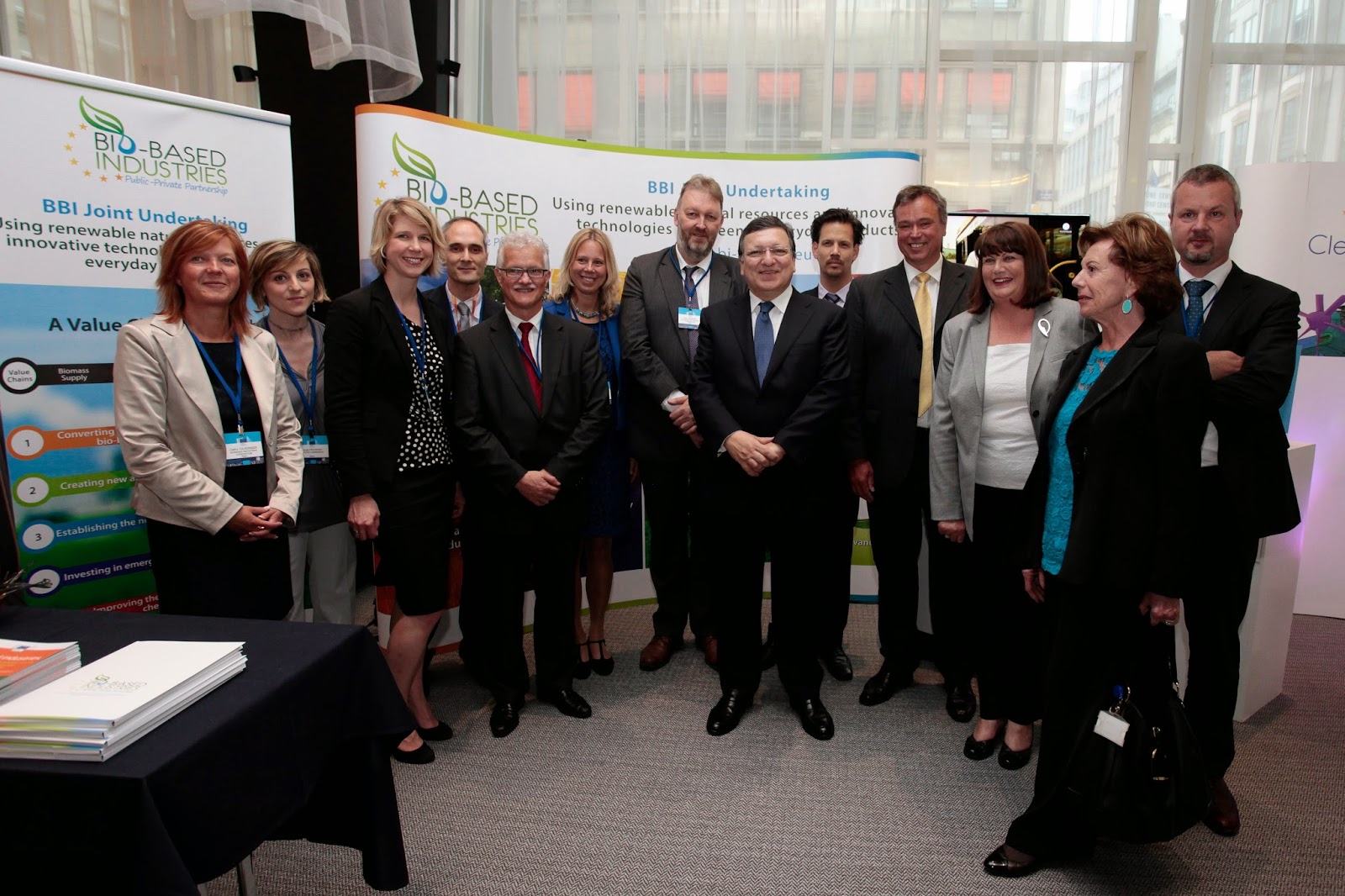
The BBI JTI is being launched with six other JTIs (including JTI on ‘Fuel Cells and Hydrogen’ and ‘Innovative Medicines’) at an event with European Commission President Barroso, Vice Presidents Neelie Kroes and Siim Kallas, and Máire Geoghegan-Quinn, European Commissioner for Research, Innovation and Science (all pictured below at the BBI JTI stand). Together, the JTIs represent a significant joint public-private investment in research and innovation for Europe’s future.


Bio Based Innovation
The BBI JTI will enable a €3.7 billion injection into the European economy between 2014 and 2024, with €975 million provided by the European Commission and €2.7 billion from the Bio-based Industries Consortium (BIC), to develop the emerging bioeconomy. The JTI will finance research and innovation projects and create new and novel partnerships across industry sectors (including agriculture, technology providers, forestry/pulp and paper, chemicals and energy).

The aim of the BBI is to use Europe's untapped biomass and wastes as feedstock to make greener, sustainable everyday products and renewable feedstock.

“At the heart of this initiative are advanced biorefineries and innovative technologies that use sustainable chemistry to convert renewable resources into sustainable chemicals, materials and fuels,” says Dr Gernot Klotz, Executive Director Research at Cefic and SusChem board member.

“The BBI JTI can help develop the building blocks needed to shift from a fossil- and imports-based society to increase the EU’s rate of economic growth, boost jobs – especially in rural areas, rejuvenate industries and reduce greenhouse gas emissions,” he continues. “New bio-based industries can increase the competitiveness of the European economy through re-industrialisation and sustainable growth along with other Key Enabling Technologies.”

Four of the six main Key Enabling Technologies (KETs) identified to be critical to strengthening Europe’s industrial and innovation capacity are from the chemical sector: advanced materials, industrial biotechnology, nanotechnology and advanced manufacturing.

BBI launch


Opening the launch of the JTIs this afternoon José Manuel Barroso (above), President of the European Commission, said: "Only if the best brains from academia, industry, SMEs, research institutes and other organisations come together can we successfully tackle the huge challenges that we are facing. This is what public-private partnerships are about, the joining of forces to make the lives of Europeans better, create jobs and boost our competitiveness. We are committed to prioritising the impact of the European budget on the recovery, and these partnerships are doing just that, with first calls for proposals for € 1.1 billion to be matched by industry, within a package representing an overall € 22 billion boost to growth and jobs creation over seven years. They will continue delivering results that no single country, company or even the European Union as such would achieve alone."

The launch of first calls comes almost exactly one year after the European Commission put forward the Innovation Investment Package, a set of proposals to establish seven public-private and four public-public partnerships (including SPIRE, see below).

Commenting on the BBI launch today Máire Geoghegan-Quinn, European Commissioner for Research, Innovation and Science, said: "The bioeconomy has huge potential that is attracting investments all around the world. With this new partnership, we want to harness innovative technologies to convert Europe’s untapped renewable resources and waste into greener everyday products such as food, feed, chemicals, materials and fuels, all sourced and made in Europe."

Peder Holk Nielsen, CEO of Novozymes, added on behalf of the industry partner, the Bio-based Industries Consortium (BIC): “The BBI is an unprecedented public-private commitment because of its focus on bringing bio-based solutions to the market. It is an opportunity to deliver sustainable growth in European regions and to reverse the investment trend currently going to other regions of the world.”


Concluding the launch event Commissioner Máire Geoghegan-Quinn (above) said: "As we heard earlier today, only through joint investments in developing our research and innovation capacity can we create the new jobs and growth to overcome the current economic crisis. The challenge is, of course, to make sure that such investments deliver tangible impacts: to help accelerate the development of new technologies and innovations, to generate new markets for innovative products and services; and to deliver good jobs and major benefits to society. I am confident that the JTIs presented here will live up to this challenge. The first calls for proposals illustrate the kind of activities that JTIs will support in our goal of accelerating the deployment of great ideas from the lab into the market – for example large scale demonstrators, testing and prototyping."

BBI and SPIRE together
The BBI JTI builds on ‘SusChem inspired’ projects such as EUROBIOREF: one of three large FP7 projects in a joint call on advanced biorefineries that responded to SusChem’s visionary project: ‘The Integrated Biorefinery’. Innovations from other SusChem FP7 projects such as the F3 Factory will also contribute to the integration of bio based processes into the economy.

“The BBI JTI is one of two major PPPs that SusChem is proud to have inspired: the other being the Sustainable Process Industry through Resource and Energy Efficiency (SPIRE) PPP,” says Dr Klotz. “SPIRE and the BBI JTI will work closely together along defined areas of common interest and will use their synergies to help deliver high resource and energy efficiency that can lay the foundation of the circular economy in Europe, alongside the materials programme of SusChem.”

BBI explained 
The BBI JTI is a €3.7 billion Public-Private Partnership (PPP) between the EU and the Bio-based Industries Consortium (BIC). The BBI is dedicated to realising the European bioeconomy potential, turning biological residues and wastes into greener everyday products through innovative technologies and biorefineries, which are at the heart of the bioeconomy. The Bio-based Industries Consortium - the industrial partner in the PPP - is constituted by a unique mix of sectors including agriculture, agro-food, technology providers, forestry/pulp and paper, chemicals and energy. A short video  explaining what the BBI JTI is all ablout has also been published (see below).


A fact sheet on the BBI and its activities is available and more information can be found at the BBI website.

An Info Day on the BBI will take place on 2 September 2014 in Brussels and will be a 'must-attend' event for all stakeholders interested in understanding the BBI rules for participation.

Five value chains
Organised in five value chains – that range from primary production to consumer markets – the BBI will help fill the innovation gap between technology development and commercialisation, sustainably realising the potential of bio-based industries in Europe.

The BBI is a shift from a fossil- and imports-based society to increase Europe’s share of sustainable economic growth, and is expected to create tens of thousands of jobs (80% in rural areas), revitalise industries, diversify farmers’ incomes, and reduce GHG emissions by at least 50% in comparison to fossil-based applications.

The aim of the BBI is to use Europe's untapped biomass and wastes as feedstock to make fossil-free and greener everyday products. At the heart of it are advanced biorefineries and innovative technologies that will convert renewable resources into sustainable bio-based chemicals, materials and fuels.

The BBI will manage the investments in the form of research and innovation projects that are defined in annual Calls for Proposals and implemented across European regions. In line with Horizon 2020 rules, all stakeholders are invited to submit innovative proposals and demonstrate progress beyond state-of-the-art.

The BBI is dedicated to realising the European bioeconomy potential, turning biological residues and wastes into greener everyday products through innovative technologies and biorefineries, which are at the heart of the bioeconomy.

The BBI is about connecting key sectors, creating new value chains and producing a range of innovative bio-based products to ultimately form a new bio-based community and economy.

Bio-based Industries: using renewable natural resources and innovative technologies for greener everyday products developing new value chains for bio-based industries, from primary production to consumer markets;
  • Using innovative technologies to turn biological residues and wastes into greener everyday products;
  • Moving from fossil-based to biobased products: planting the seeds for the European circular economy;
  • Supporting regional development by diversifying the local economy;
  • Promoting the opening of new markets for bio-based products and applications “Made in Europe”.
The BBI JTI will help create new jobs, especially in rural regions, and offer Europeans new and sustainable products sourced and produced locally. New bio-based industries can increase the
competitiveness of the European economy through re-industrialisation and sustainable growth.

The development of new bio-based products and markets based on smart and efficient use of resources will diversify industries’ revenue streams.

The BBI is expected to bridge European research knowledge with commercial scale bio-based products, making full use of European scientific and technological knowledge. The BBI should benefit all Member States where regions can play an important role through their Smart Specialisation Strategies.

Seven JTIs
The BBI was one of seven JTIs launched at a special event in Brussels on 9 July. Fact sheets on all seven JTI are available via the links below:
For more information, please visit the SusChem website or contact Esther Agyeman-Budu, Cefic communication manager for research and innovation.

An extended SusChem 10th Anniversary video describing the platform, its achievements and its contribution to BBI has also been published on YouTube.