The SusChem News Blog is now hosted on the SusChem website in the News Room. You will be redirected there in 10 seconds
.

Showing posts with label evonik. Show all posts

Monday, 13 August 2018

KETs Impact: 3D-printing for on-demand production

The recent SusChem White paper ‘Impact: Key Enabling Technologies (KETs) in Horizon Europe’ included a number of success stories highlighting publicly funded innovation involving KETs and the SusChem News blog is featuring a selection of these fruitful 'SusChem inspired' initiatives.


Sustainable chemistry is essential to the technological advance of KETs including advanced materials, advanced manufacturing technologies, industrial biotechnology, micro and nanoelectronics, nanotechnology and photonics. SusChem's key enabling technologies provide the critical building blocks for the solutions needed to achieve a sustainable low carbon circular economy. You can find out more here.

The sixth success story in this summer series features a project that developed a successful business model based on rapid, on-demand manufacture of individual spare parts. Exploitation should significantly reduce warehouse stock and associated costs: DIRECTSPARE. Rapid manufacturing technologies, such as 3D-printing (aka Additive manufacturing), can enable fast manufacture of often-complex parts. 

3D-Printing polymer materials
Technology breakthroughs enabled the creation of new business models, investments and jobs

For Evonik DIRECTSPARE was an important project within a longer period of research, development and innovation concerning material for additive manufacturing. Without EU public funding, this project would not have taken place. This would have extended the time to market considerably, resulting in a high risk of being passed by competitors from outside the EU. 

Evonik has performed R&D on polymer materials for 3D-printing for about 20 years and is now commercially producing its first 3D-printing materials. A part of the R&D was done within the EU-Project DIRECTSPARE. A growing quantity of product types in every market and every sector of industry require large warehouses to keep stock for spare parts, with corresponding high costs and complex logistics. This emerging problem is caused by continuously decreasing product lifetime, decreasing time-to-market and increasing regulatory affairs. DIRECTSPARE aimed to find a solution using additive manufacturing (AM) technology, enabling economically viable, and on demand manufacturing of spare parts. 

How was the breakthrough innovation achieved? 
The project consortium consisted of technology providers, engineering companies, equipment producers, material producers, manufacturers, users, management consultants and academia. The DIRECTSPARE project has delivered several business models that allow SMEs to provide local services. Possibilities and challenges for obtaining cost reduction on stocks and warehousing have been identified. The project also learned that to obtain waste reduction and environmental benefits, a life cycle analysis approach needs to be used. One demonstrator part indeed proved that quality improvement, based on use information, can be achieved resulting in lower costs and better margins.


The objective of the DIRECTSPARE business model was for manufacturers to rapidly produce only those spare parts that are required, at a location close to the equipment that needs to be repaired. And also to improve the quality of the spare parts along the way.

The project analysed seven demonstrator parts. The functional and material requirements and the cost model of the original part were taken as the point of departure or baseline. The project team analysed the possibilities to manufacture similar parts using AM. The design, engineering aspects, material selection, production methods, quality issues and business economics of all of these parts were taken into consideration. 

Impact
The project delivered several breakthrough innovations on materials, engineering, process management and quality management. Three viable business models were developed. DIRECTSPARE created a significant networking platform for further development of new 3D-printing powders at Evonik. In February 2018 a production plant for polyamide 12 (PA 12) high performance powders, mainly for the additive manufacturing market became operational in Marl, Germany. The PA 12 material is used in automotive and lightweight design as well as in oil and gas pipelines. In addition to current applications in the automotive sector, Evonik is also very well positioned for the future production of hybrid and electric vehicles. Furthermore, the material is used in the medical sector and in 3D-printing. The investment in a new polyamide production plant secured and created around 10 new jobs.

More information
DIRECTSPARE – ‘Strengthening the industries’ competitive position by the development of a logistical and technological system for “high performance spare parts” that is based on on-demand production’ (FP7 GA 213424)

Read the SusChem White Paper ‘Impact: Key Enabling Technologies (KETs) in Horizon Europe’

Monday, 22 February 2016

BBI and SPIRE work to increase coordination

The Public-Private-Partnerships (PPPs) ‘Sustainable Process Industry through Resource and Energy Efficiency’ (SPIRE) and ‘Bio-based-Industries Joint Undertaking’ (BBI) are both striving to improve the sustainability of European manufacturing industry in terms of global competitiveness, ecology, jobs and growth. On Monday 15 February participants at a joint workshop for the two PPPs explored ways in which the two entities could coordinate aspects of their work programmes and add value to European research and innovation outcomes in areas of common interest. The workshop was hosted by the European Commission at it Covent Garden offices in Place Rogier, Brussels, was organised under the SusChem banner and initiated and sponsored by Evonik Industries.

The two PPPs approach their common goals from complementary angles. SPIRE comprises projects that improve all aspects of resource and/or energy efficiency across a variety of manufacturing sectors, while BBI supports the establishment of a new bio-industrial structure in Europe, from the generation of biomass in the field or forest to its value-generating industrial conversion to biobased products.


When the two PPPs were being established in 2012 a joint narrative was developed which looked to establish coordination mechanisms between the two PPPs and to ensure that their respective activities were linked and harmonised whenever technically and economically reasonable. The workshop looked at how the ambitions of the joint narrative could be implemented in practice.

SusChem editor Tim Reynolds moderated the workshop that was entitled ‘Exploring the Synergies of SPIRE & BBI-JU’ and brought together stakeholders from both PPPs. The day was split into two sessions. In the morning the full group listened to perspectives from the European Commission, industry and the PPPs themselves. And in the afternoon two group discussions worked on possible actions and organisational issues.

Perspectives
Waldemar Kütt, Head of Unit for BioBased products and processing at the European Commission reminded the audience that both PPPs were industry led and driven and that both must provide important inputs to the development and implementation of the bioeconomy and circular economy.

Søren Bowadt, the Commission’s Programme Officer for SPIRE said that the Commission’s role was to support the PPPs’ decisions. He thought that the workshop was very timely and outlined a number of areas – such as waste water, industrial symbiosis, and the circular economy – where complimentary activities would be useful to both parties.

From industry Peter Nagler, Head of International Innovation at Evonik Industries AG and member of the SusChem Board, said that from the start SusChem had believed that the bioeconomy and biotechnology must play an important part in a future sustainable chemical industry. Both PPPs had launched a number of calls: it was now time to look at where complementarities could be leveraged and to identify any gaps that needed to be addressed in the short to medium term.

Christophe Rupp-Dahlem, Head of Global Public Affairs at Roquette, President of the Plant-based Chemistry Association and Vice-chair of the board of the Biobased Industries Consortium (BIC) representing the industrial partners behind BBI underlined the importance of cooperation and communication between the two PPPs and remarked that the BBI programme in 2016 will include a Coordination and Support Action (CSA) call for a Roadmap for relevant research and innovation activities for the Chemical Industry.

For SPIRE Executive Director of SPIRE’s industrial association, Loredana Ghinea, reminded the workshop that SPIRE worked with seven other large industry sectors as well as the chemical industry. She outlined a number of past calls that were of clear relevance to the bioeconomy and also announced that SPIRE was undertaking a gap analysis of past calls as part of the formulation process for future calls.  

Dirk Carrez, Executive Director of BIC reminded participants that BBI calls were open to all. He believed that the discussion should not be about competing technologies but about synergies between the two PPP programmes.

Fruitful discussion
Possible opportunities for early synergy was outlined by Nelo Emerencia of BIC who described upcoming 2016 BBI calls of potential interest to SPIRE participants, while Søren Bowadt similarly highlighted relevant SPIRE calls  for BBI stakeholders.


The two small discussion groups worked through the possibilities for the scope of a joint working group that could guide cooperation between the PPPs and also generated ideas and areas of common interest for future joint work through a brain storming session.

Key outcomes of the workshop discussion included:
  • A small joint working group (JWG) should be established quickly to prepare a platform for coordination. Members of the JWG would be drawn from BBI, SPIRE and SusChem. The platform would work under the auspices of SusChem and its role would be to connect content and programme coordinators to help development of programmes / calls that are complementary. It could also help in organising further brainstorming sessions and motivate stakeholders to participate.
  • Both PPPs have undertaken or are in the process of undertaking gap analyses of their current calls. Comparison of these analyses would be very useful in identifying areas of common interest and priorities for future content that could be taken up through the two PPPs' calls (attention should be paid to connecting TRLs and timings of deliverables).
  • It was important that existing communication channels worked effectively to ensure that information on the calls in from both PPPs were effectively disseminated to all the stakeholders in both PPPs – perhaps with topics of specific interest highlighted. 
  • In the short term, both PPPs will try to motivate their respective stakeholders to look for complementarity during project consortium formation.
The workshop concluded that enhanced cooperation between SPIRE and BBI should yield valuable synergies and that swift implementation of the JWG was important. Further discussions on areas of common interest would be undertaken at upcoming PPP events and a joint session could also be useful at the next SusChem stakeholder event on 16 June in 2016.

The discussion continued at a networking cocktail in the Sheraton Rogier Hotel.

Tuesday, 20 October 2015

EFIB 2015: The Chemical Industry and ‘Biobased’

The European Forum for Industrial Biotechnology and the Bioeconomy (EFIB) 2015 takes place on 27-29 October at the Square in Brussels and the eighth EFIB promises to be bigger than ever. SusChem and Cefic are organising a dedicated session on biobased chemical value chains as part of the conference on 29 October. In advance of the session Cefic’s Executive Director Research and Innovation Pierre Barthélemy and Dr. Henrike Gebhardt of Evonik Industries AG have been interviewed by EFIB organisers.

With major chemical players looking to move into biobased products and processes the interview focuses on key questions surrounding the session: ‘Is the chemical industry catching up with biobased’. The interview covers changing attitudes and approaches by the chemical sector to biobased, the measures needed to accelerate uptake of renewable feedstocks, views on the most significant recent developments in the biobased industry sector and what they hope the EFIB session will achieve.

Pierre (right) says: “It is important to keep looking at success stories and achievements in the chemical industry, but it is even more important to highlight the challenges faced by the chemical industry to embrace the bio-based approach more widely.  Switching to different feedstock is not just a technical challenge.  It creates new value chains with different stakeholders that have to understand each other.  It is essential for the chemical industry to explain its expectations and challenges in order to make progress in building the connections between stakeholders in these new value chains.”

“EFIB is an excellent platform to network with stakeholders from academia, finance, governments, industry, and NGOs,” comments Henrike (left). “This year I am especially looking forward to getting a insight into the approach of several brand owners to bio-based products, because they are closest to customers’ needs.”

Joining Pierre and Heinrike at the EFIB session will be Reinhard Buescher, Head of Unit for Chemicals Industry at DG Grow giving the view of the European Commission. Further insights from industry will be presented by François Monnet, Exec VP for Renewable Chemistry at Solvay, Dr. Stefan Lundmark of Perstorp AB, and Dr Marcel Wubbolts from DSM who was recently awarded CTO of the Year 2015. The presentations will be followed by a group discussion.

The session will cover topics such as differentiation in times of barrel price volatility, meeting changing consumer needs and connecting uncommon partners in new biobased value chains.

Industrial Biotechnology is currently worth €23 billion – this represents just 6% of sales in the overall worldwide chemicals market. However, the sector is significantly out-performing the overall chemicals market at an impressive 20% annual growth rate and has the potential to become the dominant technology of tomorrow’s chemicals industry - and represents a huge future opportunity.

SusChem and the bioeconomy
The SusChem Strategic Innovation and Research Agenda (SIRA) includes has a dedicated chapter on ‘A Sustainable and Inclusive Bioeconomy’ and SusChem is an essential link between the chemical industry, industrial biotechnology and stakeholders in the bioeconomy.

The platform is actively involved in two large and relevant PPPs between the European Commission and industry launched in 2014:


SusChem contributes to the alignment of both initiatives. The interface between BBI and SPIRE is the provision and use of biobased platform chemicals. In addition, both PPPs may support projects using biotechnological conversion processes and specific improvements of biotechnology processes may be eligible for funding through either PPP. SusChem will enable the coherence of on-going and future funding initiatives and the deployment of flagship projects that demonstrate technological leadership and that Europe is a globally competitive location to invest in the bioeconomy.

More information on EFIB
The conference kicks off with a set of pre-conference Workshops on 27 October with the full conference programmes on 28 October and 29 October.

Register your place today here!

Friday, 25 July 2014

SusChem Stakeholder Interviews from #SusChem10

A new video of interviews from the 2014 SusChem Stakeholder event in mid June has just been published (see below). The video outlines SusChem’s rationale, vision, achievements and future goals.

Since it launch in 2004, SusChem has made many significant achievements - including the initiation of projects worth more than € 1.5 billion in FP7, its visionary flagship projects such as the Smart Energy Home, the F3 Factory and Integrated Biorefinery, and more recently the launch of two large Public-Private-Partnerships (PPPs) under Horizon 2020 : SPIRE and the BBI JTI.


The video features interviews with Clara de la Torre of the European Commission, Gernot Klotz of Cefic, Peter Nagler from Evonik and Louis Neltner of Solvay. The short video covers topics such as SusChem’s role in tackling societal challenges, the role of PPPs, and how Horizon 2020 will help accelerate innovation in Europe.

SusChem’s vision is for a competitive and innovative Europe where sustainable chemistry and biotechnology together provide solutions for future generations.

For more information on SusChem activities and the new SusChem SIRA contact Jacques Komornicki, SusChem Coordinator at Cefic. The SusChem website is at http://www.suschem.org.

Tuesday, 16 July 2013

F3 Factory Case Study: Continuous Production of Chemical Intermediates

For its F3 Factory industrial case study Evonik Industries AG focused on demonstration of the flexible, continuous production of intermediate chemicals. Working with academic partners TU Dortmund, TU Eindhoven and Newcastle University the project looked at the development and validation of a generic methodology for modularised production plants of medium scale for example for fence-to-fence applications in emerging markets.

As a global leader in specialty chemicals production Evonik Industries AG’s products are used in a wide variety of high end application areas including pharmaceuticals, agrochemicals, paints and coatings, paper, plastics, personal care and hygiene, adhesives and sealants. Innovative production strategies in these fields are a key focus of Evonik’s research and development projects.

Typical intermediates include those produced in highly exothermic reactions which suffer from limited heat and mass transfer capabilities. Present reactor technologies are complex and unique for each product and plant and are mainly economic only in world-scale capacities: in production facilities producing more than 100 000 tonnes per annum.

The F³ Factory approach can help Evonik become more flexible in production capacities, enable the use of different feed qualities and allow faster scale-up procedures to reduce time-to-market. Depending on the specific reactions investigated, step changes in production are expected including increased production effectiveness, energy savings and lower investment costs amongst many others.

Modular production technology 
Achieving the challenging goals of the F³ Factory project can only be reached through innovative process intensification technologies. For the Evonik case study, two different technologies were investigated:
  • structured catalyst packing
  • jet-loop reactor with integrated “cold” membrane separation
Both technologies focused on the intensification of mass and heat transfer as well as simplification of the specific chemical reactor design.

The first reactor technology required new catalyst structures which could be implemented as “plug-in” technology in existing plants. In the near future these could also be used in modularised new reactor concepts.

Simpler reactor construction will reduce investment costs and enable greater standardisation of reactor technology. Parallelization of this technique offers high potential for more flexibility in production capacity to support future market growth.

The second reactor technology is designed for highly exothermic liquid-gas reactions. Innovation in catalyst development requires an improved reactor concept to enable the heat management and mixing requirements necessary to maximise catalyst efficiency.

For the F3 Factory modular approach a parallel jet-loop set-up was envisioned, which combines high mass transfer performance and efficient heat management through the jet-loop principle with an integrated membrane separation for catalyst retention. The basic set-up is shown below.


This modular approach can easily be adapted to varying production scenarios by adding additional reactors or membrane Process Equipment Assemblies.

The benefits of this approach are:
  • reduced investment costs through standardised and easily scaleable reactor equipment
  • reduced operating costs due to maximised space-time yield and integrated heat management
  • high selectivities due to low heat gradients and ideal mixing
  • improved catalyst lifespan due to separation under process conditions

Following process development the production unit was transferred to the modular, container-based concept developed within the F3 Factory project.  This hydroformylation process in a jet-loop, with an integrated membrane separation, was then successfully demonstrated in the F3 Factory backbone facility at the INVITE Research Centre in Leverkusen, Germany.

With successful demonstration of the intensified technologies in a modular production environment, the basis of a possible new production concept has been realised.  The concept will now be further developed and optimised.

Validation and demonstration
Partial oxidation, epoxidation and hydroformylation were selected as example reaction classes for the case studies.

In cooperation with the University of Newcastle and TU Dortmund, software tools have been developed to evaluate the economic and technological aspects of applying this F3 Factory approach. With the help of the universities, models have been set-up to optimise operation conditions and operation control aspects.

The applied process intensification technologies have been proven to operate successfully at both lab and pilot scale levels. Design and engineering of modularised process equipment assemblies and process equipment containers for the hydroformylation reaction was completed successfully and the modularised hydroformylation process was successfully demonstrated at INVITE.

Project contact information:
For more information visit the F3 FactoryProject website or contact Dr. Frank Stenger at Evonik.

Wednesday, 20 June 2012

Industrial Technologies 2012 - Day 1

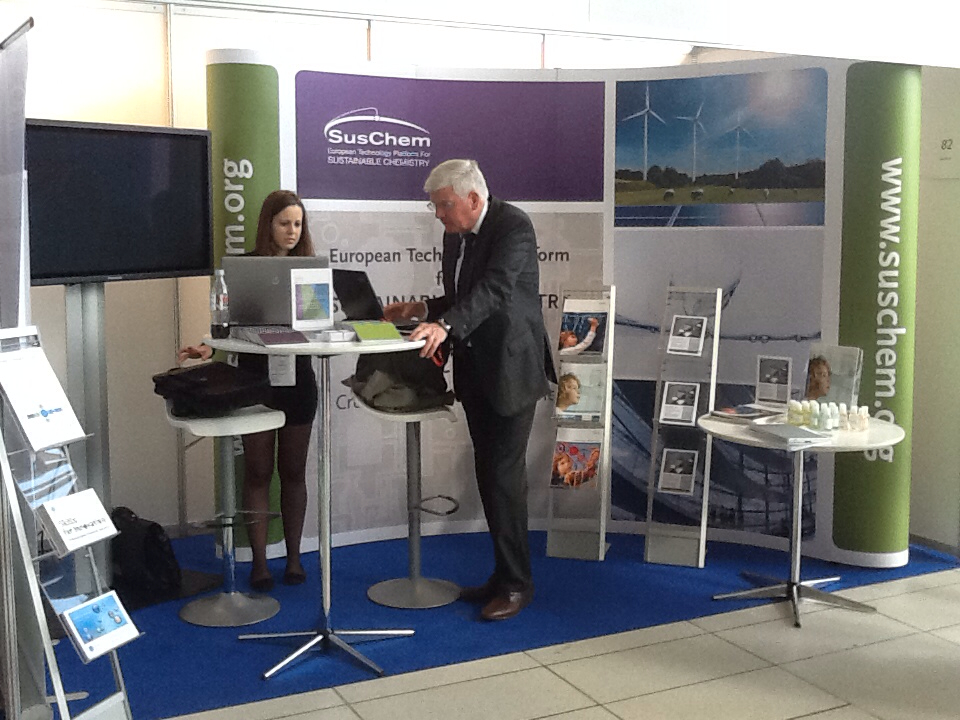
The SusChem inspired SPIRE (Sustainable Process Industry through Resource and Energy efficiency) PPP was a prominent component of many contributions at the first day of the Industrial Technologies 2012 conference in Aarhus Denmark. The SusChem stand (see below) was complemented by neighbouring booth dedicated to SPIRE and SusChem stakeholders contributed to a number of sessions.

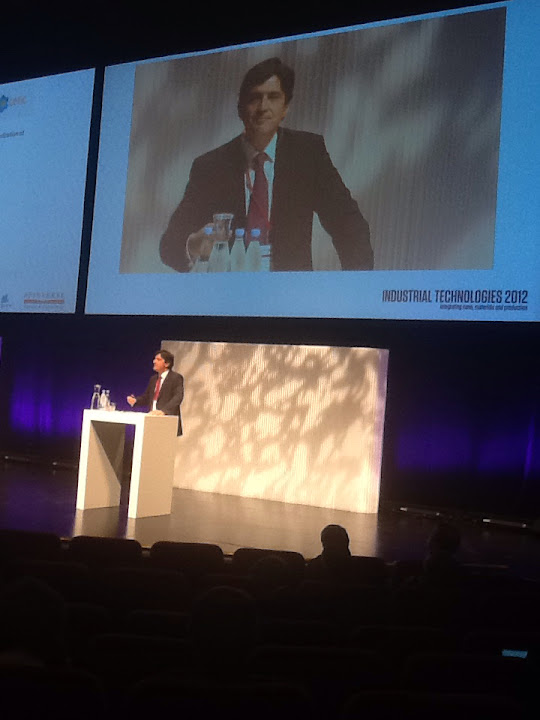
Pierre Joris of Solvay (below) contributed on behalf of SusChem to the morning plenary session on Industry and Horizon2020.

In the afternoon SusChem board member Peter Nagler from Evonik (below) introduced SPIRE and outlined its remit and current status to delegates in the Resource Efficiency session. On 28 June SPIRE will assume a legal identity in Belgium.

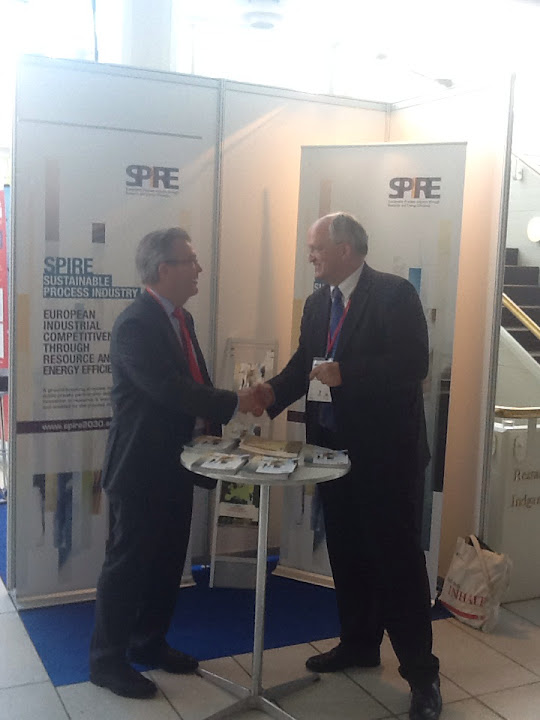
Rudolf Strohmeier, deputy director-general of European Commission's DG Research & Innovation was a visitor to both the SusChem and SPIRE stands in the afternoon. He is pictured below (left) at the SPIRE stand with Gernot Klotz of Cefic.

On Wednesday evening the conference Gala Dinner will take place. The highlight of the evening will be a competition to select the Industrial Technologies project with the highest impact. The FP6 project IMPULSE (Integrated Multiscale Process Units with Locally Structured Elements) is one of the ten projects selected for the gala final and it is a SusChem-inspired project.

Project coordinator Mike Matlosz (above) is pictured preparing for a video recording where he explains the project.

The SusChem team is looking forward to Day Two at Aarhus. To keep up to date with SusChem inspired activities at the Industrial Technologies 2012 conference follow SusChem tweets via @suschem.


Thursday, 9 February 2012

Alfred Oberholz 1952 - 2012

It is with great sadness that SusChem News has learnt of the sudden death of Dr. Alfred Oberholz.


Dr. Oberholz was a chairman of the SusChem board from 2005 to 2008 and was influential in the success of the platform. He was personally committed to the success of SusChem and a great champion for sustainable chemistry and industrial biotechnology.

He remained a strong supporter of 'SusChem thinking' when he stepped down from the chairmanship and retired from Evonik.

He will be greatly missed by the chemical community in Europe. Our thoughts are with Dr. Oberholz's wife and family at this time.