The SusChem News Blog is now hosted on the SusChem website in the News Room. You will be redirected there in 10 seconds
.

Showing posts with label public private partnership. Show all posts

Tuesday, 9 April 2013

R4R launches Survey, Website


Today (April 9) the SusChem supported FP7 project ‘Chemical Regions for Resource Efficiency’ (R4R) launched its new website and an online survey. SusChem stakeholders are invited to contribute to the survey which will set the priorities for the project that aims to overcome fragmentation across Europe’s innovative regions and set the agenda for achieving some ambitious resource efficiency targets.

Global chemicals and manufacturing industries are at the core of our modern industrial society, developing and producing the key chemicals, materials, medicines and products that allow us to achieve ever better standards of living.

Both industry and society are looking to develop real opportunities to rejuvenate and transform the chemical and process industries into highly eco-efficient high-technology solution providers through changes such as:

  • Switching to biobased feedstock
  • Improving efficiency of processes
  • Recycle wasted materials
  • Facilitating an integrated approach to ensure synergies between industrial sectors

R4R survey
Today, on its new website, the R4R project launched an online survey around Europe to picture where the chemical regions are in terms of resource efficiency and fully understand where the focus of the project should be.

“One of the first steps for the R4R project is to understand the regions, the agendas and strategies of the companies and how these align to the regional agendas,” says Pádraig Naughton, Innovation Manager - Resource and Energy Efficiency, at Cefic R&I.

Currently interviews are being conducted to understand the direction of the most important companies and partners in the project. The new online survey that has launched with the opening of the R4R website today serves to supplement and enrich these interviews and gather additional information from the wider community. The survey only takes a few minutes to complete and is available in English, German, Polish and Spanish.

“Once the information has been assembled, by beginning of May, the analysis of the data will be used to pinpoint the priorities in the various regions and to highlight synergies and potential opportunities for cooperation across the regions,” continues Pádraig. “The end result of the project should be joint action plans, which then can feed into proposals for the SPIRE or BRIDGE public-private partnership (PPP) initiatives."

Pádraig Naughton started at Cefic R&I in February and is responsible for R4R amongst other projects. He is on secondment from Dow Chemical, where he has had a long international career mostly in research and development.

“I am a mechanical engineer by training and have focused mostly on application development with customers,” he explains. “My expertise in this field relates to composites, plastics, adhesives, foams and use of computer modeling and simulation to develop applications.”

At Cefic Pádraig will concentrate on defining the needs for the industry in the area of resource and energy efficiency and position this to align with the challenges of the forthcoming Horizon 2020 programme.

About R4R
Launched in late 2012, R4R is funded for three years under the European Commission’s FP7 Research and Innovation Framework Programme. The ‘Chemical Regions for Resource Efficiency (R4R)’ project aims to overcome fragmentation of European ambitious and innovative regions. Through its methodology, R4R could lead the path to a range of promising and positive impacts on resource efficiency.


R4R brings together six complementary EU Regions (Aragon in Spain, Göteborg in Sweden, North Rhine–Westphalia in Germany, the Port of Rotterdam and the South-West regions in the Netherlands, and West Pomerania in Poland), each with their own public and private research and innovation expertise. The R4R project aims to achieve a major step improvement in regional and transnational cooperation among its participating regions and will develop practices, tools and examples which can be easily disseminated to and adopted by multiple European regions to improve regional and cross-regional collaboration in general, and in the process industry on resource efficiency in particular.


Finally, R4R will create a platform for international collaboration on resource efficiency with clusters in third countries to improve and accelerate innovation and promote European eco-innovative technologies globally.

To find out more visit the website or contact Pádraig Naughton at Cefic R&I or project coordinator AnnaSager at SP Technical Research Institute in Sweden.

Monday, 25 February 2013

Register now for the 2013 SusChem Stakeholder Event!


Registration for the 2013 SusChem Stakeholder is now open. The event has the theme ‘Essential elements for EU Growth and Jobs: Innovative Materials and Processes’ and takes place on 14 – 15 May 2013 in Brussels. The meeting will primarily address the benefits of innovation partnerships and joint public-private initiatives to boost EU growth and improve competitiveness - and how SusChem and sustainable chemistry will play a role in this. Join us and get the latest insights!

The draft programme for the event is now available and the two days are packed with presentations, workshops and networking opportunities.

On the first day high level speakers form SusChem, the European Commission, the European Council and European Parliament will discuss the role of SusChem and European Technology Platforms in Horizon 2020, innovation and the new EU Industrial Policy, improving competitiveness and much more.

The second day includes parallel session on the European Innovation Partnerships (Water Efficiency, Raw Materials, Energy materials and Smart Cities) and the two Public-Private-Partnerships (SPIRE and BRIDGE 2020) that SusChem is involved with. Delegates will also be updated on progress in the SusChem ‘Educate to Innovate’ initiative.

Strategy in action
SusChem has evolved into a Europe-wide platform that captures the full benefit of Europe’s strengths in research and provides a well-connected network for innovation in the chemical and biotechnology value chain. As a result, its strategy has evolved too.

The new SusChem 2020 strategy retains research, innovation and education actions at the heart of our activities. These three activities are important to engage with policy makers and partner organizations to shape research and innovation policies and deliver truly sustainable innovation that creates value in and for European society.

To achieve its ambitious objectives, the platform’s partnership activities will also need to expand strategically. This means a substantial increase in multidisciplinary and cross-sector working along value chains. The new strategy is also designed to strengthen cooperation between SusChem Europe and our network of National Technology Platforms.

With this new strategy and its broad and growing stakeholder base, SusChem aims to ensure that research is effectively turned into innovative products and services that will shape Europe’s future.

Where and when?
Join us on 14 and 15 May at the SusChem Stakeholder Event in Brussels to see examples of the new strategy in action!

The event will take place at the Hotel Sofitel Europe on Place Jourdan in the heart of the European Quarter in Brussels.

For more information on SusChem activities, please contact the SusChem secretariat. Places are limited so you are advised to register as soon as possible!

Tuesday, 18 December 2012

Stakeholder event on BIO-PPP

On 9 January the European Commission will report back on the results of the stakeholder consultation on the Bio-based industries PPP (BIO-PPP). The event will take place in Brussels and be opened by Robert-Jan Smits, Director-General of the Commission’s DG RTD.

Following the launch of an online public consultation on 21 September on "Bio-based industries, towards a public-private partnership under Horizon 2020", DG RTD is organising a one-day stakeholder meeting on 9 January 2013 in Brussels. The aim of the meeting will be to present industry's vision and objectives for this partnership together with the strategic innovation and research agenda and the results of the online public consultation, which is now closed.

The meeting will be opened by DG RTD Director-General Robert-Jan Smits, followed by speakers from industry and research organisations. The meeting will provide ample opportunities for discussion of the proposals.

All those directly or indirectly connected with the bio-based industries, including representatives of public authorities, farmers and foresters, businesses and associations, academics and technical experts, civil society organisations and individual citizens are encouraged to attend the meeting and to provide their views and feedback on the planned partnership.

A final report on the outcome of the online public consultation will be published later in 2013, taking into account the conclusions from this stakeholder meeting.

Registration
Meeting will take place in the Gaspari meeting room in the Charlemagne Building at Rue de la Loi 170, Brussels. Registration for the meeting is open until 4 January 2013. To register you need to send an email to RTD-KBBE-Experts@ec.europa.eu including your first and last name, date of birth, country of origin and professional occupation.

For more information on the BIO-PPP proposal and the consultation process, please contact the consortium secretariat at CEPI.

BIO-PPP is a proposed Public Private Partnership (PPP) on the Bio-Based Industries which aims to lead the transition in Europe towards sustainable alternatives to our current petroleum/ fossil fuel-based society. The aim of the initiative is to help establish a new European bioeconomy encompassing all stages in the value chain from biomass harvesting and logistics via efficient conversion processes to the manufacture of bio-based products. The industry group behind the initiative comprises major companies from a cross-section of sectors including forest, agricultural, paper, chemical, energy, fuels and biotechnology.

Thursday, 29 November 2012

Consultation supports SPIRE Roadmap

The revised roadmap for the proposed Public Private Partnership (PPP) for Sustainable Process Industry through Resource and Energy Efficiency (SPIRE) has been recently published on the SPIRE website. This document was the result of over 450 responses to the consultation on the draft roadmap and showed highly positive support for the initiative from a wide range of industry sectors, value chains and stakeholder communities.

The initial roadmap was first presented at the European Commission Info Days on 9 – 10 July and was widely disseminated with the official launch of the consultation on 27 July. The consultation period was open until 1st October 2012.

This public consultation allowed opportunities for submission of comments, requests for clarification and to suggest additional ideas not only from members of the process industry community but also from other bodies and actors across the European Research Area (ERA).

Positive feedback, high acceptance
More than 450 responses were received to the online questionnaire part of the consultation and showed a wide coverage along many different value chains (upstream industry included) as well as across the SPIRE core sectors and other organizations including SMEs, large industry, research and technology organizations, academia and NGOs.

Analysis of the responses from all the different sectors and communities showed high levels of acceptance of the SPIRE roadmap with particularly high scores for the contribution that SPIRE’s vision can make to tackling the challenges listed in the European Commission’s Europe 2020 strategy and its ability to address sustainability issues in the process industries. The responses also indicated that SPIRE will add value to sustainable innovation across the various sectors.

“Overall the consultation process showed an overarching positive feedback across many actors in the ERA,” commented A.SPIRE aisbl Executive Director Loredana Ghinea. A.SPIRE is the legal entity established to manage and implement the SPIRE PPP.

“The highly positive acceptance levels for the contents and structure of the SPIRE roadmap shown in the consultation demonstrates that it reflects the main challenges and interests of the process industry stakeholders,” she added.

More information
The revised post-consultation Roadmap is available to download now on the SPIRE website and will also be published on the European Commission PPP website. A period of validation will now take place until 15 December before formal submission to the European Commission.

For more information on the SPIRE initiative and how you can get involved please visit the SPIRE website or email the SPIRE secretariat.

Monday, 30 July 2012

Get involved with the SPIRE Roadmap Consultation!

The European Process Industry, through its newly-created Association SPIRE (A.SPIRE), has launched a public consultation on the strategic multi-annual research and innovation roadmap developed for the proposed SPIRE Public-Private Partnership (PPP). SusChem is a major supporter and contributor to the SPIRE initiative.

This public consultation is a unique opportunity for all interested parties to have their say on this initial 92 page, cross-sectorial research and innovation roadmap. The document provides the pathway for Europe to decouple resource consumption from human well-being and achieve increased competitiveness in the European process industry. The consultation process will run until 1 October 2012.

The consultation survey must be undertaken online but a pdf preview of the questions can be downloaded here.

The consultation on the proposed SPIRE PPP is also accessible via the European Commission’s Industrial Technologies webpage on Public Private Partnerships in Research together with other open consultations on current PPPs Factories of the Future and Energy-efficient Buildings.

What is SPIRE about?
The realisation of SPIRE is essential in order to rejuvenate the European process industry and to ensure that economic growth is decoupled from resource impact – a key factor to enable sustainable economic growth.

The sectors, including the chemical industry, united in the SPIRE initiative represent a major part of the manufacturing base in the European Union involving more than 450,000 individual enterprises with over 6.8 million employees and generating more than €1.6 trillion annual turnover.

The cross-sectorial research and innovation roadmap produced by SPIRE provides the pathway for the European Process Industry to decouple resource consumption from human wellbeing and achieve increased competitiveness in the Europe. The roadmap is the result of an extensive process of collecting input from the eight process industry sectors actively participating in SPIRE, in consultation with other sectors such as glass, paper and pulp, and the European Commission through a provisional Ad hoc Industrial Advisory Group (AIAG).

The roadmap represents the collaborative efforts of public research and technology organisations and academia as well as industry stakeholders throughout Europe, along and across the value chain.

The SPIRE research and innovation roadmap was developed with two key resource and energy efficiency targets in mind and a time horizon of 2030:

  • A reduction in fossil energy intensity of up to 30% from current levels by 2030 through a combination of, for example, cogeneration-heat-power, process intensification, introduction of novel energy-saving processes, energy recovery, and progressive introduction of alternative (renewable) energy sources within the process cycle, and
  • Upto 20% reduction in non-renewable, primary raw material intensity compared to current levels, by increasing chemical and physical transformation yields and/ or using secondary (through optimised recycling processes) and renewable raw materials.

For both targets a full life cycle cost analysis is required to consider all effects along the value chain and to prove the sustainability advantage. In addition both targets will make a significant contribution to the political and societal objectives of drastic efficiency improvement in CO2-equivalent footprints of up to 40% by 2030.

Key components, key actions
SPIRE will implement its research and innovation roadmap through six Key Components that are at the core for a resource and energy efficient process industry:

  1. Feed: Increased energy and resource efficiency through better preparation and product mix of raw materials, higher levels of alternative and renewable feedstock (including waste and waste water), as well as better managing increased quality variations in material resources.
  2. Process: Solutions for more efficient processing and energy systems for the process industry, including industrial symbiosis.
  3. Applications: New processes to produce materials for market applications that boost energy and resource efficiency up and down the value chain.
  4. Waste2Resource: Valorisation and re-use of waste streams within and across sectors, including recycling of post-consumer waste streams and new business models for eco-innovation.
  5. Horizontal: underpinning the accelerated deployment of the R&D&I opportunities identified within SPIRE through sustainability evaluation tools and skills and education programmes as well as enhance the sharing of knowledge and best practices.
  6. Outreach: Reach out to the process industry, policy makers and citizens to support the realisation of impact through awareness, stimulating societal responsible behaviour.

Key Actions have been developed for each Key Component, enabling an ambitious, realistic and measurable agenda driven approach towards fulfilling the SPIRE objectives and consequently achieving impact overcoming technological and non-technological barriers.

The SPIRE roadmap will be updated through an open and consultative process during the lifetime of the PPP to reflect progress as well as possible changes in priorities. You can take part in the initial public consultation by clicking the survey button below.

Monday, 2 July 2012

The Aarhus Declaration

The Declaration signed on 21 June in Aarhus, Denmark was the climax of the Industrial Technologies 2012 conference and represents a major commitment by industry to support European research and innovation activities for the common good of European society and its citizens. The declaration was formulated and signed by a range of industrial partners, including SusChem on behalf of the proposed PPP SPIRE consortium, and we reprint the text in full below.

Please feel free to forward the declaration to colleagues and other interested parties. To find more information on the declaration and SusChem activities to achieve its aims and objectives, please contact the SusChem secretariat.


Declaration at the Industrial Technologies 2012 Conference

“We, the undersigned, represent globally competitive industrial sectors employing over 19 million people in Europe. Our members are committed to join forces with the public sector to significantly contribute to European recovery and to address the challenges facing European society. This is a matter of great urgency. The European economy is stagnant. Unemployment in the EU-27 countries stands at over 10% as of April 2012. Significant and sustainable improvements in economic growth and employment are required.

The EU 2020 strategy demonstrates that this requirement is well understood, and an emphasis on mobilising EU policies to support growth and strengthen job creation is welcome. In order to succeed in the light of intensified global competition a significant effort on not only research, but innovation is needed.

Significant public support for industrial innovation has enabled manufacturing in the US to add 160 000 jobs since 2009, and to maintain this growth significant funding for industrial innovation has been committed via their recovery package. China’s Innovation 2020 plan will see it invest heavily in research and development in High End Manufacturing and Advanced Materials, whilst continuing to spend heavily on infrastructure.

The Opportunity
To address this challenge, we must have companies and industries which are able to thrive in global markets, thereby increasing employment in Europe. Europe cannot compete by compromising on labour costs and less strict environmental protection; nor can it change the restricted nature of its budgets, especially in these challenging times.

Our belief is that innovative products and processes provide the only sustainable way for our industries to thrive in global competition and to continue to create jobs in Europe.

This is an area in which Europe has great potential. We know that Europe benefits from having an exceptionally strong technology base. The European industrial ecosystem has integrated value chains which include a healthy mix of globally leading companies and an extensive network of SMEs, assuring the necessary set of competencies to compete for leadership and excellence.

The Industrial Technologies conference has demonstrated what is meant by industrial innovation:

  • Transforming factories through intelligent automation and integrating factories into smart business networks
  • Developing new technologies to accelerate the implementation of energy efficient solutions in our building stock, enabling new business models and value propositions for citizens
  • Building competitive process industries with exceptional resource efficiency, with value chain coverage to address the sustainable manufacturing requirements in Europe.
  • Ensuring our mobility system becomes more sustainable
Realising this vision requires action and commitment from all partners, public and private.

Public Private Partnerships for Research and Innovation

A better orientated partnership between Industry and Research
We will work closely with the research community, to develop innovations which can be applied in new products and services, and we commit to an open dialogue and responsible partnerships with research centres and universities, to communicate our needs and to be open to new technological opportunities. The most successful outcomes will often occur as a result of collaboration, across research and industry, but also across disciplines: Europe can build from clustering the key value chain players and create a global competitive advantage from this, through such a collaborative approach.

European industry will continue to maintain the high quality of its research base, and therefore the emphasis on excellence is welcomed. This also requires a strategic partnership from the research community to take research closer to market introduction by working on applied research and prototypes.

Public support and investment
Governments at European and national level play a critical role in funding research and innovation in areas where the level of the challenges and market uncertainties make it difficult or impossible for companies or consortia to undertake such projects alone. This requires funding programmes to be structured in a way which enables companies to participate, with faster decision making and by reducing the administrative burden.

We also strongly believe that, to make innovation happen in Europe, public engagement must go further, to design favourable, consistent and coordinated framework policies and fund activities that, whilst closer to market, are still risky and knowledge-intensive, such as piloting and demonstrations.

The overall role of public as incubator specifically where breakthroughs on societal challenges are required must be incorporated in this overall endeavour and therefore policy engagement is required in addition to funding initiatives.

Industrial Commitment
Industry's role is to participate as a partner in this collaborative research and innovation and to ensure that successful joint demonstrations are followed by commercial investment in Europe into new products and processes, which will also trigger job creation.

With this requirement well recognised, our industries are ready to enter into joint programmes and investments to develop, implement and deploy innovative solutions that will secure the sustainability and competitiveness of European industry along with the highly skilled jobs that it provides.

Investing our finances, resources, knowledge and skills will represent our strong and determined commitment to this undertaking, and we foresee that our own investment in Europe will provide an important leverage to that of the public sector and have an impact on growth, competitiveness and jobs."

The declaration was supported and signed by the following four parties in Aarhus, Denmark:

Ignacio Calvo
Vice-President, Energy Efficient Buildings Association (E2BA) on behalf of the Energy Efficient Buildings European Initiative (E2B EI).

Massimo Mattucci
Chairman, European Factories of the Future Research Association (EFFRA)
Klaus Sommer
Chairman of the Board, SusChem, representing the Sustainable Process Industry through Resource and Energy Efficiency (SPIRE) consortium

Wolfgang Steiger
Chairman, European Green Cars Initiative

Endorsement
In addition three organisations representing European material research societies and the wider community of academic and industrial researchers and innovators supported the commitements expressed in the document and were willing to share in achieving its goals of a more competitve and sustainable industrial economy in Europe.

The organisations are:

Rodrigo Martins
President, European Materials Research Society

Ehrenfried Zschech
President of the Federation of European Materials Societies (FEMS)

Marco Falzetti
Chairman of the Steering Committee of EuMaT (the European Technology Platform for Advanced Engineering Materials and Technologies)

Tuesday, 26 June 2012

Industrial Technologies 2012: Awards and Declarations

The Industrial Technologies 2012 conference in Aarhus Denmark was a real winner for SusChem on a number of levels. The event concluded with the signing of a declaration by a number of industrial innovation players, including SusChem, committing them to help bring Europe out of its economic woes through innovation and entrepreneurship. SusChem inspired FP6 project IMPULSE was also voted 'Best Industrial Technologies Project' at the event's Gala Dinner.

We published pictures from Day 1 of the conference earlier. Here are some photo highlights from the following two days in Aarhus.


The declaration at the end of the conference was signed by SusChem chairman Dr Klaus Sommer (third left above) on behalf of the Sustainable Process Industry through Resource and Energy Efficiency (SPIRE) consortium.


On the morning of Wednesday 20 June Michael Roper of BASF (above), a member of the SusChem Management Team, contributed on behalf of the platform to the session on critical raw materials.

And the winner is ...

The conference Gala Dinner was held on the evening of 20 June with the highlight of the evening being the Best Industrial Technologies Project awards. SusChem was represented by the IMPULSE. The project was presented by Prof Michael Matlosz of Nancy University.


Ten projects had been shortlisted for the final. All the projects were presented via a short video (see Mike  Matlosz above explaining aspects of process intensification) and an improvised Q&A session with our host for the evening Danish musical maestro Kim Sjogren (right below).


Needless to say the vote was an overwhelming victory for SusChem inspired IMPULSE and Mike Matlosz was joined on stage by IMPULSE consortium chairman Sue Fleet of Britest (right below) to receive the award.


The award was sponsored by the European Commission's DG Research Directorate for Industrial Technologies. Director Herbert von Bose (below right) congratulated Mike Matlosz and the team on the award.


Celebrations of the IMPULSE win were shared by SusChem team members and a very special thank you to Dr. Patrick Loeb of IMM who supplied a number of key IMPULSE components for Mike's 'show and tell'.

However the next morning both Sue Fleet (below) and Mike Matlosz were up and ready to present SusChem's 'Educate to Innovate' programme to the Thursday morning session on Innovation Skills.


And there was still time for a final video recording for the European Commission's official record of the conference.


More to come
During the conference the SusChem communication team recorded interviews with SusChem stakeholders and members of the SPIRE consortium. We will be posting these videos over the next few weeks.

Thursday, 21 June 2012

SusChem commits to lead Europe out of crisis!

Today, the European Technology & Innovation Platform for Sustainable Chemistry (SusChem), underlined its commitment to lead European growth through innovation initiatives, by its engagement with the bold declaration by European manufacturing industry to support innovation and address the societal and economic challenges faced by the European Union. The declaration was the climax of the European Commission’s Industrial Technologies 2012 Conference that took place in Aarhus, Denmark where SusChem took a leading role.

The declaration was signed by major industrial sectors employing over 19 million people in Europe: industries involved in initiatives such as Green Cars, Sustainable construction and Factories of the Future. The declaration outlines a path to revitalise the European economy through realising the full innovative potential of industrial technologies such as the chemical and biotechnology sectors.

“SusChem has built a track record of connecting key industrial partners and offering technologies and products that are vital to many industries,” said SusChem Board chairman and Senior Vice-President Bayer Technology Services Dr. Klaus Sommer, who signed the declaration on behalf of the Sustainable Process Industry through Resource and Energy Efficiency (SPIRE) PPP consortium. “This very specific role across numerous value chains makes us forefront contributors in major European innovation initiatives such as urban living, water, resource and energy efficiency, and raw materials.”

A proposal for huge positive impact on growth and jobs

SusChem is a leading proposer of one of the first innovation-driven Public-Private-Partnerships (PPP) to be developed in the European Union: the Sustainable Process Industry through Resource and Energy Efficiency (SPIRE) initiative. This cross-sectorial proposal unites all major process industries and aims to reduce fossil energy intensity in industrial processes by up to 30% and reduce non-renewable, primary raw material use by 20%. SPIRE was the main focus of the ‘Resource Efficient Process Industries’ session at the Industrial Technologies 2012 conference and this SusChem inspired initiative could have a huge positive impact on European growth and jobs.

To download the SusChem press release, click here.

Wednesday, 20 June 2012

Industrial Technologies 2012 - Day 1

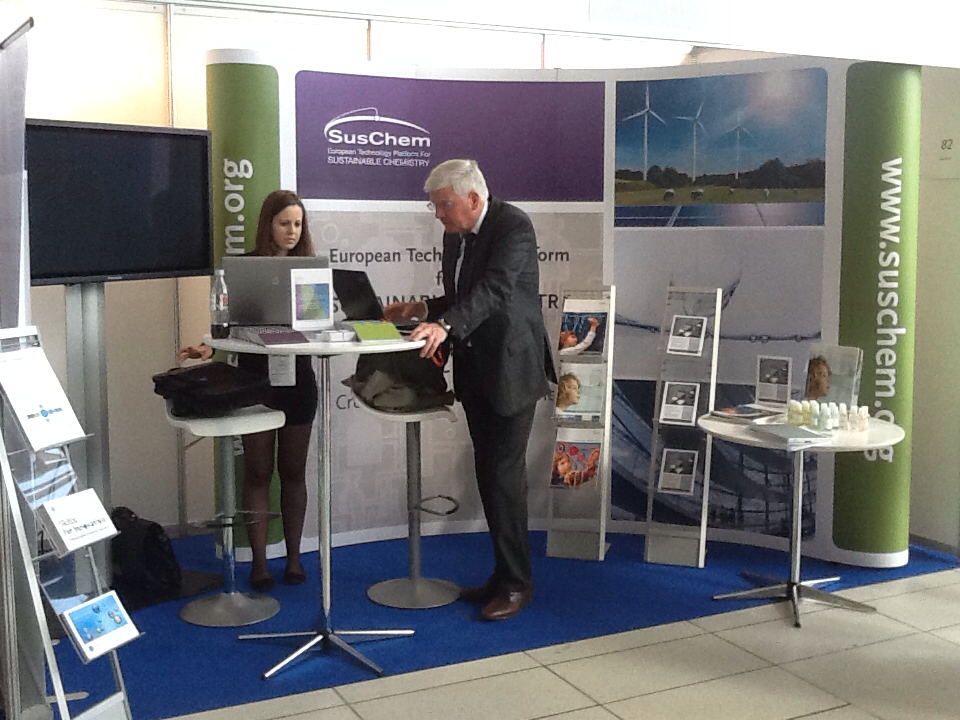
The SusChem inspired SPIRE (Sustainable Process Industry through Resource and Energy efficiency) PPP was a prominent component of many contributions at the first day of the Industrial Technologies 2012 conference in Aarhus Denmark. The SusChem stand (see below) was complemented by neighbouring booth dedicated to SPIRE and SusChem stakeholders contributed to a number of sessions.

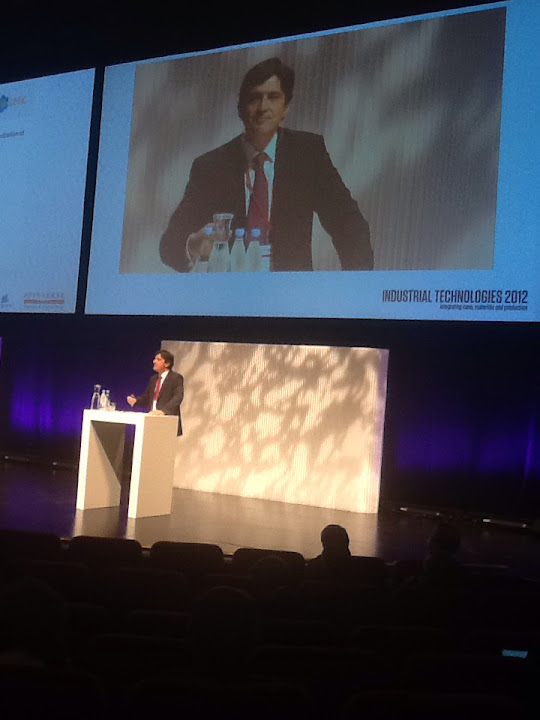
Pierre Joris of Solvay (below) contributed on behalf of SusChem to the morning plenary session on Industry and Horizon2020.

In the afternoon SusChem board member Peter Nagler from Evonik (below) introduced SPIRE and outlined its remit and current status to delegates in the Resource Efficiency session. On 28 June SPIRE will assume a legal identity in Belgium.

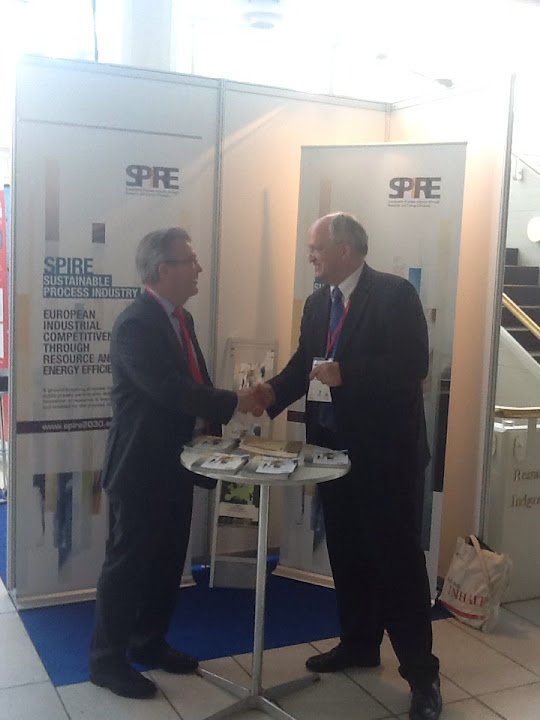
Rudolf Strohmeier, deputy director-general of European Commission's DG Research & Innovation was a visitor to both the SusChem and SPIRE stands in the afternoon. He is pictured below (left) at the SPIRE stand with Gernot Klotz of Cefic.

On Wednesday evening the conference Gala Dinner will take place. The highlight of the evening will be a competition to select the Industrial Technologies project with the highest impact. The FP6 project IMPULSE (Integrated Multiscale Process Units with Locally Structured Elements) is one of the ten projects selected for the gala final and it is a SusChem-inspired project.

Project coordinator Mike Matlosz (above) is pictured preparing for a video recording where he explains the project.

The SusChem team is looking forward to Day Two at Aarhus. To keep up to date with SusChem inspired activities at the Industrial Technologies 2012 conference follow SusChem tweets via @suschem.


Friday, 25 May 2012

SusChem Spain Annual Assembly

On June 19, SusChem Spain will celebrate its Annual Assembly at the Ministry of Economy and Competitively in Madrid. The main theme of the meeting will be current and future Public-Private cooperation opportunities as a way of improving the competitively of science and technology based business.

Following a welcome address from a ministry speaker, delegates will debate public-private cooperation opportunities in the context of both national and European initiatives. The role of SusChem in stimulating public-private initiatives will be presented and then specific opportunities coming up under the new Horizon 2020 research and innovation programme will be discussed.

The SusChem-led SPIRE Public-Private-Partnership will be presented as well as the Energy Materials Industrial Research Initiative (EMIRI) and also the Biobased Industries PPP.

Registration for the Annual Assembly is free for SusChem members. For non-members of SusChem Spain there is a participation fee of €100 (VAT not included). For more information and registration, please visit the SusChem Spain website.

Tuesday, 24 April 2012

2012 SusChem Event builds Innovation Momentum

SusChem 2012 was a resounding success. Well over 200 participants enjoyed two days of discussions and debate on future SusChem strategy and heard about progress in priority innovation activities including resource efficiency, water, critical raw materials, smart cities and education. New initiatives were launched and delegates left with a clear understanding of SusChem’s commitement to Europe’s priorities and renewed enthusiasm for the challenges ahead. A summary video of the stakeholder event can be viewed on YouTube.

The next year will be important for SusChem, sustainable chemistry and Europe as the scope and direction of Horizon 2020 and our portfolio of innovation initiatives are discussed and decided.

Summing up the two-day event Klaus Sommer, chairman of the SusChem board, stated: “SusChem has achieved excellent recognition with European institutions. We have good momentum in all our activities and a fantastic opportunity to shape our own and Europe’s future.”

The main conference session on day one had been opened with a supportive message from Prof Jerzy Buzek, MEP who conveyed his strong belief that the “real remedy [to the current economic crisis] will be found through research, development, and applied innovation and the chemical sector will play here a leading role.” He thought SusChem and other technology platforms held a key role in identifying the right ideas and ensuring that EU funds are allocated in the most appropriate manner. The full text of Prof. Buzek's message can be read here.

New initiatives

At the start of the event the 11th full SusChem National Technology Platform (NTP) was formally initiated with the launch of SusChem Belgium.

The 10th Stakeholder also saw the launch of a significant new Education initiative – ‘Educate to Innovate’ - that seeks to exploit innovation outputs from SusChem’s research and innovation projects to help enhance the innovation skills of future generations of scientists and engineers.

Sommer described the education initiative in his summary as: “an opportunity to introduce concepts of sustainability, social skills and entrepreneurship as a mind set and new paradigm into higher education.”

Workshops and plenary sessions throughout the meeting covered the four main innovation initiatives that SusChem is involved with. The road ahead and main issues were discussed. In particular for the proposed SPIRE Resource Efficiency Public-Private-Partnership had been the subject of a Dinner Debate on the evening of the first day with supportive messages from industry, public authorities and the Commission.

Strategy

On day one SusChem board member Rodney Townsend had had presented the new SusChem strategy initiative to move SusChem towards a European Technology and Innovation Platform (ETIP). On the second day he summed up initial feedback from stakeholders on proposals.

This was generally positive, but there were calls for greater clarity on economic considerations and a clearer definition of innovation. Also there were queries about how to set criteria to define sustainability and suggestion to include regional networks and standardisation into SusChem thinking. Issues such as how collaborative activities can be continued beyond the pre-competitive stage, relationships between large and small companies, and investment, merger and acquisition will all feed into the developing strategy.

Communication

Concluding the conference Sommer discussed increased stakeholder involvement in SusChem activities. He saw a need to improve communications with our National Platform network and ensure their alignment with activities on the European level. Discussion and debate between stakeholders was important in shaping policies and more time for this needed to be included in stakeholder meetings.

Sommer also promised a regular email newsletter to SusChem stakeholders to ensure everyone was up-to-date on the status of our initiatives in what was likely to be a dynamic year ahead. And he stressed that stakeholders should not hold back from sending their feedback and input to SusChem at any time – multiple channels were available (twitter, email, this blog etc) – and all input was appreciated.

Next SusChem events

SusChem will be participating strongly in the European Commission’s Industrial Technologies 2012 conference and exhibition in Aarhus, Denmark from 19 – 21 June.

The next SusChem event will be the FP7 Brokerage event on 18 September in Brussels. We look forward to seeing you there!


Photos from #SusChem2012

The 10th SusChem Stakeholder event on 17 and 18 April was filled with interesting and inspiring sessions. Here we present a small selection of photos from the event. Lots more images can be found on the SusChem website and we aim to upload all presentations in the near future.

#suschem2012 delgates
Delegates started with a coffee before an official launch of SusChem Belgium NTP and a welcome message from Prof Jerzy Buzek, MEP.

Ger Spork, #suschem2012
Ger Spork (above) of the SusChem secretariat at Cefic was the master of ceremonies for the day.

#suschem2012 Klaus Sommer
The chairman of the SusChem board Klaus Sommer of Bayer TS told the stakeholder audience that 'the future is based on chemistry'. He is pictured (above) being interviewed by Euractiv. Euractiv has produced a series of videos from the event that are available on the Euractiv website and across SusChem communication platforms in the near future.


"That's about the size of it" says Mike Pitts of the UK's CIKTN gave an entertaining and informative presentation on Critical Raw Materials on Day 1 of the stakeholder seminar. He will also feature in one of the Euractiv video interviews. Mike has already blogged his presentation here.

Rudolf Strohmeier is Deputy Director General of the European Commission's DG Research & Innovation. He made a number of interventions and presentations during the stakeholder meeting calling for a clear private commitement to the forthcoming innovation initiatives.


Friday, 16 March 2012

SPIRE, F3 show Sustainable ‘Cleantech’ Solutions

Both the SPIRE and the SusChem inspired F3 Factory project will feature at a lunchtime event at the North Rhine-Westphalia (NRW) office in Brussels on 21 March. The theme of the event is ‘Resource Efficiency. Novel Approaches – Products and Processes for a Sustainable Society’.

Global chemicals and manufacturing industries consume large quantities of non-renewable fossil-based raw materials and energy, but are at the core of our modern industrial society, developing and producing the key chemicals, materials, medicines and products that allow us to achieve ever better standards of living.

Current research and innovation trends offer significant opportunities to transform these industries into eco-efficient high-tech solution providers, by, for example, switching to bio-based feedstock, improving efficiency, recycling and reusing waste materials and looking at the industry as an integrated system.

Finding sustainable “cleantech” solutions requires a strong commitment between research and industry to establish a new paradigm in sustainable production methodology for the European chemical- and bio-industry.

SusChem inspired solutions
The event will be opened by Rainer Steffens, Head of the NRW representation to the EU, Svenja Schulze, Minister for Innovation, Science and Research in the State of North Rhine-Westphalia and Dr. Rudolf W. Strohmeier European Commission, Deputy Director-General, DG Research.

The F³-Factory (fast, flexible, future) is a FP7 project success story and an exemplary industrial case study. This original Suschem visionary project can allow the flexible, continuous production of chemical intermediates. The story will be presented by Dr. Frank Stenger of Evonik Industries and Dr. Sigurd Buchholz of Bayer Technology Services

Within the F3 project is a backbone facility: the INVITE research centre(pictured above). A joint venture with TU Dormund University its development and realisation will be told by Prof. Dr. Sebastian Engell.

Ed d‘Hooghe, Innovation Manager at Cefic will describe the Research and Innovation Public and Private Partnership (PPP) proposal, Sustainable Process Industry through Resource and Energy Efficiency (SPIRE). SPIRE aims to realise European competitiveness through improved resource and energy efficiency.

To achieve this SPIRE has the objective to develop enabling technologies and solutions along the value chain. These solutions are required to reach long term sustainability for Europe in terms of global competitiveness, ecology and employment.

The driving force behind SPIRE is the Resource and Energy Efficiency Partnership (REP) that brings together the collective expertise of more than 10 major industry sectors with strong connections to process manufacturing.

To find out more about the event contact the Representation of North Rhine-Westphalia to the European Union.

Environmental research
SPIRE, and other SusChem initiatives, will also be presented at the 20th anniversary seminar and workshop for the European Network of Environmental Research Organisations (ENERO). This all day event takes place on 29 March in Brussels.

The theme of the seminar is ‘Boosting and Securing Eco-innovations through new Partnerships’. The event will bring together key players to reflect on research organisations' role in producing sustainable innovations for the global market, and the links between environmental research and innovation.

Ed D’Hooghe will present SPIRE and other presentations will cover other areas of interest to SusChem including the bio-based chemical industry and improving water efficiency. For more information visit the ENERO website.

Wednesday, 30 November 2011

SusChem welcomes Horizon 2020 proposals


Today (November 30) the European Commission's proposal for Horizon 2020 - a key component in implementing the Innovation Union flagship under the Europe 2020 strategy - was published. The European Commission communication outlines an ambitious research and innovation programme that reflects much SusChem thinking. SusChem looks forward to supporting and fully engaging with the Horizon 2020 programme.

At the press conference to launch the 350 page programme proposal Commissioner Máire Geoghegan-Quinn described the Horizon 2020 as: “A new vision for European research and innovation in a dramatically changed economic environment. Horizon 2020 provides direct stimulus to the economy and secures our science and technology base and industrial competitiveness for the future, promising a smarter, more sustainable and more inclusive society."

She also promised that Horizon 2020 will allow "more research with less bureaucracy" by slashing red tape to reduce time to grant by 100 days compared current EU programmes.

SusChem response
Responding to the communication Gernot Klotz Executive (right) Director of R&I at Cefic and SusChem board member said: “SusChem and the chemical industry fully support this EU-wide approach to research and innovation. The significant increase in the proposed budget in comparison to FP7 is particularly welcome, especially in the area of innovation.”

“Horizon 2020 has a focus on output rather than being over prescriptive,” Klotz continued. “We support the use of bridging actions to coordinate programmes and the inclusion of pilot plant and scale-up activities that are vital to moving ideas into the market quickly.”

Such Horizon 2020 initiatives include European Innovation Partnerships (EIPs) and Public Private Partnerships (PPPs) that incorporate both research and innovation activities. SusChem is involved with the development of four proposed innovation initiatives namely, water-efficiency, resource efficiency, critical raw materials, smart cities and is especially pleased to see references in the Horizon 2020 communication in these areas that strongly reflect SusChem thinking in these areas.

SusChem is also very happy to see the strong commitment in Horizon 2020 to develop and support the concept of Key Enabling Technologies (KETs) and will contribute strongly to this area especially on advanced materials, biotechnology and nanotechnologies.

Fit for innovation
To accelerate the EU out of economic crisis SusChem believes that the whole value chain (from advanced materials and processes to consumer-focused industries) needs to be stimulated simultaneously. Horizon 2020 must support and catalyse this innovation process.

The proposals for a single set of rules for participation and dissemination are attractive, but often drivers for research and innovation are different. “We need to make sure that the research-orientated instruments used in Horizon 2020 are fit-for purpose,” says Klotz. “They also need to pass a ‘fitness-check for innovation’ and, if necessary, be adapted to ensure they address issues such as value chain inclusion and speed of implementation.”

“European Technology Platforms (ETPs), such as SusChem, could help here,” says Klotz. “The formation of advisory groups involving relevant ETPs and other stakeholder could ensure funding is most appropriately and beneficially allocated. We also think that ETPs should now function as EU Technology and Innovation Platforms covering research and innovation and education – all three components are vital for future economic success.”

SusChem is already heavily involved in establishing cross platform and cross sector research and innovation initiatives. For example it has worked closely with others to build the basis for a proposed EIP on a ‘Water Efficient Europe’ that will offer both technological solutions and the opportunity to rethink water use in Europe. The aim being to ensure water quality that is appropriate to its use is available and make sure that for this increasingly scarce resource in Europe ‘every drop counts’.


Horizon 2020
Horizon 2020 promises to be a radical departure from current EU research funding. It aims to modernise and simplify support for research and innovation around three major objectives: excellent science, competitive industries and better society.

It will focus its investments on addressing major concerns shared by all European citizens such as climate change, affordable renewable energy and ensuring a sustainable future. The proposed budget for Horizon 2020 is €80 billion and the programme will run from 2014 to 2020.

The European Commission and European Parliament members are supporting or looking to increase Horizon 2020’s proposed budget, however a number of Member States are advocating lower expenditure. An extended negotiation will now take place before programme budgets are finalised.

More information
A press summary of the Horizon 2020 proposal can be found here and a more detailed memo summary found here. The full European Commission communications on Horizon 2020 proposal communication can be downloaded here from the revamped Horizon 2020 website. To view a recording of the Commission press launch click on the embedded video link below or on the EBS website here. This video link may not be functional after December 6.

A powerpoint presentation on the Horizon 2020 proposal is also available.

Monday, 14 November 2011

Biorefinery Study Bridging Gap Between Research and Market

A study released at the European Forum for Industrial Biotechnology and the Bio-based Economy (EFIB) event in Amsterdam in October shows that Europe is well positioned to spearhead the development of a bio-based economy but must invest in demonstration activities to gain a competitive edge.

The “Biorefinery Feasibility Study” was launched by EuropaBio and nine partners, including DSM, Evonik, Genencor, Novozymes and Sud-Chemie, and undertaken by Dalberg Global Development Advisors. The study provides a blueprint for establishing integrated, demonstration scale biorefineries in the EU and recommends co-investments from public and private stakeholders to overcome the gap from research to market.

The “Integrated Biorefinery” concept was one of the original visionary projects described in SusChem’s Vision and Strategic Research Agenda. A cluster of FP7 projects are laying the knowledge-basis for such future bio-based facilities.

Vision, Value
Nathalie Moll, Secretary General of EuropaBio said: “The results present a vision, value chains and required capital investments, funding options, governance and implementation paths for demonstration biorefineries in the EU. These facilities are essential if we are to translate the full potential of our excellence in industrial biotech into smart, sustainable, marketable bio-based products and processes.”

The study provides a fact base on options and funding needs for demonstration biorefineries. It focuses on biotechnological conversion of agricultural residue, hard wood and energy crops into chemicals, materials and energy.

Biorefinery PPP?
According to the Dalberg study, diverse private sector interests mean competing sub-consortia of private and public stakeholders are likely to be most effective. The SPIRE PPP proposal that has been launched by the Resource and Energy Efficiency Partnership has included the topic of industrial biotechnology and biorefineries in their proposal and would provide excellent facilitation to access funding – including through Horizon 2020.

Other findings in the study include recommendations on the preferred location for biorefineries linked to synergies in co-location and feedstock availability. The study also outlines the need to focus on products with the highest added value, such as fuels and chemicals over heat and power, and to focus on funding for first-of-their-kind production plants and accessing funding to reduce risks to investors.

To find out more on the study and to access the full report contact EuropaBio either via Joanna Dupont-Inglis (Director, Industrial Biotechnology) or Rosalind Travers (Communications and Associations Liaison Officer).

Monday, 7 November 2011

SPIRE proposes Process Efficient Europe

A big step closer to a sustainable, smart and inclusive Europe has been made with the publication of the SPIRE (Sustainable Process Industry through Resource and Energy Efficiency) proposal for a major Public Private Partnership (PPP) for Horizon 2020 - the next EU Framework Programme for Research and Innovation.

The SPIRE proposal was developed and is driven by the Resource and Energy Efficiency Partnership (REP) involving more than 10 major process industry sectors which together represent 20% of the European economy. The high-tech process industry is a significant part of advanced manufacturing.

The main objective of SPIRE will be to bring to life, for the first time, a European innovation agenda that would look into new technologies, business models and solutions along the value chain for improved European industry competitiveness, resource efficiency and employment. SusChem has played a leading role in the development of the SPIRE proposal.

Innovative process industry for a prosperous Europe
"The SPIRE initiative is key to the rejuvenation of the EU's industrial base and to its future. It will provide the technological and non-technological tools as well as focus public-private efforts necessary to decouple economic growth from increasing use of resources," said Dr Klaus Sommer, Chair of the SusChem Board.

The consortium behind SPIRE is addressing for the first time, in addition to research, the innovation opportunities for resource efficiency from a full value chain perspective. This value chain goes from raw material suppliers, to transformative industries, such as the chemical (including industrial biotechnology) industries, to intermediate and end-user products.

"The proposal is targeted to be high impact," says Ed D'Hooghe, Innovation Manager at Cefic. "Therefore, along with technological innovation, SPIRE covers novel business models, design and branding services in a comprehensive innovation concept. It looks to include also public sector and social innovation."

SPIRE ambitions
SPIRE will bring together large corporate industry and high-tech SMEs as well as academic centres of excellence to develop innovative materials and breakthrough technologies to modernise the EU's industrial landscape.

"SPIRE can boost enterprise in Europe and create more jobs in the process and related industries including in high-tech SMEs by stimulating existing and new global markets that Europe can lead," concludes Dr. Klaus Sommer. "At the same time, citizens’ quality of life will improve as a greener, more efficient and smarter industry is built in Europe."

For more information on SPIRE and related SusChem activities contact Ed D'Hooghe at Cefic. The SPIRE proposal brochure can be downloaded here and the Executive Summary from the document can be accessed here.

Wednesday, 31 August 2011

Tomorrow starts with chemistry at EC HQ

As part of the International Year of Chemistry 2011 (IYC2011) the European Commission DG Enterprise is hosting an exhibition at the European Commission Headquarters: ‘Tomorrow starts with Chemistry’. The event will be held at the piazza of the EC’s Berlaymont building in Brussels. Earlier in the year the Berlaymont building was adorned with a giant IYC2011 banner (right).

The exhibition will take place from 5-8 September and will be officially opened on 6 September at an early evening ceremony involving EC Vice-President and Commissioner for Enterprise and Industry Antonio Tajani, Mr. Giorgio Squinzi, President of Cefic, the European Chemical Industry Council, and Prof. Ulrich Schubert, President-elect of the European Association for Chemical and Molecular Sciences (EuCheMS).

The exhibition will show how advanced materials can deliver a more sustainable future and demonstrate the fundamental role of chemistry in our everyday life via engaging exhibits and displays that will lead visitors through an experience that stimulates all the senses. Technologies such as conductive films, light and smart materials, photovoltaic cells and other renewable energy technologies will be highlighted to show how sustainable chemistry can turn science into tools for a world that is fit for the future.

It is often forgotten that chemistry is not only the basis for technologies that make our current high standard of living possible, but also the key to solving many of society’s current challenges.

Without chemistry, innovative advanced materials to build complex electronic devices, or to improve the efficiency and safety of current and future electric vehicles, solar panels or wind turbines to harness the energy of nature, new products to protect health, food and water would simply not be possible.

United effort
In its efforts to create smart growth and an economy based on knowledge and innovation, Europe needs to play to its strengths and build upon robust industrial sectors that have a track record of successful research, innovation and deployment of technology. The chemical industry is such a sector and is determined to play its part.

The chemical community is committed to support, and where appropriate lead, new public-private partnerships in key areas, such as raw materials, sustainable technologies, water efficiency and smart cities, to ensure that big and small businesses can collaborate with society to keep Europe at the forefront of innovation and sustainability and address the major challenges that society faces. The exhibition will demonstrate how many of these challenges may be addressed.

Wednesday, 13 July 2011

FP7 PPPs: An EU R&I Success Story?


This week (11 and 12 July) over 950 registered delegates met in Brussels to network, discuss past progress and future funding for the EU’s initial Public Private Partnerships (PPPs) on Factories of the Future (FoF), Energy Efficient Buildings (EeB) and the Green Car initiative in Brussels. The three PPPs seem to have worked well, increased industrial participation in FP7 and worked in a fast, efficient and flexible manner. More PPPs are planned as part of Horizon 2020.

The event held at the Charlemagne Building supported the preparation of proposals for the third tranche of cross-thematic coordinated calls by these research PPPs.

In his opening addresss Rudolf Strohmeier, Director-General of DG Research & Innovation, noted that €3.2 billion had been invested so far in the three existing PPP programmes, and a further €480 million of EU funding was available for the next call with deadline 1st December 2011. Projects responding to calls launched under the three PPPs have been characterised by significant industrial (including SME) participation compared to conventional FP7 projects.

Industry re-engaged
Massimo Mattucci speaking for the Factories of the Future PPP said that “Industry had re-engaged in FP7 through the PPPs” and that the PPP research roadmaps reflected industry needs.

Wolfgang Steiger of Volkswagen and the Green Cars initiative said that FP7 PPPs are “a real success story: an efficient, fast model that produces results.”

Jose-Lorenzo Valles from DG R&I endorsed the focus on industry in PPPs but stressed that the FP7 PPP calls were open to all. Overall the success rate for project proposals for PPP calls was higher (~20%) than for conventional FP7 projects. PPPs were of high added-value for competitiveness, more flexible (faster) than JTIs, and brought EC & industry together, with industry able to commit to long-term R&I investment.

Bruno Smets from Philips and EeB said PPPs were “not business as usual” They represent a true value chain approach. It was important to create a market and listen to the voice of the user. But improving the dissemination of programme results to whole value chain was very important.

Many speakers indicated that accurate measurement of the impact of the PPP work was important for the future. There was also a need to refine the governance of PPPs to allow for long term stability.

To coincide with the Information Days a new brochure has been published highlighting progress in the PPPs and including indicative information on the upcoming July 2011 calls for the FoF, EeB and Smart Cars PPPs.

Future of PPPs
Commissioner Máire Geoghegan-Quinn delivered the closing address at conference saying: "I am sure you will be very pleased to hear that the draft legislative proposal in preparation for Horizon 2020 will address the use of Public-Private Partnerships. It is important that there is a place for large-scale strategic actions such as PPPs with the critical mass to reach their objectives"

She also indicated how criteria for selecting the industry sectors that are most suitable for future PPPs are developing. Criteria should include:
  • Clear added value by acting at the European level

  • Demonstration of sufficient scale of impact on industrial competitiveness, sustainable growth and/or socio-economic issues

  • A long-term commitment from all parties based on a shared vision and clearly defined objectives

  • The scale of the resources involved in the proposal, and the ability to leverage additional investments in research and innovation

  • Clear defined roles for each of the partners and agreed key performance indicators
The full text of the Commissioner’s speech can be accessed here.

Herbert von Bose of DG Research had also underlined some essential characteristics for future PPPs. Commitment from industry was essential and the proposal had to be “more than just doing business together”. The Commission needed to easily understand what the ultimate goal of the PPP is – essentially what are the measurable economic or environmental impacts or objectives. PPPs need both a technology and a business roadmap. The critical question to answer is: “What does the proposed R&I investment (i.e. EU funding) bring to the citizen and society?”