The SusChem News Blog is now hosted on the SusChem website in the News Room. You will be redirected there in 10 seconds
.

Showing posts with label stakeholder event. Show all posts

Wednesday, 19 December 2018

SusChem wishes you a successful 2019!

Dear colleagues and members of the SusChem community,


The past year showed us once again the enormous challenges and changes that our world and our industry have to cope with, whilst striving to achieve sustainable development. An extended summer across Europe reminded me and many of us that CO2 emissions are still on the rise; and the issue of plastics waste became more urgent on the political agenda.

Identifying solutions to global challenges like these is achieved via science and technology – and through collaboration. This is exactly the purpose of SusChem, and I think in 2018 we made further progress in sharing a ‘European voice’ on research and innovation priorities in Sustainable Chemistry and Industrial Biotech.

One highlight was our response to Horizon Europe, the ambitious research and innovation programme that the European Commission is forging to succeed Horizon 2020.  At our annual stakeholders event in June, the potential of the contribution of SusChem and Key Enabling Technologies (KETs) under Horizon Europe was highlighted. And we initiated our consultation to build a new SusChem Strategic Innovation and Research Agenda (SIRA). I am sure the new SIRA will be a solid base for advising the European Commission on future technology priorities for Horizon Europe. Delivery of a final draft is planned in the course of 2019 – a major task for next year.

Looking back on 2018, I also well remember our brokerage event in October which was supported by keynote speakers from the Commission and also the disruptive innovation community. The event brought together some 200 European innovators to form strong consortia under open Horizon 2020 calls – a really impressive number! Also the number of national technology platforms (NTPs) rose in 2018 with the accession of Bulgaria, Finland and Sweden, so that our community now comprises 17 NTPs across Europe. 

2018 also saw SusChem making significant contributions to the innovation discussion in Europe. Our extended ‘Key Enabling Technologies in Horizon Europe’ paper was published in February, while two new white papers gave insight and recommendations on recycling of polymer composites and battery energy storage. And most recently, ‘SusChem Plastics Strategic Research and Innovation Agenda in a Circular Economy’ was published with contributions from across the full plastics value chain, as a contribution to the implementation of the EU Plastics strategy.

So 2018 was really impactful. Our key focus for 2019 will be to build on SusChem’s role as a multi-stakeholder advisory forum engaging with both academia and industry. Together we can provide a vision and direction on innovation and technology priorities in Sustainable Chemistry and industrial biotechnology to ensure the success of Horizon Europe. We therefore invite you to join us in formulating together the new SusChem SIRA!

On behalf of the SusChem Board and the SusChem secretariat, I would like to thank you all very much for your continuing commitment to our platform and activities. I wish you a relaxing Christmas break and a healthy, happy and “sustainable” New Year. We look forward to working with you on new SusChem inspired initiatives over the next 12 months!


Best wishes,


Dr Markus Steilemann
Chairman of the SusChem Board

Thursday, 12 July 2018

Watch the #suschem2018 Highlights Video

A highlights video of the 2018 SusChem Stakeholder Event (#suschem2018) is now available. On June 20, at its 16th Annual Stakeholder event in Brussels, the European Technology Platform for Sustainable Chemistry (SusChem) started the collaborative process to build a new Strategic Innovation and Research Agenda (SIRA) focusing on the forthcoming Horizon Europe framework programme.

The short video features interviews with Markus Steilemann, SusChem Chairman and CEO at Covestro AG; Signe Ratso, Deputy Director-General, Directorate Research and Innovation at the European Commission; Christine Maul, Head of Advanced Process Control Technology at Covestro; Martin Stephan, Deputy CEO at Carbios; and Bertrand Fillon, General director of research at Innovation Plastics Composites (IPC).


The SusChem stakeholder event was a great opportunity to underline SusChem’s role and vision under Horizon Europe. The keynote speech given by the European Commission presented the novel elements and opportunities in the new framework programme (2021-2027). Focusing on priorities for advanced materials, advanced processes and associated digital technologies, the initial task of identifying technology priorities was initiated. The SusChem innovation ecosystem was also boosted by the addition of three new National Technology Platforms (Bulgaria, Finland and Sweden). The day was completed with a lively and provocative panel discussion on how to leverage the strength of the innovation ecosystem as a whole to boost the competitive position of Europe in Research and Innovation.

Wednesday, 27 June 2018

#suschem2018 starts defining technology priorities for Horizon Europe

On 20 June, at its 16th Annual Stakeholder event (#suschem2018) in Brussels, the European Technology Platform for Sustainable Chemistry (SusChem) started the collaborative process to build a new Strategic Innovation and Research Agenda (SIRA) for Horizon Europe.

The SusChem stakeholder event was a great opportunity to underline SusChem’s role and vision under Horizon Europe. The keynote speech given by the European Commission presented the novel elements and opportunities in the new framework programme (2021-2027). Focusing on priorities for advanced materials, advanced processes and associated digital technologies, the initial task of identifying technology priorities was initiated. The SusChem innovation ecosystem was also boosted by the addition of three new National Technology Platforms (Bulgaria, Finland and Sweden). The day was completed with a lively and provocative panel discussion on how to leverage the strength of the innovation ecosystem as a whole to boost the competitive position of Europe in Research and Innovation.


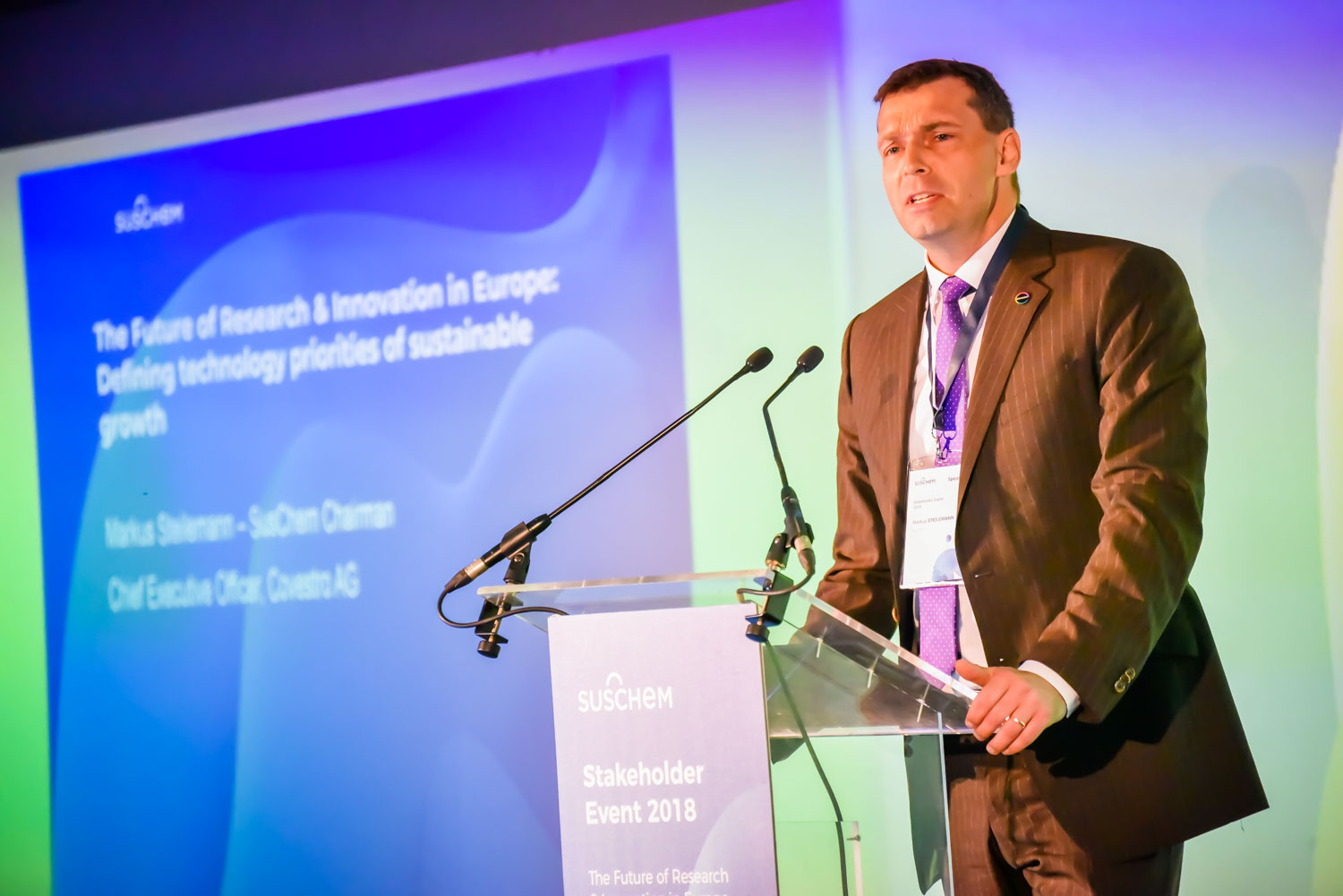
An opening keynote speech by Markus Steilemann, CEO of Covestro and SusChem chairman (pictured above), described the role of SusChem as: “responding to global challenges and EU priorities” by providing “innovation solutions based on sustainable chemistry.”

He also emphasised SusChem’s significant role in enabling a highly collaborative research and innovation environment by bringing together industry including small and medium-sized enterprises, academia and Research and Technology Organisations (RTOs) at a European level whilst connecting with regional and national programmes through its expanding network of National Technology Platforms (NTPs).

Steilemann called on all SusChem stakeholders to voice their priorities and help define the technology priorities for the next SusChem SIRA. The next SIRA will be a solid base for advising the European Commission on high-impact missions and priorities for Horizon Europe. SusChem will remain an active and engaged partner of the European Commission.

“We have demonstrated that SusChem enables the development of sustainable technologies that lead to sustainable products,” he concluded.

Horizon Europe
A second keynote speech was given by Ms. Signe Ratso, Deputy Director General at the Commission’s DG Research & Innovation (pictured below), focusing on the proposal for the next Research Framework programme: Horizon Europe.


Ratso sees Horizon Europe as our chance to shape the future: “Europe has world-class research and strong industries – our knowledge and skills are our main resources – but Europe fails to transform leadership into leadership in innovation and entrepreneurship.” Horizon Europe – although an “evolution rather than revolution” aimed to address that.

Key novelties in the programme proposal were the increased support for breakthrough innovation (via mission-oriented research), the ambition to create more impact, and a more strengthened international cooperation. Horizon Europe also aims to reinforce openness.

In terms of the ‘missions’ concept, Ratso underlined the need for missions to connect with citizens and be “bold and inspirational” while having measurable goals that could be achievable in around a ten-year time frame. Activities in missions should be across-sectors, involve actors from different disciplines and work along value chains. She invited all partners to work together on further shaping Horizon’s Europe missions and looked forward to SusChem’s input to the programme.

Defining technology priorities
One of the main focus points of the event was to start the consultation process to build the new SusChem Strategic Innovation and Research Agenda (SIRA). Two parallel breakout sessions covered advanced materials and advanced process technologies. Both sessions considered the role of Digital Technologies as an enabler for designing better performing materials and processes. More specifically, the sessions initiated the debate on technology priorities and looked to identify experts who could contribute to the development of the next SIRA.

The materials session focused on three thematic clusters: circularity for materials; energy storage, production and efficiency; and functionality and performance. The advanced process technology themes were: digital technologies for process design and control, waste as feedstock, fossil-based feedstock, biobased feedstock, and CO2 as feedstock. The sessions identified technology clusters that require further attention as well as the following broad issue areas: sustainability assessment; skills, consumer awareness, and education and training.


All the input gathered at #suschem2018 will be assessed and processed further to form the basis of the new SIRA together with additional expert input from SusChem working groups that are currently being set-up.

Expanding ecosystem
The SusChem National Technology Platforms discussed how they approached stakeholder engagement in their countries and gave examples of the successful formation of consortia and transnational collaborations. Moreover, they reflected on how to enhance their role even further together with the SusChem ETP. Representatives from nine of SusChem’s 17 NTPs were involved in the debate moderated by Susanne Coles (SusChem UK).

The session was also a great opportunity to present the three new national platforms – Bulgaria, Finland and Sweden - that were approved for membership by the SusChem board the day before the event. SusChem also welcomed Andreas Falk (SusChem Austria) as the new Chair of the NTPs network for the following year.


#suschem2018 concluded with a wide-ranging debate, led by Marco Mensink Director General of Cefic, which explored the priorities required to maintain Europe’s leading role in global innovation and how the structure of Horizon Europe can mobilise our innovation ecosystems. The panel included Peter Dröll, Director Industrial Technologies at Commission’s DG Research & Innovation, Prof. Ferdi Schüth, Vice-President of the Max-Planck-Society, Kateřina Šebková, Director of the Stockholm Regional Centre for Central and Eastern Europe, Martin Stephan, Deputy CEO of CARBIOS, and Olaf Wachsen, Head of Group Process Technology, Clariant.

Panel members called for the continuation of enduring partnerships and collaborations created through programmes like Horizon 2020, which were considered more valuable than the funding per se. They suggested that Horizon Europe could be seen as a part of the EU’s vision to reindustrialise Europe.  The continuation of Key Enabling Technologies (KETs) and the need to bring together all of the bright minds of Europe, were other prominent points stressed by the panel, no country can bring about change alone.

Future path
#suschem2018 has successfully set the course to develop the next SusChem SIRA. It has continued the vibrant dialogue with our platform’s stakeholders and the European Commission on future orientations for sustainable chemistry research and innovation to enable the development of technologies and that will meet EU global challenges.


The process continues at the next major SusChem event: our 2018 Brokerage event that will be held on 23 October 2018 at Hotel Le Plaza, Brussels and will cover later sustainable chemistry relevant calls for Horizon 2020. Save the date!

Wednesday, 20 June 2018

#suschem2018: Defining technology priorities for sustainable growth in Europe

Today (20 June, 2018() the European Technology Platform for Sustainable Chemistry (SusChem) holds its annual Stakeholder event (#suschem2018) in Brussels. The event brings together global audiences, senior players from the chemical and biotechnology industries, academia, research and technology organisations (RTOs) and EU institutions to address common challenges and discuss priorities crucial to the sustainability of the European chemical and biotechnology innovation sectors. 

The theme for #suschem2018 is ‘The Future of Research & Innovation in Europe: Defining Technology Priorities for Sustainable Growth’.

This year’s opening keynote speeches will be presented by SusChem Chairman Dr. Markus Steilemann, Chief Executive Officer of Covestro, and Signe Ratso, Deputy Director-General for Research and Innovation at the European Commission. 

The event will culminate with a high-level debate on how the SusChem community can leverage the strength of the innovation ecosystem to boost research and innovation in Europe and deliver real socio-economic impact through the next European Research Framework Programme (Horizon Europe)

SusChem Chairman Dr. Markus Steilemann said:
“SusChem welcomes the room given to industry in the first proposal of Horizon Europe and calls for continued support for Key Enabling Technologies (KETs) as drivers of innovation. Especially advanced materials and processes enhanced by digitalisation technologies and combined with new business models are considered key areas for investment and growth. SusChem can and will substantially contribute to this development. We believe that sustainable chemistry and its innovation ecosystem in Europe – consisting of businesses of all sizes, academia and associations – can  thrive well in the Open Science and Open Innovation Pillars of Horizon Europe.”
What’s happening?
In the morning, the event will kick off with the plenary presentations from Steilemann and Ratso, followed by two parallel breakout sessions on future research and innovation priorities for SusChem and Horizon Europe, including discussions on potential missions. The two sessions will cover:

  • Creating the future with advanced materials: What are your priorities?
  • Creating the future with advanced process technologies: What are your priorities?

Both sessions will also deal with the question of how emerging digital technologies can be integrated to enhance impact in these areas. 

In preparation for Horizon Europe, SusChem presented its position on the role of Key Enabling Technologies in a white paper outlining the major technology developments and initiatives needed to create advanced materials, develop advanced process technologies and leverage them by the implementation of digital technologies.

Innovation ecosystem
In the afternoon, the participants will hear from the SusChem National Technology Platform (NTP) network on their successful stakeholder engagement strategies and we will welcome three new NTPs (Bulgaria, Finland & Sweden). A high-level panel discussion will follow on how to leverage the strength of the innovation ecosystem to boost research and innovation in Europe, especially in the context of KETs and Horizon Europe.

The panel will be moderated by Cefic Director General Marco Mensink and will feature contributions from Peter Dröll, Director Industrial Technologies at DG RTD, Prof. Ferdi Schüth, Vice-President of the Max-Planck-Society, Kateřina Šebková, Director of the Stockholm Regional Centre for Central and Eastern Europe, Martin Stephan, Deputy CEO of CARBIOS, and Olaf Wachsen, Head of Group Process Technology, Clariant.

#suschem2018 takes place at the Thon Hotel City Centre, Brussels, Belgium on 20 June. A full programme for the event is available here.

Wednesday, 13 June 2018

Spotlight on Digital Technologies at #SusChem2018

Join us at the 2018 SusChem Stakeholder Event - #SusChem2018 - your number one destination for innovation policy dialogue and debate this summer. The 2018 Stakeholder event takes place at the Thon Hotel City Centre in Brussels on 20 June 2018 and will give you the opportunity to voice your priorities and help define SusChem’s input into the next EU Framework Funding Programme: Horizon Europe.

This year’s theme is "The Future of Research & Innovation in Europe: Defining Technology Priorities for Sustainable Growth" and will bring together global audiences, senior players from the chemical industry, academia, research technology organisations (RTOs) and EU institutions to address common innovation challenges and debate priorities crucial to the sustainability of the European chemical and biotechnology sectors.

At the event Stakeholder input will be collected through two carefully designed parallel breakout sessions: one on Advanced Materials and the other on Advanced Process Technologies. Input from both sessions will contribute to our future strategic research and innovation agenda beyond 2020.These two technology areas are complimented by Digital Technologies and will also feature at #SusChem 2018.

Spotlight on Digital Technologies
The chemical industry is an enabler for the continuous development of smarter and more sustainable electronic devices and equipment in other industries. The chemical industry is itself being transformed and disrupted through digitalisation. We have a real opportunity to leverage the immense capabilities of information and communication technologies (ICT) to optimise our processes and improve our production efficiency. Watch our social spotlight video ‘LEVERAGE’ with Martin Winter from the SusChem Management Team.


Watch out for our other Social Media Spotlights on Advanced Materials (CREATE) and Advanced Processes (MAKE).

All three of these SusChem Key Enabling Technologies (KETs) featured in SusChem’s recent white paper on the potential for KETs in Horizon Europe. The white paper outlined the major technology developments and initiatives needed to ‘create’ advanced materials, ‘develop’ advanced process technologies and ‘leverage’ digital technologies.

Debate at #SusChem2018
All three SusChem KETs will be debated and discussed at #SusChem2018. Our keynote speakers include: Signe Ratso, Deputy Director-General – Directorate Research and Innovation (RTD), EU Commission; Joanna Dupont-Inglis, Director of Industrial Biotechnology at EuropaBio, and SusChem Board Member; Markus Steilemann, Chief Commercial Officer & Member of Management Board, Covestro and Chair of the SusChem Board; and Marco Mensink, Director General of Cefic, the European Chemical Industry Council.

Register today for a chance to define the technology priorities needed to shape Europe’s sustainable future. You can download a full list of speakers here.

Wednesday, 16 May 2018

Spotlight on Advanced Process Technologies at #SusChem2018

Join us at the 2018 SusChem Stakeholder Event - #SusChem2018 - your number one destination for innovation policy dialogue and debate this summer. The 2018 Stakeholder event takes place at the Thon Hotel City Centre in Brussels on 20 June 2018 and will give you the opportunity to voice your priorities and help define SusChem’s input into the next EU Framework Funding Programme: Horizon Europe.

This year’s theme is "The Future of Research & Innovation in Europe: Defining Technology Priorities for Sustainable Growth" and will bring together global audiences, senior players from the chemical industry, academia, research technology organisations (RTOs) and EU institutions to address common innovation challenges and debate priorities crucial to the sustainability of the European chemical and biotechnology sectors.

At the event Stakeholder input will be collected through two carefully designed parallel breakout sessions: one on Advanced Materials and the other on Advanced Process Technologies. Input from both sessions will contribute to our future strategic research and innovation agenda beyond 2020.

Spotlight on Advanced Process Technologies
Advanced Process Technology developments are crucial to the transition to a more circular, energy efficient, and carbon neutral industry and feature at #SusChem2018. Watch our social spotlight video 'MAKE' on Advanced Processes with Sophie Wilmet from the SusChem Management Team:


Watch out for future Social Spotlights on Advanced Materials (CREATE) and Digital Technologies (LEVERAGE).

All three of these SusChem Key Enabling Technologies (KETs) featured in SusChem’s recent white paper on the potential for KETs in Horizon Europe. The white paper outlined the major technology developments and initiatives needed to ‘create’ advanced materials, ‘develop’ advanced process technologies and ‘leverage’ digital technologies.

SusChem speakers
Our keynote speakers include: Signe Ratso, Deputy Director-General – Directorate Research and Innovation (RTD), EU Commission; Joanna Dupont-Inglis, Director of Industrial Biotechnology at EuropaBio, and SusChem Board Member; Markus Steilemann, Chief Commercial Officer & Member of Management Board, Covestro and Chair of the SusChem Board; and Marco Mensink, Director General of Cefic, the European Chemical Industry Council.

Register today for a chance to define the technology priorities needed to shape Europe’s sustainable future. You can download a full list of speakers here.

Tuesday, 3 April 2018

Define Technology Priorities for Sustainable Growth at #suschem2018

Registration is now open for the 2018 SusChem Stakeholder Event, The Future of Research and Innovation in Europe: Defining Technology Priorities for Sustainable Growth, which will be held at the Thon Hotel City Centre in Brussels on 20 June 2018.

In light of the forthcoming European Commission (EC) communication on the Multiannual Financial Framework (MFF) and the overall structure of the next R&I Framework programme (FP9), this year’s stakeholder event happens at a critical moment in the EU’s policy cycle. This presents a significant opportunity for SusChem  stakeholders to voice their reactions and expectations to the Commission on the strategy and direction of the key policies that have direct implications for the priorities of chemical sector.

The exciting programme for the 2018 SusChem Stakeholder event will give participants opportunities to voice their priorities and help shape SusChem’s input into FP9 and our next Strategic Innovation and Research Agenda (SIRA).


Event highlights include:

  • Two parallel breakout sessions on priorities for Advanced Materials and advanced process technologies  (download details)
  • A lively high-level panel debate to discuss first insights on the upcoming Framework Funding Programme (FP9) and how it can accelerate breakthrough innovation in Europe, and
  • The impact of innovation around Europe presented by SusChem National Technology Platforms
Register today!
You can access the draft agenda for the 2018 SusChem Stakeholder event here and you can register for the event from the event page on the SusChem website.

See you in Brussels on 20 June! Spread the word using #suschem2018

Wednesday, 28 June 2017

#suschem2017 in tweets

We've assembled the story of the SusChem Stakeholder event on June 8 as told through twitter! Enjoy!


Please feel free to share with your colleagues.

Thursday, 8 June 2017

#suschem2017 - Sustainable chemistry: Accelerating innovation and impact in Europe

Today, 8 June, 2017, the European Technology Platform for Sustainable Chemistry (SusChem) will be holding its annual Stakeholder event (#suschem2017) in Brussels. The event will bring together global audiences, senior players from the chemical and biotechnology industries, academia, research technology organisations (RTOs) and EU institutions to address common challenges and debate priorities crucial to the sustainability of the European chemical and biotechnology innovation sectors. The theme for #suschem2017 is ‘Accelerating innovation and impact in Europe: Shaping expectations and priorities for the next EU Framework Programme’.

The SusChem Stakeholder event is the platform’s biggest and most influential event and will culminate with a high level debate on how Europe can accelerate innovation and deliver real socio-economic impact through the next European Research Framework Programme (FP9). There will also be updates from SusChem’s network of National Technology Platforms and the launch of new SusChem branding at the event. All participants will get a chance to give input to the proceedings through parallel breakout workshops.
SusChem Chairman Dr. Klaus Sommer said: “Our SusChem 2017 Stakeholder event will provide input on success factors for innovation impact, how to better stimulate SMEs to engage with FP9 and which new instruments might be required in FP9, amongst other topics. This is exactly the role that a European Technology Platform like SusChem should play, continuing our role as thought leaders for sustainable chemistry Research & Innovation in Europe.”
What’s happening?
In the morning, the event will kick off with plenary presentations from Peter Droell, Director at European Commission DG Research and Innovation for Industrial Technologies and Dr. Klaus Sommer, Chairman of the SusChem Board. The SusChem communications team will also present the SusChem rebranding project.

Participants will then split into three parallel breakout workshop sessions. The three breakout session topics are:
  • Defining success factors for EU funded projects to optimise innovation impact and value for Europe. How can we maximise the market uptake and impact of EU funded project results by examining success learnings from projects?
  • SMEs as a driver of the EU innovation ecosystems: How can we stimulate market-creating innovation through SME funding? This breakout session will try to identify the right mechanisms and ways to enhance their engagement in European public funding.  
  • Shaping funding instruments to accelerate innovation and competitiveness in Europe. This breakout session we will examine the strengths and weaknesses of the design and structure of EU innovation funding instruments by sharing experiences with Horizon 2020.
FP9 debate
In the afternoon SusChem stakeholders will receive updates from the SusChem NTP network and feedback from the breakout sessions before a high-level panel discussion will examine how to accelerate innovation and deliver impact in the forthcoming FP9 programme.
“The SusChem platform has made a significant contribution to the formulation, execution, implementation and success of the FP7 and Horizon 2020 European research and innovation programmes. The forthcoming FP9 programme is a great opportunity to ensure that this success continues for the benefit of European industry and society in general. For this it is essential that the outcomes of successful projects are widely implemented to achieve tangible impact.” concludes Sommer.
The panel will be moderated by Cefic Executive Director for Research and Innovation Pierre Barthelemy and features contributions from Prof. Michael Matlosz, President and Chief Executive Officer of the French National Research Agency (ANR), Angels Orduña, the SPIRE PPP Executive Director, Iryna Sukhotska, Head of Public Affairs and R&D Project Management at Biopolis, Ulrich Kuesthardt, SusChem Board Member and CIO at Evonik, Muriel Attané, Secretary General of EARTO and Kurt Vandenberghe, Director for Policy Development and Coordination at DG Research and Innovation.


#suschem2017 takes place at the Crowne Plaza Hotel, Brussels, You can access the full programme for the event is available here.

Wednesday, 19 April 2017

SusChem 2017 Registration - Lets do it!

Our most influential annual event – the SusChem Stakeholder event – is now open for registration. The 2017 event takes place on 8 June at the Crowne Plaza Hotel, Brussels and will bring together global audiences, senior players from the chemical industry, academia, research technology organisations (RTOs) and EU institutions to address common challenges and debate priorities crucial to the sustainability of the European chemical and biotechnology innovation sectors. This year’s theme is ‘Accelerating innovation and impact in Europe: Shaping expectations and priorities for the next EU Framework Programme’.

Registration is easy. Cefic Innovation manager and member of the SusChem secretariat show you how the registration launch happened - and how to sign up for the sustainable chemistry event of the year!


Thursday, 13 April 2017

Registration for SusChem Stakeholder event 2017 is open!

Our most influential annual event – the SusChem Stakeholder event – is now open for registration. The 2017 event takes place on 8 June at the Crowne Plaza Hotel, Brussels and will bring together global audiences, senior players from the chemical industry, academia, research technology organisations (RTOs) and EU institutions to address common challenges and debate priorities crucial to the sustainability of the European chemical and biotechnology innovation sectors. This year’s theme is ‘Accelerating innovation and impact in Europe: Shaping expectations and priorities for the next EU Framework Programme’.


In the morning plenary presentations will be given by Peter Droell, Director at DG Research and Innovation for Industrial Technologies and Dr. Klaus Sommer, Chairman of the SusChem Board and the SusChem communications team will also present the SusChem rebranding project.

Breakout sessions
Participants will then split into three parallel breakout workshops. There will be two sessions held either side of the morning coffee break and delegates will be asked to select two of the three topics at registration.

The three breakout session topics are:

  • Defining success factors for EU funded projects to optimise innovation impact and value for Europe How can we maximise the market uptake and impact of EU funded project results by examining success learnings from projects? Exemplary projects will share relevant success factors and critical learnings and all stakeholders will have an opportunity to share their views on collaborative projects and how they can be designed to optimise impact.
  • SME’s as a driver of the EU innovation ecosystems: How can we stimulate market-creating innovation through SME funding? Chemical and biotechnology SMEs are key enablers of innovation. This breakout session will try to identify the right mechanisms and ways to enhance their engagement in European public funding.  The session will examine current policies drivers, funding requirements and barriers to the commercialisation of SME innovation.
  • Shaping funding instruments to accelerate innovation and competitiveness in Europe Competitiveness relies on the capacity to create added value.  In this breakout session we will examine the strengths and weaknesses of the design and structure of EU innovation funding instruments by sharing experiences with Horizon 2020. Together, we will identify a short list of ideas and recommendations for the EU Commission in the evolution and design of the next EU Framework Programme.

FP9 debate
After lunch SusChem stakeholders will receive updates from our National Research Platform (NTP) network and feedback from the breakout sessions before a high-level panel discussion that will examine how to accelerate innovation and deliver impact in the upcoming Framework Funding Programme (FP9).

The panel will be moderated by Cefic Director General Marco Mensink and will feature contributions from Prof. Michael Matlosz, President and Chief Executive Officer of the French National Research Agency (ANR), Cosimo Franco, CEO of Endura, Angels Orduña, the SPIRE PPP Executive Director, Ulrich Kuesthardt, SusChem Board Member and CIO at Evonik, and Kurt Vandenberghe, Director for Policy Development and Coordination at DG Research and Innovation.

Following a summing up of the day’s activities and outcomes, the SusChem Stakeholder event 2017 will conclude – as ever – with a networking cocktail reception.

For more details, please visit the event website or register direct by clicking here. In the meantime why not catch up with the highlights of the 2016 SusChem Stakeholder event!


Tuesday, 13 December 2016

2016 SusChem End of Year Message

Dear colleagues and members of the SusChem community,

The year 2016 represented a significant milestone for SusChem. Together we defined five main priority areas for our research and innovation activities in sustainable chemistry -  Sustainable bio-economy, ICT for processes, Water, Catalysis and Processes, and Materials for Energy  -  and developed a comprehensive plan for following up other important topics.

During the year a number of SusChem inspired projects delivered significant results, most notably the E4Water project, that demonstrated the very tangible impact of our research and innovation agenda. 2016 also saw SusChem act to facilitate enhanced collaboration and cooperation between the two SusChem inspired Public Private Partnerships: the BBI Joint Undertaking and SPIRE.

We successfully held our annual Stakeholder event in June, as usual in Brussels, and a very successful Brokerage event in Seville in September during the 6th European Chemical Congress. New Working Groups were created and substantial and significant input, based on the needs of our sector, was gathered, delivered to the European Commission and well received by them. Moreover, our network of National Technology Platforms expanded to include a record number of fourteen Member States.

Towards the end of the year we launched our new SusChem identity at a reception in the European Parliament. This rebranding campaign will continue into 2017 including a revision of the SusChem website.

But above all, the greatest success factor for SusChem in 2016 was YOU! Your commitment, trust and involvement strengthened SusChem and motivated the platform in its mission to represent the significant sustainable chemistry research and innovation efforts of the Chemical Industry within the chemical science community, to the European Institutions, and beyond.

On behalf of the SusChem Board and the SusChem secretariat, I would like to thank you for your continuing engagement and we wish you all very happy and relaxing holidays and a healthy, happy and “sustainable” New Year. 2017 will be another important year for SusChem and we look forward to working with you on new SusChem inspired initiatives over the next 12 months.

Best wishes,


Dr Klaus H. Sommer
Chairman of the SusChem Board

Thursday, 16 June 2016

Sustainable Chemistry: Innovation for Competitiveness

Today (16 June) at its annual Stakeholder event (#suschem2016) the European Technology Platform for Sustainable Chemistry (SusChem) will discuss how sustainable chemistry can continue to deliver  innovation for competitiveness for Europe. The SusChem Stakeholder Event is the biggest annual event held by the technology platform and brings together the chemical industry, academia, Research Technology Organisations (RTOs) and EU policy representatives to address common challenges and debate priorities in the European chemical and biotechnology innovation sectors.

SusChem Chairman Dr. Klaus Sommer (right) said: “In the context of the European Commission Innovation Strategy and the recently published action plans on the Circular Economy, Energy Union and Digitisation, this year’s Stakeholder Event will highlight the role of the European chemical industry in five innovation priority areas. These areas are Sustainable bio-economy, ICT for processes, Water, Catalysis and Processes, and Materials for Energy and were identified through intense discussions during our 2015 Stakeholder Event.”
                                                                                     
“Progress in these areas, as an integral part of the SusChem Strategic Innovation and Research Agenda (SIRA), will be discussed in two panel debates. These discussions will help us to identify new opportunities and synergies and define priorities. The outcomes will help to create a shared view between the Chemical Industry and the European Commission on future research and innovation actions in the European chemical and biotechnology sectors. This will then be quality input for the next calls under the Horizon 2020 programme and other European and national collaborative research and innovation initiatives. This is exactly the role that a European Technology Platform like SusChem should play” he continued.

What is happening?
This year’s event will include a number of exciting activities and present important new developments for the SusChem community, including two lively high-level panel debates to discuss the recently published European Commission Innovation Strategy packages: Circular economy and the Energy Union and Digitisation.

Strategic topics related to SusChem funding and its programme will be described by Rudolf Strohmeier, former Deputy Director General of DG Research and Innovation, and this will be followed by SusChem chairman Dr Klaus Sommer presenting on 'Implementing the new SIRA: Status and priorities'.

Delegates will receive updates from working groups on the five main SusChem research and innovation priorities of Water; ICT for processes; Processes & Catalysis; SustainableBioeconomy; and Materials for Energy management.

SusChem's network of National Technology Platforms (NTPs) will also present and demonstrate their vital role in the SusChem eco-system by leveraging national government funds, working with SMEs and initiating cross border cooperation. 

Plenary debates
The afternoon sessions will be dominated by two plenary discussions on Circular economy and the Energy Union and Digitisation that will bring together strategy experts from the European Commission and captains of industry to discuss the hot topics surrounding these EC packages including:
  • Identifying new challenges and opportunities for sustainable chemistry ;
  • Identifying areas of consensus that align with the priorities of the EC and the European chemical industry; and
  • Defining new ways forward to ensure that the five SusChem innovation priorities identified are systematically considered in these two new high-level policy initiatives.
 The first plenary debate will examine the “Circular Economy” and be moderated by Pierre Barthélemy, Executive Director of Research and Innovation at Cefic. Contributions from the European Commission will come from Reinhard Buescher, Head of Unit 'Chemicals' at DG Internal Market, Industry, Entrepreneurship and SMEs (GROW), and Waldemar Kuett, Head of Unit 'Biobased Products and Processes' at DG Research and Innovation (RTD).

On the industry side the panellists are Reinier Grimbergen, Director Science to Innovate at DSM, Gloria Gaupmann, Public & Regulatory Affairs Manager, Group Biotechnology at Clariant, Anton Valero, General Manager of Dow Chemical Ibérica, and Greet van Eetvelde, Head of Energy & Innovation Policy at INEOS.

The second plenary debate will cover “Energy Union & Digitisation.” Alexis Bazzanella, Head Research & Project Coordination at DECHEMA e.V. is the moderator and panellists for the Commission are Khalil Rouhana, Director for 'Components & Systems' at DG Communications Networks, Content and Technology (CNECT), Marie Donnelly, Director for 'Renewables, Research and Innovation, Energy Efficiency' at DG Energy (ENER) and Helene Chraye, Head of Unit 'Advanced Materials and Nanotechnologies' at DG Research and Innovation (RTD).

On the industry side are Jens Rieger, Senior Vice President at BASF, Henrike Gebhardt, Senior Manager Scientific Relations at Evonik Industries AG, and Nicolas Cudre-Mauroux, Research & Innovation Group General Manager (CTO) at Solvay.

Event objectives
The SusChem Stakeholder Event is an annual high-level initiative that aims to:
  • Improve dialogue between our stakeholders;
  • Identify innovation drivers for the future;
  • Present the European chemical industry as a solution provider to address societal challenges;
  • Promote a common view between the chemical industry and the European Commission to increase synergies and develop shared solutions on innovation priority areas.
You can follow the SusChem Stakeholder event using the hashtag #suschem2016 The event takes place at the Hotel Bloom in Brussels, Belgium. The full programme for the event is available here: http://bit.ly/1On0L2A

Tuesday, 7 June 2016

SusChem Stakeholder 2016: Materials focus

This year’s SusChem stakeholder event takes place on 16 June in Brussels. One of the areas for discussion at the stakeholder event will be Materials. In this blog Anne Chloe Devic (pictured below right), Cefic Innovation Manager responsible for this SusChem priority area, outlines the field, its many areas of innovation for sustainable chemistry and how you can participate in the discussion at #suschem16.

Materials is one of the five SusChem priority areas for innovation. There are at least two European Commission policy areas that relate closely to materials. One is ‘Closing the loop - An EU action plan for the Circular Economy’ and the second is the Energy Union with its Strategic Energy Technology (SET) plan. SusChem has defined its priority areas for research and innovation in materials as materials for energy efficiency, materials for low carbon electricity production, and materials for energy storage.

However, these three application areas remain very wide and SusChem wants to narrow down the priorities in order to maximise impact. Therefore SusChem is looking to engage its stakeholders to support and contribute to refining and defining the top priorities for sustainable chemistry in the materials domain.

In the next few month a SusChem working group, currently being formed, will discuss and propose the priorities that SusChem will put forward for inclusion in future calls of Horizon 2020 (and beyond) and other European and National collaborative research and innovation programmes.

Materials and Energy
The chemical industry is a key solution provider for many value chains and other industry sectors that are aligned with the priorities outlined in the fifth pillar (research and innovation) of the Energy Union.

Sustainable chemistry provides technologies and advanced materials for:

  • Enabling the EU to be a world leader in renewable energy. This includes providing advanced materials 
    • for sustainable production of renewable electricity, for example new composites for wind turbine blades and materials for photovoltaic technologies that include the recycling of these materials, 
    • for energy storage, for example: electrical energy storage - materials for advanced batteries; chemical energy storage - advanced materials and process technologies such as H2 and CO2 based energy carriers via power-to-gas and power-to-liquid technologies; and thermal energy storage - phase change materials or reversible thermochemical reactions.
  • Efficient energy conservation solutions to make the future and existing building stock energy neutral. This includes: advanced materials for thermal insulation, efficient lighting, and phase change materials amongst others.
  • More sustainable transport systems through the use of lightweight materials as a solution to enable lower carbon transport. This includes innovation in ‘light-weighting’ technologies in terms of both materials and process technologies that can play a vital role to improve fuel efficiency and reduce CO2 emissions in transport. Composite materials, such as fibre reinforced plastics (FRP that can be carbon or glass reinforced) have a significant potential for weight reduction in vehicles. They can offer light weight benefits in comparison to other structural metallic materials, while maintaining high mechanical properties. In addition hybrid materials, combining composites and metals, with appropriate joining technologies, can reduce vehicle weight. Materials development for more fuel efficient tyres and advanced battery technologies are also important.

Materials and the Circular Economy 
The development of innovative advanced materials by the chemical sector is essential to enable a better use of existing resources along the whole life cycle of products and services, and to develop new production and recycling process paths.

The development of materials enabling ‘eco-design’ of products is required to address very demanding requirements in terms of performance in downstream applications, including better recyclability. New technological development of materials is often carried out by the chemical industry in collaboration with its value chain partners to provide improved / desired material characteristics and to enable more recyclable end-use products.

For this design and development process to be effective, sustainability assessment over the whole life cycle of the product needs to be considered. The evaluation of environmental impact should consider all environmental aspects including energy and water.

Stakeholder discussions
A highly interactive debate is expected at the Stakeholder event on 16 June and your questions and expectations on the outcomes for the panel debates, in particular on materials for energy, are welcome in advance.

Registration for the 2016 SusChem Stakeholder event is still open, but will be closing soon. This dedicated registration website includes all the information you will need to attend the event.

You are invited to submit your questions and comments and also your expectations for outcomes as part of the registration process. You can submit your questions and comments when you register and there will also be a link for question submission sent with the registration confirmation email.

Wednesday, 1 June 2016

SusChem Stakeholder 2016: Bioeconomy focus

This year’s SusChem stakeholder event takes place on 16 June in Brussels. One of the areas for discussion at the stakeholder event will be SusChem and the sustainable bioeconomy. In this blog Flavio Benedito, SusChem secretary and Cefic Innovation Manager (pictured below) responsible for this SusChem priority area, outlines the field, its many areas of innovation for sustainable chemistry and how you can participate in the discussion on the sustainable bioeconomy at #suschem16.

A sustainable bioeconomy is one of the five SusChem priority areas for innovation. The European Commission sees the bioeconomy as Europe's response to the key environmental challenges that the world is facing today. Promoting the bioeconomy will help to reduce Europe’s dependence on natural resources, transform manufacturing, promote sustainable production of renewable resources and encourage their conversion into food, feed, fibre, biobased products and bioenergy, while growing new jobs and industries.

Over the coming decades, the world will witness increased competition for limited and finite natural resources. A 70% increase of the world food supply will be  required to feed the nine billion global population by 2050.

A transition will be needed towards an optimal use of renewable biological resources. We must move towards sustainable primary production and processing systems that can produce more food, fibre and other biobased products with fewer inputs, less environmental impact and reduced greenhouse gas emissions.

Managed in a sustainable manner, the bioeconomy can help build a more competitive, innovative and prosperous Europe by:
  • sustaining a wide range of public goods, including biodiversity and ecosystem services,
  • reducing the environmental footprint of primary production and the supply chain as a whole
  • increasing competitiveness,
  • enhancing Europe's self-reliance, and
  • providing jobs and business opportunities.
SusChem and the bioeconomy
A sustainable bioeconomy features in the SusChem Strategic Innovation and Research Agenda (SIRA) encompassing the production of renewable biological resources and the conversion of these resources and associated waste streams into value-added products such as feed, food, biobased products and bioenergy.

Integrated biorefineries are central to the development of the bioeconomy and were one SusChem’s original flagship innovation concepts. They can deliver new sources of chemical building blocks that are either structurally similar to fossil-based feedstock or new with novel functionalities and improved properties. In order to unlock the full potential of a sustainable biomass supply, it is essential to consider all possible sources including second generation biomass and waste streams (such as municipal wastes). The bioeconomy can improve resource efficiency and is a key element in achieving the broader concept of a circular, integrated, renewable economy.

Innovation is also a key solution provider for the transition to a more Circular Economy and the development by the chemical sector of innovative advanced materials and process technologies is essential to enable a better use of existing resources along the whole life cycle, to develop new production and recycling paths.

SusChem – an essential link
SusChem is an essential link between the chemical industry, industrial biotechnology and stakeholders in the bioeconomy and is actively involved in two large and relevant PPPs between the European Commission and industry that were launched in 2014: the ‘Biobased Industries’ (BBI) Joint Undertaking that brings together research and industry partners along the whole value chain of biobased products and focuses on innovation for products from biobased feedstock; and the ‘Sustainable Process Industry through Resource and Energy Efficiency’ (SPIRE) PPP that provides a solid basis for academia, SMEs, and multinational companies to collaborate on cross-sectorial initiatives in these areas.

SusChem contributes to the alignment of both initiatives and recently participated in the successful BBI Info Day.

The interface between BBI and SPIRE is the provision and use of biobased platform chemicals. In addition, both PPPs may support projects using biotechnological conversion processes and specific improvements of biotechnology processes may be eligible for funding through either PPP. SusChem is working to ensure the coherence of on-going and future funding initiatives and the deployment of flagship projects that demonstrate technological leadership and that Europe is a globally competitive location to invest in the bioeconomy.

Stakeholder discussions
A highly interactive debate is expected at the Stakeholder event on 16 June and your questions and expectations on the outcomes for the panel debates, in particular on water treatment, reuse and management, are welcome in advance.

Registration for the 2016 SusChem Stakeholder event is now open. This dedicated registration website includes links to discounted accommodation at the Hotel Bloom in Brussels - the venue for the event.

You are invited to submit your questions and comments and also your expectations for outcomes as part of the registration process. You can submit your questions and comments when you register and there will also be a link for question submission sent with the registration confirmation email.

Tuesday, 24 May 2016

SusChem Stakeholder 2016: Sustainable Water Solutions

This year’s SusChem stakeholder event takes place on 16 June in Brussels. One of the areas for discussion at the stakeholder event will be Water. In this blog Henk Pool, Cefic Innovation Manager responsible for this SusChem priority area, outlines the field, its many areas of innovation for sustainable chemistry and how you can participate in the discussion at #suschem16.

Water is was one of the five SusChem priority areas for innovation. The European Commission’s action plan for ‘Closing the loop - An EU action plan for the Circular Economy’ translates literally to the realm of the chemical industry and its customers. Development of technologies enabling closing of water loops are highlighted in the two SusChem inspired European PPPs - Sustainable Process Industry through Resource and energy Efficiency (SPIRE) and Bio-Based Industries (BBI) – and are working to enable industry to seize the opportunities offered by water innovation programmes.

In the spring of 2016 SusChem set up a working group of water experts from industry to identify and develop the SusChem ‘Water Innovation Agenda’ at a European level and to build the base for future funding calls, projects and collaborations.

Water and Sustainable Chemistry
Water is a scarce resource and a critical element for the development of our society and economy. The continuing increase in urbanisation and agricultural production combined with new demands from the development of biobased and eco-industries and the need to preserve biodiversity and the natural ecosystem put high demands on water management. The chemical industry is a user of water but it is also an important solution provider of innovative products, technologies and services which can enable more sustainable water management. On this front, SusChem and the chemical industry are very active in the European Innovation Partnership Water (Water EIP).

Water is used in the chemical industry for many purposes including processing, washing, diluting and heating, cooling, and transporting product. The chemical industry aims at near-zero discharge of water by using closed-loop systems. The control of impurities in closed water systems needs a combination of real time monitoring tools and sensors, highly selective separation processes and new water treatments to prevent fouling and corrosion.

Water efficiency measures are also aligned with targets to reduce energy consumption: energy consumption is a critical indicator when developing new technologies for water management and water treatment.

Water symbiosis and delivery of ‘fit-for-purpose’ water are considered as key elements to ensure and enable the optimal and integrated (re)use of water not only for the chemical industry but also in collaboration with other sectors including urban and agricultural use.

Focus on Water Innovation
The new SusChem working group is currently completing its efforts and formulating recommendations, but broad areas for water innovation programmes already identified include:
  • Water sources & availability Sources of water which have not been widely used, are now increasingly considered as important sources including desalination, re-use of treated wastewater, rainwater harvesting and gas humidity condensation (such as cooling tower blowdown). Different technical options are in development to access these sources with their specific implementation strongly dependent on local conditions. Development of ‘tailor-made’ system solutions and scale up testing for robust industrial processes will be required.
  • Water treatment, reuse & resource recovery, and cross industry symbioses. ‘Fit for Purpose’ will become the driving force in water treatment and management. Developments required for full scale implementation of this new paradigm include:
    • Development of new chemical additives for water treatment to facilitate reuse. 
    • Economically effective solutions to remove and recover salts from industry water.
    • Development of advanced membrane technologies to increase selectivity, reduce energy use and reduce maintenance operations (fouling resistance).
    • Resource recovery (“circular economy”), development of novel highly selective and energy-efficient separation technologies to recover specific resources (e.g. phosphorous) from industry wastewater.
  • Water analysis including online analysis & process development. Making the next steps forward in closing loops in industry water systems will require development of water monitoring systems and tools that are able to analyse water quality and quantity constantly. These analytical tools combined with process control will allow the closing of the water loops. Specific attention to the development of analytical instruments capable of determining the level of water disinfection required (e.g. to tackle legionella bacteria) will be required. Full understanding of the process in combination with advance process control will allow optimised dosing of treatment chemicals. Today these chemicals are added at high levels as a preventative measure. Better monitoring can ensure appropriate, lower dosing.
  • Water distribution, in particular loss of water in distribution networks. Fresh water distribution systems can lose up to 20% of their water capacity due to leaks in their pipes and poor maintenance. Replacement of aging distribution infrastructure is expensive and/or impossible. The chemical industry has solutions that it would like to develop with partners along the value chain allowing retrofit leak repair of water distribution systems.
E4Water shows the way
A recently completed SusChem inspired and EU funded project E4Water has shown what is possible in the chemical and related sectors in terms of water management. At the project’s final conference in April 2016, new integrated approaches for efficient and sustainable water management were presented. Each of the six industrial case studies that formed the core of the project illustrated the ability to de-couple the growing economic activity of the chemical industry from actual water use. By carefully selecting the right water treatment and management processes and systems the six examples were able to demonstrate on an industrial scale who the chemical sector can enable water to be reused several times – our goal of near zero discharge of water is getting within reach!

You can download the final results brochure from the E4Water project here.

Water innovation potential
The European industry, led by the chemical industry, clearly has the opportunity to develop knowledge and solutions to radically reduce consumption of water and, as a consequence, reduce energy consumption too.

By developing these sustainable solutions Europe is gaining competitive advantage that can create new high-skilled jobs, while reducing its consumption of resources and energy, increasing its production capacity and continuing to create the innovative products that a changing global society needs.an excellent Moreover it shows how

SusChem inspired initiatives such as SPIRE are helping to make sustainable water use in a wide cross-section of European industries a reality. Close cooperation and alignment in the definition phases of the funding calls available under Horizon 2020 across all PPPs and all levels of stakeholder involvement is necessary to ensure that all the needs of the process industries are fully considered.

Stakeholder discussions
A highly interactive debate is expected at the Stakeholder event on 16 June and your questions and expectations on the outcomes for the panel debates, in particular on water treatment, reuse and management, are welcome in advance.

Registration for the 2016 SusChem Stakeholder event is now open. This dedicated registration website includes links to discounted accommodation at the Hotel Bloom in Brussels - the venue for the event.

You are invited to submit your questions and comments and also your expectations for outcomes as part of the registration process. You can submit your questions and comments when you register and there will also be a link for question submission sent with the registration confirmation email.