The SusChem News Blog is now hosted on the SusChem website in the News Room. You will be redirected there in 10 seconds
.

Showing posts with label advanced materials. Show all posts

Sunday, 16 September 2018

SusChem: Mixing and Moving for Mobility!

European Mobility Week 2018 is focusing on 'multimodality' - the mixing of transport modes within the same journey or for different trips. This EU-wide week of events takes place from 16 to 22 September 2018 under the slogan ‘Mix and Move!’ and is encouraging  EU citizens to explore the many different options available for getting from A to B. Embracing the concept of multimodality means rethinking the way we move about our cities and being willing to try out new forms of more sustainable mobility.

Mobility is one of the major challenges facing our urban areas today. And it is an area where SusChem and sustainable chemistry is contributing significantly. SusChem’s 2015 Strategic Innovation and Research Agenda has a dedicated chapter on Smart, Green and Integrated Transport covering many innovations that are vital to achieving more sustainable mobility and has also focused on specific innovations in lightweight materials and advanced battery storage technologies.

Chemistry contributions
Electric mobility must play an important role in the future and chemistry already offers numerous products and solutions in this area. The battery is the key component in electric vehicles and chemistry can make this technology more affordable, powerful and secure with the aim of increasing the range of vehicles.


SusChem has recently published a White Paper on Battery Energy Storage addressing the current state of battery technologies in Europe, outlining the main challenges and suggesting future action options.

Smart mobility – sustainable solutions
Similarly, lightweight design of vehicles is important as lowering the weight of a vehicle enables increased range can increase and / lower energy use. The chemical industry offers tailor-made polymers for many different applications from vehicle bodies to the engine compartment. SusChem has published its ideas on how Polymer Composites can enable automotive sustainability and more recently a White Paper on the technology and non-technology requirements for ensuring such advanced materials  can be successfully integrated into the circular economy.

Future vehicles must be made using recyclable materials, such as bio- and smart-materials, that can ensure vehicles do not become waste at the end of their useful life. And new tyre concepts can reduce rolling resistance and extend range. SusChem has a significant focus on advanced material technologies that can enable breakthrough application development across a wide range of value chains.


Managing energy in vehicles is  also important for efficiency, especially for electric vehicles. In summer, air conditioning consumes additional energy, while in winter good insulation is important. In contrast to internal combustion engines the electric motor produces almost no ‘waste’ heat. Chemical products can help here: special pigments applied on the windows reduce the warming of the interior in the sun, while high-performance foams offer perfect insulation in the winter.

While the internal combustion engine remains a significant vehicle propulsion source, sustainable chemistry will help through new catalytic exhaust gas treatments to remove organic compounds and fine particles. And fossil fuels can be substituted by synthetic fuels made, for example, by the conversion of carbon dioxide (CO2) with solar energy or by fuels made from renewable (biomass) sources. Hydrogen produced efficiently from renewable sources is also a potential emission-free alternative to fossils fuels.

You can find out more about some of the solutions that sustainable chemistry can provide to meet the mobility challenge for Smart Cities and help stem urban air pollution on the dedicated Smart Cities pages of SusChem's Innovation for Growth website.

What is European Mobility Week?
EUROPEANMOBILITYWEEK is an annual campaign on sustainable urban mobility supported by the European Commission’s directorates for Energy and Transport. The aim of the campaign is to encourage European local authorities to introduce and promote sustainable transport measures.


The week runs from 16 to 22 September every year and sees events taking place across Europe and globally. Since 2002 EUROPEANMOBILITYWEEK has sought to influence mobility and urban transport issues, as well as improve the health and quality of life of citizens. The campaign also gives citizens the chance to explore what the role of city streets really is, and to explore concrete solutions to tackle urban challenges, such as air pollution.

To discover more about how participating cities have used the campaign to enhance their sustainable transport policies, visit the EUROPEANMOBILITYWEEK website.

Friday, 13 July 2018

SusChem and KETs in Horizon Europe

SusChem has updated and enlarged its position paper on the potential impact of Key Enabling Technologies (KETs) in the next EU Research and Innovation (R&I) Framework Programme: Horizon Europe. The paper, originally published in February, outlines SusChem’s views on KETs in relation to sustainable chemistry and now includes 11 case study examples derived from SusChem inspired FP7 and Horizon 2020 projects.

The paper 'Impact: Key Enabling Technologies in Horizon Europe' calls for strong support for EU future technology competitiveness and argues that sustainable chemistry is essential for the technological advance of many KETs from advanced materials to photonics and industrial biotechnology.

SusChem believes that that Horizon Europe should firmly embrace KETs as drivers of technology development for jobs and growth and the white paper focuses on their potential positive impact on society.

KETs of specific interest to SusChem, such as advanced materials, advanced process technologies and industrial biotechnology, are essential to address societal challenges and accelerate the development of a low-carbon economy, circular economy and enable the energy transition.

SusChem also recognises the need to integrate digital technologies into process technologies, materials development and new business models. SusChem believes that synergies between current KETs and new digital KETs can accelerate the creation of new markets, growth and jobs.

Create, develop, leverage
The SusChem White Paper details the major technology developments and initiatives needed to:
  • Create Advanced Materials for use in energy efficiency (e.g., light weight), renewable electricity production and energy storage (e.g., batteries elements), or smart functionalities responding to stimuli (e.g., self-repair).
  • Develop Advanced Process Technologies, including Industrial Biotechnology, for more sustainable production including through utilisation of alternative carbon feedstock (waste, biomass, CO2) and alternative energy sources.
  • Leverage Digital Technologies for use in advanced process control and materials modelling, to enable disruptive business models and to create new customer experiences.

Examples
All three areas give examples of how the KETs can make a difference to achieving societal policy goals and are illustrated by case study examples from completed SusChem projects.

The paper calls for on the European Commission to ensure strong support for KETs in Horizon Europe. You can download and read the report here.

Wednesday, 27 June 2018

#suschem2018 starts defining technology priorities for Horizon Europe

On 20 June, at its 16th Annual Stakeholder event (#suschem2018) in Brussels, the European Technology Platform for Sustainable Chemistry (SusChem) started the collaborative process to build a new Strategic Innovation and Research Agenda (SIRA) for Horizon Europe.

The SusChem stakeholder event was a great opportunity to underline SusChem’s role and vision under Horizon Europe. The keynote speech given by the European Commission presented the novel elements and opportunities in the new framework programme (2021-2027). Focusing on priorities for advanced materials, advanced processes and associated digital technologies, the initial task of identifying technology priorities was initiated. The SusChem innovation ecosystem was also boosted by the addition of three new National Technology Platforms (Bulgaria, Finland and Sweden). The day was completed with a lively and provocative panel discussion on how to leverage the strength of the innovation ecosystem as a whole to boost the competitive position of Europe in Research and Innovation.


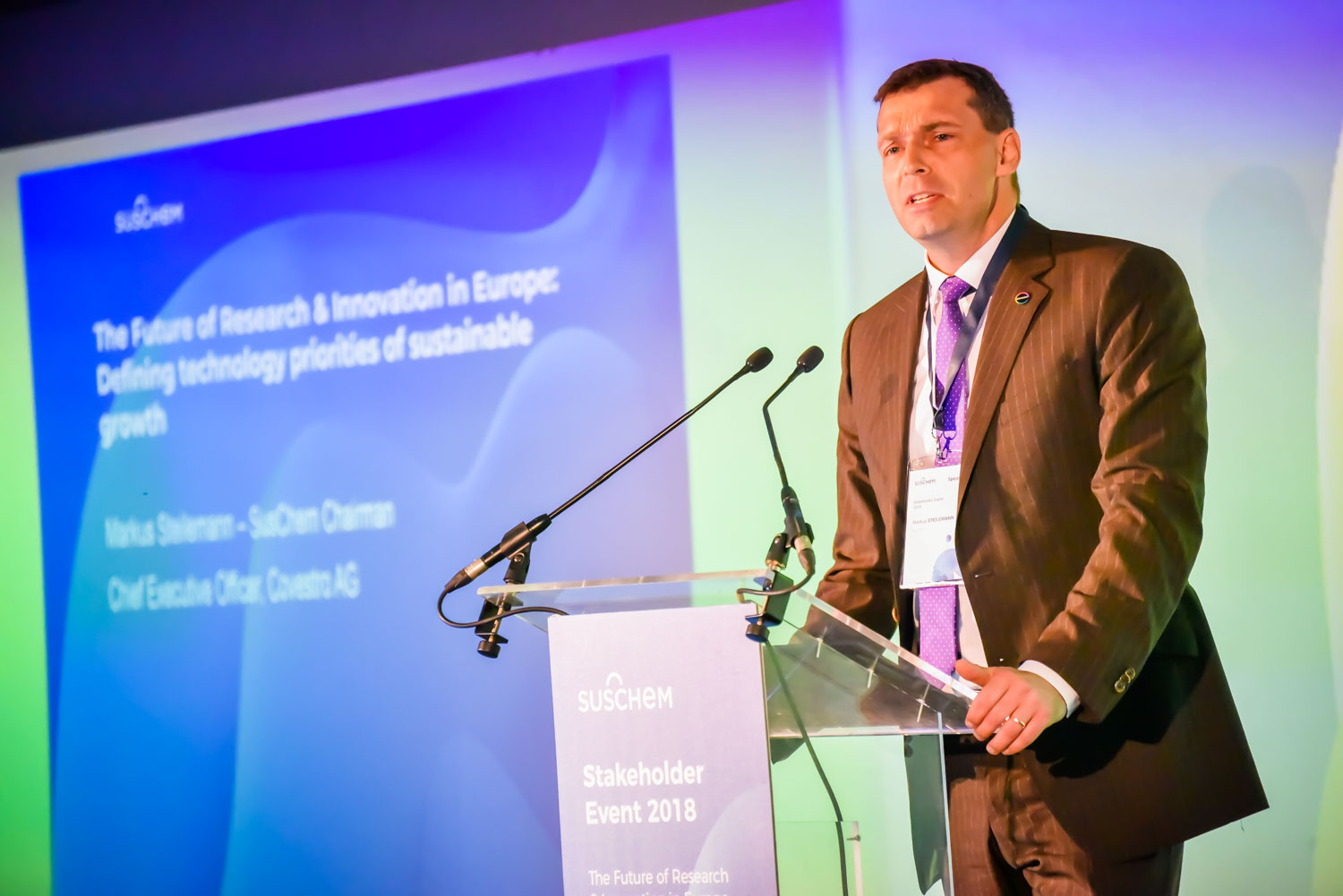
An opening keynote speech by Markus Steilemann, CEO of Covestro and SusChem chairman (pictured above), described the role of SusChem as: “responding to global challenges and EU priorities” by providing “innovation solutions based on sustainable chemistry.”

He also emphasised SusChem’s significant role in enabling a highly collaborative research and innovation environment by bringing together industry including small and medium-sized enterprises, academia and Research and Technology Organisations (RTOs) at a European level whilst connecting with regional and national programmes through its expanding network of National Technology Platforms (NTPs).

Steilemann called on all SusChem stakeholders to voice their priorities and help define the technology priorities for the next SusChem SIRA. The next SIRA will be a solid base for advising the European Commission on high-impact missions and priorities for Horizon Europe. SusChem will remain an active and engaged partner of the European Commission.

“We have demonstrated that SusChem enables the development of sustainable technologies that lead to sustainable products,” he concluded.

Horizon Europe
A second keynote speech was given by Ms. Signe Ratso, Deputy Director General at the Commission’s DG Research & Innovation (pictured below), focusing on the proposal for the next Research Framework programme: Horizon Europe.


Ratso sees Horizon Europe as our chance to shape the future: “Europe has world-class research and strong industries – our knowledge and skills are our main resources – but Europe fails to transform leadership into leadership in innovation and entrepreneurship.” Horizon Europe – although an “evolution rather than revolution” aimed to address that.

Key novelties in the programme proposal were the increased support for breakthrough innovation (via mission-oriented research), the ambition to create more impact, and a more strengthened international cooperation. Horizon Europe also aims to reinforce openness.

In terms of the ‘missions’ concept, Ratso underlined the need for missions to connect with citizens and be “bold and inspirational” while having measurable goals that could be achievable in around a ten-year time frame. Activities in missions should be across-sectors, involve actors from different disciplines and work along value chains. She invited all partners to work together on further shaping Horizon’s Europe missions and looked forward to SusChem’s input to the programme.

Defining technology priorities
One of the main focus points of the event was to start the consultation process to build the new SusChem Strategic Innovation and Research Agenda (SIRA). Two parallel breakout sessions covered advanced materials and advanced process technologies. Both sessions considered the role of Digital Technologies as an enabler for designing better performing materials and processes. More specifically, the sessions initiated the debate on technology priorities and looked to identify experts who could contribute to the development of the next SIRA.

The materials session focused on three thematic clusters: circularity for materials; energy storage, production and efficiency; and functionality and performance. The advanced process technology themes were: digital technologies for process design and control, waste as feedstock, fossil-based feedstock, biobased feedstock, and CO2 as feedstock. The sessions identified technology clusters that require further attention as well as the following broad issue areas: sustainability assessment; skills, consumer awareness, and education and training.


All the input gathered at #suschem2018 will be assessed and processed further to form the basis of the new SIRA together with additional expert input from SusChem working groups that are currently being set-up.

Expanding ecosystem
The SusChem National Technology Platforms discussed how they approached stakeholder engagement in their countries and gave examples of the successful formation of consortia and transnational collaborations. Moreover, they reflected on how to enhance their role even further together with the SusChem ETP. Representatives from nine of SusChem’s 17 NTPs were involved in the debate moderated by Susanne Coles (SusChem UK).

The session was also a great opportunity to present the three new national platforms – Bulgaria, Finland and Sweden - that were approved for membership by the SusChem board the day before the event. SusChem also welcomed Andreas Falk (SusChem Austria) as the new Chair of the NTPs network for the following year.


#suschem2018 concluded with a wide-ranging debate, led by Marco Mensink Director General of Cefic, which explored the priorities required to maintain Europe’s leading role in global innovation and how the structure of Horizon Europe can mobilise our innovation ecosystems. The panel included Peter Dröll, Director Industrial Technologies at Commission’s DG Research & Innovation, Prof. Ferdi Schüth, Vice-President of the Max-Planck-Society, Kateřina Šebková, Director of the Stockholm Regional Centre for Central and Eastern Europe, Martin Stephan, Deputy CEO of CARBIOS, and Olaf Wachsen, Head of Group Process Technology, Clariant.

Panel members called for the continuation of enduring partnerships and collaborations created through programmes like Horizon 2020, which were considered more valuable than the funding per se. They suggested that Horizon Europe could be seen as a part of the EU’s vision to reindustrialise Europe.  The continuation of Key Enabling Technologies (KETs) and the need to bring together all of the bright minds of Europe, were other prominent points stressed by the panel, no country can bring about change alone.

Future path
#suschem2018 has successfully set the course to develop the next SusChem SIRA. It has continued the vibrant dialogue with our platform’s stakeholders and the European Commission on future orientations for sustainable chemistry research and innovation to enable the development of technologies and that will meet EU global challenges.


The process continues at the next major SusChem event: our 2018 Brokerage event that will be held on 23 October 2018 at Hotel Le Plaza, Brussels and will cover later sustainable chemistry relevant calls for Horizon 2020. Save the date!

Tuesday, 19 June 2018

Spotlight on MAKE, CREATE and LEVERAGE at #suschem2018

Join us at the 2018 SusChem Stakeholder Event - #SusChem2018 - on 20 June 2018 your number one destination for innovation policy dialogue and debate this summer. The 2018 Stakeholder event takes place at the Thon Hotel City Centre in Brussels and will be a great opportunity to voice your priorities and help define SusChem’s input into the next EU Framework Funding Programme: Horizon Europe.

This year’s theme is "The Future of Research & Innovation in Europe: Defining Technology Priorities for Sustainable Growth" and will bring together global audiences, senior players from the chemical industry, academia, research technology organisations (RTOs) and EU institutions to address common innovation challenges and debate priorities crucial to the sustainability of the European chemical and biotechnology sectors.


At the event Stakeholder input will be collected through two carefully designed parallel breakout sessions: one on Advanced Materials (CREATE) and the other on Advanced Process Technologies (MAKE). Input from both sessions will contribute to our future strategic research and innovation agenda beyond 2020.These two technology areas are complimented by Digital Technologies (LEVERAGE) and will also feature at #suschem 2018. All three themes are described in the video above.

All three of these SusChem Key Enabling Technologies (KETs) featured in SusChem’s recent white paper on the potential for KETs in Horizon Europe. The white paper outlined the major technology developments and initiatives needed to ‘create’ advanced materials, ‘develop’ advanced process technologies and ‘leverage’ digital technologies.

See you at #suschem2018!

SusChem defines future technology requirements for Energy Storage and sustainable Polymer Composites

Today (19 June 2018), the European Technology Platform for Sustainable Chemistry (SusChem) is publishing two white papers outlining the future research and innovation requirements for Battery Energy Storage technologies and the technology and non-technology requirements for integrating Polymer Composites fully into the Circular Economy.

The two papers are designed to stimulate debate on future research and innovation programmes, including Horizon Europe, in the two areas. Both papers have been produced by expert teams for SusChem and give a view of the current market, the technologies and the opportunities and challenges ahead.

In both cases a through-the-value-chain holistic European innovation programme is needed, an approach that SusChem has championed before in response to other complex societal challenges.'

Battery Storage
The ‘Battery Energy Storage’ paper investigates the current state of battery storage technologies in Europe, the main challenges, and suggests actions for the future. The paper builds on the views of stakeholders in the European battery value chain and, in particular, the chemical industry and raw material suppliers.

“The increase of Renewable Energy Sources has highlighted the next challenge: storage of energy when demand is lower than the supply. Among the different technologies, batteries have the highest cost reduction potential now. The growing need for European energy independence and security pushes for more 'in-house' developments and installation. European players should focus on developing battery cell production capacity in Europe in order to complete the value chain and allow a full integration, from material to final batteries,” comments Anne.-Chloe Devic, coordinator of the SusChem Materials Working Group.

Composites for circularity
The ‘Polymer Composites Circularity’ paper examines the technology and non-technology requirements to ensure that these advanced materials, that are featuring in an increasing number of applications, can be successfully integrated into the circular economy.

“The growing demand of polymer composites, together with the increase in number of applications raises the question: what will happen to all the composite waste that is generated either from production or end-of-life parts? Although significant efforts have been made in Europe, including the Circular Economy Package and, in particular, its Plastics Strategy, the fibre-reinforced polymer space is not really included in the focus as yet, Developing and ensuring a systematic circular ecosystem for these materials needs to be a priority,” commented Anne-Chloe Devic

The two papers will be available and discussed at the SusChem Annual Stakeholder event (#suschem2018) to be held on 20 June in Brussels.

You can download the two papers here:


Both papers were authored by the SusChem Materials Working Group in collaboration with international consultants Bax & Company.

Wednesday, 13 June 2018

Spotlight on Digital Technologies at #SusChem2018

Join us at the 2018 SusChem Stakeholder Event - #SusChem2018 - your number one destination for innovation policy dialogue and debate this summer. The 2018 Stakeholder event takes place at the Thon Hotel City Centre in Brussels on 20 June 2018 and will give you the opportunity to voice your priorities and help define SusChem’s input into the next EU Framework Funding Programme: Horizon Europe.

This year’s theme is "The Future of Research & Innovation in Europe: Defining Technology Priorities for Sustainable Growth" and will bring together global audiences, senior players from the chemical industry, academia, research technology organisations (RTOs) and EU institutions to address common innovation challenges and debate priorities crucial to the sustainability of the European chemical and biotechnology sectors.

At the event Stakeholder input will be collected through two carefully designed parallel breakout sessions: one on Advanced Materials and the other on Advanced Process Technologies. Input from both sessions will contribute to our future strategic research and innovation agenda beyond 2020.These two technology areas are complimented by Digital Technologies and will also feature at #SusChem 2018.

Spotlight on Digital Technologies
The chemical industry is an enabler for the continuous development of smarter and more sustainable electronic devices and equipment in other industries. The chemical industry is itself being transformed and disrupted through digitalisation. We have a real opportunity to leverage the immense capabilities of information and communication technologies (ICT) to optimise our processes and improve our production efficiency. Watch our social spotlight video ‘LEVERAGE’ with Martin Winter from the SusChem Management Team.


Watch out for our other Social Media Spotlights on Advanced Materials (CREATE) and Advanced Processes (MAKE).

All three of these SusChem Key Enabling Technologies (KETs) featured in SusChem’s recent white paper on the potential for KETs in Horizon Europe. The white paper outlined the major technology developments and initiatives needed to ‘create’ advanced materials, ‘develop’ advanced process technologies and ‘leverage’ digital technologies.

Debate at #SusChem2018
All three SusChem KETs will be debated and discussed at #SusChem2018. Our keynote speakers include: Signe Ratso, Deputy Director-General – Directorate Research and Innovation (RTD), EU Commission; Joanna Dupont-Inglis, Director of Industrial Biotechnology at EuropaBio, and SusChem Board Member; Markus Steilemann, Chief Commercial Officer & Member of Management Board, Covestro and Chair of the SusChem Board; and Marco Mensink, Director General of Cefic, the European Chemical Industry Council.

Register today for a chance to define the technology priorities needed to shape Europe’s sustainable future. You can download a full list of speakers here.

Spotlight on Advanced Materials Technologies at #SusChem2018

Join us at the 2018 SusChem Stakeholder Event - #SusChem2018 - your number one destination for innovation policy dialogue and debate this summer. The 2018 Stakeholder event takes place at the Thon Hotel City Centre in Brussels on 20 June 2018 and will give you the opportunity to voice your priorities and help define SusChem’s input into the next EU Framework Funding Programme: Horizon Europe.

This year’s theme is "The Future of Research & Innovation in Europe: Defining Technology Priorities for Sustainable Growth" and will bring together global audiences, senior players from the chemical industry, academia, research technology organisations (RTOs) and EU institutions to address common innovation challenges and debate priorities crucial to the sustainability of the European chemical and biotechnology sectors.

At the event Stakeholder input will be collected through two carefully designed parallel breakout sessions: one on Advanced Materials and the other on Advanced Process Technologies. Input from both sessions will contribute to our future strategic research and innovation agenda beyond 2020.
http://www.suschem.org/events/suschem-stakeholder-event-2018/breakout-sessions-52

Spotlight on Advanced Materials Technologies
Advanced material technologies enable breakthrough application development across a wide range of value chains. Innovative products can improve your quality of life and offer solutions to many societal and environmental challenges and will feature at #2018. Watch our social spotlight video ‘CREATE’ with Anne Chloé Devic from the SusChem Management Team.


Watch out for our other Social Media Spotlights on Advanced Processes (MAKE) and Digital Technologies (LEVERAGE).

All three of these SusChem Key Enabling Technologies (KETs) featured in SusChem’s recent white paper on the potential for KETs in Horizon Europe. The white paper outlined the major technology developments and initiatives needed to ‘create’ advanced materials, ‘develop’ advanced process technologies and ‘leverage’ digital technologies.

Debate at #SusChem2018
All three SusChem KETs will be debated and discussed at #SusChem2018. Our keynote speakers include: Signe Ratso, Deputy Director-General – Directorate Research and Innovation (RTD), EU Commission; Joanna Dupont-Inglis, Director of Industrial Biotechnology at EuropaBio, and SusChem Board Member; Markus Steilemann, Chief Commercial Officer & Member of Management Board, Covestro and Chair of the SusChem Board; and Marco Mensink, Director General of Cefic, the European Chemical Industry Council.

Register today for a chance to define the technology priorities needed to shape Europe’s sustainable future. You can download a full list of speakers here.

Tuesday, 3 April 2018

Define Technology Priorities for Sustainable Growth at #suschem2018

Registration is now open for the 2018 SusChem Stakeholder Event, The Future of Research and Innovation in Europe: Defining Technology Priorities for Sustainable Growth, which will be held at the Thon Hotel City Centre in Brussels on 20 June 2018.

In light of the forthcoming European Commission (EC) communication on the Multiannual Financial Framework (MFF) and the overall structure of the next R&I Framework programme (FP9), this year’s stakeholder event happens at a critical moment in the EU’s policy cycle. This presents a significant opportunity for SusChem  stakeholders to voice their reactions and expectations to the Commission on the strategy and direction of the key policies that have direct implications for the priorities of chemical sector.

The exciting programme for the 2018 SusChem Stakeholder event will give participants opportunities to voice their priorities and help shape SusChem’s input into FP9 and our next Strategic Innovation and Research Agenda (SIRA).


Event highlights include:

  • Two parallel breakout sessions on priorities for Advanced Materials and advanced process technologies  (download details)
  • A lively high-level panel debate to discuss first insights on the upcoming Framework Funding Programme (FP9) and how it can accelerate breakthrough innovation in Europe, and
  • The impact of innovation around Europe presented by SusChem National Technology Platforms
Register today!
You can access the draft agenda for the 2018 SusChem Stakeholder event here and you can register for the event from the event page on the SusChem website.

See you in Brussels on 20 June! Spread the word using #suschem2018

Tuesday, 20 February 2018

SusChem publishes views on Key Enabling Technologies (KETs) in FP9

In preparation for the next Research and Innovation (R&I) Framework Programme (FP9), the European Technology Platform for Sustainable Chemistry (SusChem) has today (19 February 2018), publishes a new paper outlining its position on what can be achieved by Key Enabling Technologies (KETs).

The paper 'Key Enabling Technologies in FP9' calls for strong support for EU future technology competitiveness and details the major technology developments and initiatives needed to:

  • Create Advanced Materials for use in energy efficiency (e.g., light weight), renewable electricity production and energy storage (e.g., batteries elements), or smart functionalities responding to stimuli (e.g., self repair).
  • Develop Advanced Process Technologies, including Industrial Biotechnology, for more sustainable production including through utilisation of alternative carbon feedstock (waste, biomass, CO2) and alternative energy sources.
  • Leverage Digital Technologies for use in advanced process control and materials modelling, to enable disruptive business models and to create new customer experiences.

The paper calls for on the European Commission to ensure strong support for KETs in the next Framework Funding Programme. You can download and read the paper here.

Thursday, 6 July 2017

SusChem Brokerage 2017 is on 18 October

The SusChem 2017 Brokerage event which will take place on Wednesday 18 October 2017 in Brussels, Belgium at the Thon Hotel in the EU quarter. Don’t hesitate - register now! Participation in the event is free of charge, but prior registration is compulsory.

As always the SusChem Brokerage event will be the unique opportunity for SusChem stakeholders from industry, academia, SMEs and other sectors to present project ideas, develop consortia and submit funding proposals targeting the 2018 and 2019 calls for Horizon 2020 with deadlines falling in the late 2017 and early 2018.

The Horizon 2020 work programme for 2018-2020 is expected to be officially published in early October, but you can read a Commission document that describes the context for the entire strategic programming process, which will guide the preparation of the work programme itself, here.

During the SusChem brokerage event, you will have the opportunity to:

  • Get detailed views on the Horizon 2020 2018-2019 programme calls focusing on:
    • Advanced Materials Research
    • Process and Biotechnologies, and
    • Raw Materials calls in Societal Challenge 5
  • Present your project ideas to the SusChem stakeholder community
  • Meet consortia looking for partners, and
  • Interact with other stakeholders during the speed dating session.  


Use Grant-It
Delegates are kindly invited to propose their project ideas for the 2018 and 2019 calls of Horizon 2020 on GRANT-IT - your one-stop access to funding opportunities from the European Commission and Regional and National governments in the field of sustainable chemistry.

SusChem members can use GRANT-IT resources for free to search for funding, identify project opportunities, propose project ideas and search for potential project partners.

Submitting your project ideas via GRANT-IT will make it available to the whole SusChem community and allow interested partners to contact you for meeting requests when the brokerage speed dating tool is open.

For additional information and for questions related to accommodation or how to access the venue, please visit the SusChem 2017 Brokerage event registration portal.

Do not miss this opportunity - register now for the SusChem 2017 Brokerage Event! 

Monday, 9 January 2017

European Polymer Federation Congress, Lyon, July 2017

The 16th European Polymer Federation Congress (EPF 2017) takes place in Lyon from 2-7 July 2017. The Congress promises to be an exceptional rendezvous for all polymer scientists and engineers belonging to universities, institutions, and companies from around the World. The Congress theme is ‘From last trends in polymer science to cutting-edge industrial innovations’. 

With invited plenary talks and some 40 keynote presentations given by renowned speakers from leading international teams EPF 2017 will present the latest trends, results, and applications for polymers and polymer science.

With the highly relevant selected topic areas and the anticipated high participation from all areas of the polymer science world and related fields, the EPF 2017 congress will be an important place for inspiring international and interdisciplinary exchanges at the forefront of polymer science and technology. The EPF 2017 Congress aspires to be the place to identify the hottest topics in polymer science and the latest applications of polymers, to meet all the polymer community, to discuss,  and design new collaborations, … and to discover Lyon as well!

The EPF 2017 Congress topics include:

  • Macromolecular Chemistry
  • Polymerisation Processes
  • Physics of Polymers & Polymer Materials
  • Polymer Characterisation Methods
  • Modelling & Simulation

Sessions will also cover Polymers as Answers to Societal Issues including topics such as Energy, Transport and Mobility, Resources and Environment, Global Health, Information Society, Polymers and the Industry of the Future

On Tuesday 4 July, EPF 2017 will also be hosting , the second Australian-European Workshop that will illustrate connections, interactions and collaborations between European and Australian polymer researchers.

The extensive list of plenary speakers for EPF 2017 includes Prof. Jean-Marie Lehen, Université Strasbourg; Dr. Floryan De Campo, Head of Technology Specialty Polymers Solvay Company; Prof. Emmanuel Giannelis, Cornell University; Prof. Gaetano Guerra, Università degli Studi di Salerno; Prof. Laura Kiessling, University of Wisconsin - Madison; Prof. Joao Mano, University of Aveiro; Prof. Rolf Mulhaupt, Freiburg University; Prof. Anthony Ryan, Sheffield University; and Dr. Søren Kristiansen, LEGO Group Sustainable Materials.

Get involved!
All participants are invited to submit abstracts for oral or poster presentations. Submitted abstracts will be peer reviewed for their acceptance by the International Advisory Board and the Organising Committee. If the organisers cannot accept an oral presentation, presenters will be invited to present their research via a poster presentation.

Online registration and abstract submission are open now, but be quick as the deadline for abstract submission for an oral presentation is 31 January and notification of acceptance of the abstract is 15 March. The deadline for abstract submission for a ‘last-minute’ poster presentation is 31 March.

Find out more on the EPF 2017 website. For further details contact the EPF 2017 Congress Secretariat via email.

Wednesday, 13 July 2016

Register now for the SusChem Brokerage Event

More details are now available for the recently announced SusChem 2016 Brokerage event which will take place on Tuesday, 13 September 2016, in Seville, Spain. And registration is now open! The SusChem Brokerage event will take place at the FIBES - Seville Conference Centre during the Sixth European Chemistry Congress organised by EuCheMS and the Asociación Nacional de Químicos de España, ANQUE. The Congress itself runs from 11 to 15 September.

The SusChem Brokerage event is a unique opportunity for industry, academia, SMEs and other sustainable chemistry research and innovation actors to get ready to develop consortia and submit funding proposals targeting the more than 70 SusChem-relevant Horizon 2020-2017 call topics with deadlines falling in the period Q4 2016 and Q1 2017. 

The identified call topics include potential projects in research areas such as Raw Materials, Energy Sources, Process Technologies, Material Technologies and Horizontal Issues.

A dedicated registration website has been established for the SusChem Brokerage event and registration is open now. Participation in the event is free to all stakeholders

During the SusChem Brokerage event participants will be able to:

  • Present project ideas to large chemical companies and  the SusChem stakeholder community
  • Meet consortias looking for partners
  • Interact with other stakeholders during the speed dating session


Get involved!
Project ideas for the Horizon 2020-2017 can be submitted on the GRANT-IT portal. All submitted project ideas will be made available to the SusChem community and will allow interested partners to contact you for meeting requests when the SusChem Brokerage event 'speed dating' tool is open.

For additional information on the event and for questions related to accommodation or how to access the venue, please visit the SusChem 2016 Brokerage event registration portal at suschembrokerage.comThe SusChem 2016 Brokerage event is jointly organized with SusChem Spain.

Thursday, 23 June 2016

SusChem 2016: Sustainable Chemistry – Innovation for Competitiveness

The 2016 SusChem Stakeholder event that took place in Brussels on 16 June once again showed that SusChem is a strong platform supporting a strong industrial sector. The platform acts as an effective bridge between the sustainable research and innovation needs of the chemical industry and European Commission policies. The debate demonstrated the excellent fit between the SusChem Strategic Innovation and Research Agenda (SIRA), its technologies and priorities, including a sustainable bioeconomy, materials for energy management, processes and catalysis, ICT for processes, and water, and European Commission initiatives such as the Energy Union, Digitisation and the Circular Economy. Despite SusChem having no direct funding for R&I activities the influence of the technology platform is huge. At the event two new members of the SusChem community of national technology platforms were introduced: SusChem Austria and SusChem Greece.

With some 230 delegates registered from 18 European Member States the 2016 annual SusChem stakeholder event demonstrated once again the role of the platform in building a sustainable future for the European Chemical Industry. The video below give a quick overview of the whole event.


The event was also a big hit on social media with tweets using the hashtag #suschem2016 reaching over 25 700 users and with over 101 000 tweet views estimated. The three 'top tweets' from the day are republished below. 


In an opening presentation, strategic topics related to the SusChem programme were addressed by Rudolf Strohmeier (above right), former Deputy Director General of DG Research and Innovation, and a good friend and supporter of SusChem since its inception. He highlighted the recent Competitiveness Council of 26 May which for the first time had endorsed the “innovation principle” that the impact of regulation on innovation activities must be taken into account in all EU policy-making. This was a very important positive point for industry moving forward he believed. But he argued that in order to show European decision-makers and investors the value of innovation required sound business cases to be presented.

Implementing the new SIRA: Status and priorities
SusChem Chairman Dr Klaus Sommer (above left) reviewed the progress of the technology platform over the past year. He also noted that the sector had effectively decoupled energy intensity from production growth. He saw an excellent fit between the SusChem Strategic Innovation and Research Agenda (SIRA), its technologies and priorities, and numerous European Commission initiatives such as the Energy Union, Digitisation and the Circular Economy. There were currently 70 open calls across various parts of the Horizon2020 programme that were relevant to the SusChem community. Despite SusChem having no direct funding for R&I activities the influence of the technology platform was massive.

In the coming year Dr Sommer looked to SusChem intensifying its input for future work programmes through thematic workshops and also linking through the Chem21 project into the Innovative Medicines Initiative (IMI) for work on healthcare and well-being issues. In addition work on synergy between the BBI JU and SPIRE cPPP would be pursued, a project brokerage workshop was being organised in Seville on 13 September 2016 within the EuCheMS 6th European Chemistry Congress, and new lighthouse projects needed to be identified.

Priorities and platforms
Updates on the five main SusChem thematic priorities were given by the responsible Cefic Innovation Managers.


Work on the Sustainable Bioeconomy was described by SusChem secretary Flavio Benedito (above left) and Materials for Energy Management was presented by Anne Chloe Devic (above, middle left). Martin Winter (middle right) covered two priority areas: Processes and Catalysis, and ICT for Processes. The final topic presented was Water with Henk Pool (above right).

You can download the presentations made by Dr. Sommer and the Innovation Managers here. You can also download factsheets on the five SusChem Innovation priorities here.

Eric Firtion of SusChem France and the French Chemical Industries Union (UIC) introduced presentations on activities from a selection of SusChem's national technology platforms (NTPs). These included two new NTPs: Andreas Falk described SusChem Austria and Stelios Bikos outlined SusChem Greece’s ambitions (second and first right below respectively).


Other NTP presentations were made by Suzanne Coles (SusChem UK), Cristina Gonzalez (SusChem Spain), Eric Firtion (SusChem France), Alexis Bazanella (SusChem Germany), Tine Schaerlaekens (SusChem Belgium), Ladislav Novak (SusChem Czech Republic), and Nico Versloot (SusChem Netherlands) pictured from left to right above.

Panels debate Circular Economy, Energy Union
After lunch two panel debates took place involving European Commission and industry representatives. The first focused on SusChem and the Circular Economy and was moderated by Pierre Barthélemy, Executive Director of Research and Innovation at Cefic (pictured below, right). The circular economy could boost Europe’s global competitiveness, growth and jobs. SusChem had produced a position paper on the Circular economy calling for a sustainability based approach. Innovation is key to achieving a circular economy but this needed to be accompanied by a clear regulatory framework to ensure deployment stated Barthélemy.


The panel members were Reinhard Buescher, Head of Unit 'Chemicals' at DG GROW (middle right above); Waldemar Kuett, Head of Unit ‘BioBased Products and Processes’ at DG Research and Innovation; Gloria Gaupmann, Public & Regulatory Affairs Manager, Biotechnology and Renewables at Clariant; Reinier Grimbergen, Director Science to Innovate at DSM; Anton Valero, General Manager at Dow Chemical Ibérica (left above); and Greet van Eetvelde, Head of Energy & Innovation Policy at INEOS (middle left above).


The second panel discussion covered two topics – SusChem and the Energy Union and SusChem and Digitisation – and was moderated by Alexis Bazzanella, Head Research & Project Coordination at DECHEMA e.V. with panel members Eva Hoos, Policy Officer at DG Energy (middle above); Helene Chraye Head of Unit 'Advanced Materials and Nanotechnologies' at DG Research and Innovation; Khalil Rouhana, Director for 'Components & Systems' at DG CNECT (left above); Jens Rieger, Senior Vice President at BASF (right above); Henrike Gebhardt, Senior manager Scientific Relations at Evonik Industries AG; and Nicolas Cudré-Mauroux, Research & Innovation Group General Manager (CTO) at Solvay

From the two panel discussions on the ‘Circular Economy’ and on ‘Digitisation’ and the ‘Energy Union’ the role of the chemical industry as an amazing enabler for innovation was clear, but there was a need to ensure enhanced collaboration along and across value chains to maximise the impact of the sector’s innovations on the wider economy. Sustainable chemistry has a key role in maximising use of resources (including water) and energy both within our own sector and across other industrial and manufacturing sectors. 


Concepts such as industrial symbiosis, advanced digital technologies, and recyclable and renewable materials innovation pioneered by the chemical sector would be essential in enabling Industry 4.0, the circular economy and other sustainable development initiatives while maintaining competitiveness, jobs and growth in Europe.

Conclusions
Summing up the day Dr Klaus Sommer said that the clear link between competitiveness and innovation had been demonstrated, but he stressed the need for establishing sound business cases to ensure innovation can gain investment and move to implementation. Future SusChem priorities had been described and he called on all interested stakeholders to get involved with the relevant working groups. He concluded by stating that SusChem was still a strong platform supporting a strong sector and acting as a bridge between our research and innovation needs and European Commission policies.

Tuesday, 7 June 2016

SusChem Stakeholder 2016: Materials focus

This year’s SusChem stakeholder event takes place on 16 June in Brussels. One of the areas for discussion at the stakeholder event will be Materials. In this blog Anne Chloe Devic (pictured below right), Cefic Innovation Manager responsible for this SusChem priority area, outlines the field, its many areas of innovation for sustainable chemistry and how you can participate in the discussion at #suschem16.

Materials is one of the five SusChem priority areas for innovation. There are at least two European Commission policy areas that relate closely to materials. One is ‘Closing the loop - An EU action plan for the Circular Economy’ and the second is the Energy Union with its Strategic Energy Technology (SET) plan. SusChem has defined its priority areas for research and innovation in materials as materials for energy efficiency, materials for low carbon electricity production, and materials for energy storage.

However, these three application areas remain very wide and SusChem wants to narrow down the priorities in order to maximise impact. Therefore SusChem is looking to engage its stakeholders to support and contribute to refining and defining the top priorities for sustainable chemistry in the materials domain.

In the next few month a SusChem working group, currently being formed, will discuss and propose the priorities that SusChem will put forward for inclusion in future calls of Horizon 2020 (and beyond) and other European and National collaborative research and innovation programmes.

Materials and Energy
The chemical industry is a key solution provider for many value chains and other industry sectors that are aligned with the priorities outlined in the fifth pillar (research and innovation) of the Energy Union.

Sustainable chemistry provides technologies and advanced materials for:

  • Enabling the EU to be a world leader in renewable energy. This includes providing advanced materials 
    • for sustainable production of renewable electricity, for example new composites for wind turbine blades and materials for photovoltaic technologies that include the recycling of these materials, 
    • for energy storage, for example: electrical energy storage - materials for advanced batteries; chemical energy storage - advanced materials and process technologies such as H2 and CO2 based energy carriers via power-to-gas and power-to-liquid technologies; and thermal energy storage - phase change materials or reversible thermochemical reactions.
  • Efficient energy conservation solutions to make the future and existing building stock energy neutral. This includes: advanced materials for thermal insulation, efficient lighting, and phase change materials amongst others.
  • More sustainable transport systems through the use of lightweight materials as a solution to enable lower carbon transport. This includes innovation in ‘light-weighting’ technologies in terms of both materials and process technologies that can play a vital role to improve fuel efficiency and reduce CO2 emissions in transport. Composite materials, such as fibre reinforced plastics (FRP that can be carbon or glass reinforced) have a significant potential for weight reduction in vehicles. They can offer light weight benefits in comparison to other structural metallic materials, while maintaining high mechanical properties. In addition hybrid materials, combining composites and metals, with appropriate joining technologies, can reduce vehicle weight. Materials development for more fuel efficient tyres and advanced battery technologies are also important.

Materials and the Circular Economy 
The development of innovative advanced materials by the chemical sector is essential to enable a better use of existing resources along the whole life cycle of products and services, and to develop new production and recycling process paths.

The development of materials enabling ‘eco-design’ of products is required to address very demanding requirements in terms of performance in downstream applications, including better recyclability. New technological development of materials is often carried out by the chemical industry in collaboration with its value chain partners to provide improved / desired material characteristics and to enable more recyclable end-use products.

For this design and development process to be effective, sustainability assessment over the whole life cycle of the product needs to be considered. The evaluation of environmental impact should consider all environmental aspects including energy and water.

Stakeholder discussions
A highly interactive debate is expected at the Stakeholder event on 16 June and your questions and expectations on the outcomes for the panel debates, in particular on materials for energy, are welcome in advance.

Registration for the 2016 SusChem Stakeholder event is still open, but will be closing soon. This dedicated registration website includes all the information you will need to attend the event.

You are invited to submit your questions and comments and also your expectations for outcomes as part of the registration process. You can submit your questions and comments when you register and there will also be a link for question submission sent with the registration confirmation email.

Monday, 11 April 2016

EFFRA Launches Public Consultation on FoF PPP Work Programme

The European Factories of the Future Research Association (EFFRA) has just launched a public consultation on the ‘Factories of the Future’ (FoF) PPP work programme for 2018 through to 2020. The FoF consultation document contains a wide range of potential call topics that will be of interest to the SusChem community from manufacturing complex and multi-material components to additive manufacturing (3D printing), material and resource efficiency in manufacturing, energy efficiency, new processes, digitisationresouir and circular economy issues.

The public consultation is part of EFFRA’s preparations for strategic discussions with the European Commission concerning the final ‘Factories of the Future’ work programme under Horizon 2020.

The consultation is a unique opportunity to provide your input to this important research and innovation programme. The deadline for consultation feedback is 4 May 2016 (17:00 CET).

EFFRA is looking for input from representatives of industry, research and innovation, and academia to provide their views on priorities for the work programme that will shape the ‘Factories of the Future’ research and innovation call topics in 2018, 2019 and 2020.

EFFRA will use the input received to compile a roadmap document that complements the current ‘Factories of the Future 2020’ roadmap. The new document will be entitled 'Factories 4.0 and Beyond' and will be delivered to the European Commission to provide a key contribution to preparations for the work programme.

How to get involved
The consultation feedback form can be completed online through the EFFRA Innovation Portal. The feedback form does not have to be completed in one sitting and participants may save and return to it as often as they need until the close of the consultation on Wednesday 4 May.

To access the response form you must be registered and logged into the EFFRA Innovation Portal. Instructions on how to participate are available here.

You can access the consultation response form here when logged onto the portal. The consultation document itself is available without logging on here.

For more information, or if you have specific questions on the consultation, please contact Chris DeCubber at EFFRA.

Friday, 15 January 2016

SusChem publishes Polymer Composites Brochure

SusChem has just published a new brochure on ‘Polymer composites for automotive sustainability’. The brochure is the result of a collaborative effort involving stakeholders all along the automotive value chain in Europe. Automotive composites are a growing market that is driven by efficiency and emissions issues. The market for global automotive composite materials is forecast to reach €3.72 billion by 2017. This represents a real opportunity for the European chemical and composites industry. 

The automotive industry faces a new challenge aligning material properties, product design and production or assembly processes - especially in larger volume production series vehicles – but could take more advantage of the potential of composites for light-weighting vehicles. The demand for weight reduction is driven by the demand for better fuel efficiency and reduced emissions to comply with EU legislation. In 2007 over 500 million tons of CO2 emissions were estimated to be due to cars in the EU; it is estimated that savings due to composites light-weighting result in a potential 1.4% improvement here.

SusChem’s role
From its inception in 2004, SusChem identified advanced materials as an enabling technology critical to achieving its vision and mission. SusChem has set innovation priorities for advanced materials to be adopted in key end user markets including automotive and highlighted 'Multifunctional light-weight construction' as a priority for smart, green and integrated transport in its Strategic Innovation and Research Agenda (SIRA).

The SusChem Working Group on Composites Materials for Automotive pulled together experts from the chemical industry, the automotive industry, the automotive parts suppliers as well as academia and recommended the publication of the brochure as well as a wider consultation with the established competence centres in Europe.

In October 2013 SusChem and the automotive R&D association EARPA organised a joint workshop, “Exploring cross-innovation opportunities on automotive composites and bio-based materials” in Frankfurt. The outcomes of this workshop, as well as feedback collected by a stakeholder consultation held as a follow-up exercise, are summarised in several key conclusions and recommendations within the polymer brochure.

Key objectives
The brochure integrates specific input from key stakeholders across the value chain, including those involved in production equipment, and provides concrete recommendations to enable faster progress in advanced composites light-weighting innovation uptake in the European automotive industry.

A set of specific R&D&I challenges are defined for advanced composite materials including:

  • Novel and innovative polymer composite raw materials with enhanced recyclability properties
  • Low cost adaptive, flexible and efficient manufacturing and assembly processes specific to the high-volume automotive industry
  • Multi-attribute design optimisation that works even in case of a multi-material architecture
  • Automated joining techniques for multi-materials and composites
  • Invisible damage identification and repair techniques for composite parts

A key wider-scale objective is the establishment of an EU-wide programme to ensure adequate support for automotive composites research and innovation in the long term.

As well as this coordinated R&D&I programme, the establishment of a European Automotive Composites Competence Network is proposed. This network of R&D&I clusters can improve the coordination between local knowledge hubs.

For further information on SusChem activities in this area contact Jacques Komornicki at Cefic.