The SusChem News Blog is now hosted on the SusChem website in the News Room. You will be redirected there in 10 seconds
.

Showing posts with label advanced process technology. Show all posts

Friday, 31 August 2018

KETs Impact: National funding promotes Process Analytical Technologies


The recent SusChem White paper ‘Impact: Key Enabling Technologies (KETs) in Horizon Europe’ included a number of success stories highlighting publicly funded innovation involving KETs and the SusChem News blog is featuring a selection of these fruitful 'SusChem inspired' initiatives.


Sustainable chemistry is essential to the technological advance of KETs including advanced materials, advanced manufacturing technologies, industrial biotechnology, micro and nanoelectronics, nanotechnology and photonics. SusChem's key enabling technologies provide the critical building blocks for the solutions needed to achieve a sustainable low carbon circular economy. You can find out more here.

Our final KETs success story focuses on the PAC (Process Analytical Chemistry) network, an Austrian industrial research initiative for process analysis that brings together industrial and academic research expertise and has been funded by a combination of national and regional sources.

"imPACts delivered”: the Austrian platform for Process Analytical Chemistry

imPACts creates IMPACT through unique partnership

Member State funding creates unique collaboration in a PAC platform of more than 20 partners

PAT – Process Analytical Technologies have an immense impact on the productivity, efficiency and safety of large volume chemical production. Investment in this expertise pays off in securing the position of the process industry. 

In Austria, already in 2010, the research platform PAC – Process Analytical Chemistry was founded, based on a national funded research project. 

The consortium placed a strong focus on further development of PAT in Spectroscopy and Micro-Electro-Mechanical Systems (MEMS) based on inline Rheology, on Process-Modelling and Process-Understanding, together leading to a closed-loop and tight real-time Process Control and Optimisation.

New measurement technologies were invented, application demonstrators implemented and evaluated in industry, high ranking journal papers were published, and patents were filed.


How was the breakthrough innovation achieved? 
In the consortium more than 20 partners from industry and research institutions cooperate and perform application-oriented research as well as strategic research. 

Impact
  • Technology: more than 10 technology demonstrators evaluated, six patents filed
  • Economic & Environmental: all process optimisation targeting efficiency issues
  • Social: 28 PhD, 34 Master, 28 Bachelor Theses; internal training scheme established
  • Scientific: 75 journal publications, > 200 conference contributions, five conferences
  • European Link: The PAC-network was sustainably established in SusChem-AT - the SusChem National Technology Platform (NTP) in Austria
More information
The projects received funding from the Austrian Ministries BMVIT and BMWFW, the Federal State of Upper Austria and the Federal State of Lower Austria.


imPACts (contract # 843546) and PAC (contract # 825340) are Austrian COMET K-projects.

Thursday, 16 August 2018

KETs Impact: Optimising Resource Efficiency in Process Plants

The recent SusChem White paper ‘Impact: Key Enabling Technologies (KETs) in Horizon Europe’ included a number of success stories highlighting publicly funded innovation involving KETs and the SusChem News blog is featuring a selection of these fruitful 'SusChem inspired' initiatives.


Sustainable chemistry is essential to the technological advance of KETs including advanced materials, advanced manufacturing technologies, industrial biotechnology, micro and nanoelectronics, nanotechnology and photonics. SusChem's key enabling technologies provide the critical building blocks for the solutions needed to achieve a sustainable low carbon circular economy. You can find out more here.

Our seventh success story looks at the FP7 project MORE that sought to monitor resource efficiency during daily operations of large production plants to influence operational decisions and ensure that plant efficiency is optimised and environmental footprint is constantly minimised.

MORE – Real-time Monitoring and Optimisation of Resource Efficiency in Integrated Processing Plants 

Real-time data and online decision support systems enable IMPACT

MORE has brought the computation, visualisation and use of resource efficiency indicators to a new level by evaluating them online in daily operations, visualising them for operators and managers in a transparent fashion and using them in decision support and optimisation

MORE was a STREP (Small and medium scale focused research project) supported by the European Commission in the field of Nanosciences, Nanotechnologies, Materials and new Production Technologies (NMP) aiming at identifying resource efficiency indicators (REIs) that can support operational decisions in processing plants through the use of real-time data and the implementation of dedicated online decision support systems. MORE ran from November 2013 to February 2017.

How was the breakthrough innovation achieved? 
Within MORE, the academic and research partners Technische Universität Dortmund, Germany, Universidad de Valladolid, Spain and VTT, Technical Research Centre of Finland, the solutions providers LeiKon GmbH and S•PACT GmbH, Germany, the industrial partners PETROLEOS DEL NORTE SA (Petronor), Spain, BASF Personal Care and Nutrition GmbH, INEOS Köln GmbH, Germany and LENZING AG, Austria as well as the coordinating consultant inno TSD, France collaborated impressively to develop theoretical results, implement them in practice, publish and standardise them. 


Impact
As key results MORE defined principles for the definition of real-time Resource Efficiency Indicators (REIs) and proposed indicators for integrated chemical plants to be used in the daily operations of continuous and batch processes. They significantly extend available indicators as they cover resources overall and are based on the processing of real-time data that is available in the monitoring and control systems and from innovative analytical measurements. They form the basis for necessary steps from monitoring to improving resource efficiency through model-based real-time decision support provided to plant operators and plant managers.

Technical achievements were reported through the implementation in industrial cases. Two examples:
  • At Petronor the MORE partners optimised the distribution of hydrogen. Petronor estimates an economic gain of between EUR one million to EUR five million per annum equivalent to 3-5% of cost savings and a reduction of greenhouse gas emissions of 3.5%. 
  • At Lenzing, the specific steam consumption together with the overall cycle cost of the evaporator system was optimised with an economic impact of EUR 575 000 to EUR 825 000 per annum coupled with a significant reduction of direct CO2 emissions from the site by about 0.3%. 

More information
MORE – ‘Real-time Monitoring and Optimization of Resource Efficiency in Integrated Processing Plants’ (FP7 GA 604068) 

Read the SusChem White Paper ‘Impact: Key Enabling Technologies (KETs) in Horizon Europe’.

Tuesday, 31 July 2018

KETs Impact: The CONSENS Project

The recent SusChem White paper ‘Impact: Key Enabling Technologies (KETs) in Horizon Europe’ included a number of success stories highlighting publicly funded innovation involving KETs and the SusChem News blog is featuring a selection of these fruitful 'SusChem inspired' initiatives.


Sustainable chemistry is essential to the technological advance of KETs including advanced materials, advanced manufacturing technologies, industrial biotechnology, micro and nanoelectronics, nanotechnology and photonics. SusChem's key enabling technologies provide the critical building blocks for the solutions needed to achieve a sustainable low carbon circular economy. You can find out more here.

Our first highlighted success story is on the SPIRE Horizon 2020 project CONSENS (Integrated Control and Sensing for Sustainable Operation of Flexible Intensified Processes) that has paved the way for the factory of the future by developing novel sensors and integrated process control techniques.

Sustainable operation of flexible intensified processes 
Digital technologies enable the migration from batch to flexible continuous intensified processes

Public funding facilitates the fruitful collaboration of seven companies from the chemical industry and eight excellent European partners from academia, research and technology

The future competitiveness of the European chemical industry depends on its ability to deliver high quality and high value products at competitive prices in a sustainable fashion, and to adapt quickly to changing customer needs. The use of flexible intensified continuous processes is a promising strategy towards this goal, because they give access to new and difficult to produce chemical compounds, lead to better product uniformity and reduce the consumption of raw materials and energy drastically. Moreover, it facilitates flexible and mobile production in more efficient and smaller plants and enables companies to bring new products quickly to the market. As an analysis within the former SusChem flagship project F³ Factory has shown, a fully automated process operation is a prerequisite to realise these benefits.


Therefore, the main goal of the CONSENS project was to advance the continuous production of high-value products that meet high quality demands in flexible intensified continuous plants by introducing novel digital technologies such as: new online sensors with capabilities that are not available on the market, novel closed-loop control methods for flexible operation and high-quality levels, as well as data-based and simulation-based methods to ensure optimal operation of the controlled system.

How was the breakthrough innovation achieved? 
The development work was steered by the needs of the industrial partners. Three commercially relevant case studies were selected that reflect the requirements: an intensified pharmaceutical synthesis, a continuous polymerisation process, and the continuous formulation of complex liquids. The key success factor was to consider sensors, closed-loop control, monitoring solutions, soft-sensors, and process dynamics in an integrated approach. This led to holistic control solutions that were validated very successfully in the pilot plants.

KETs

Impact
From the results achieved in the three case studies, we can conclude financial savings of EUR 265 million/year, a reduction of CO2 emissions by more than 490 000 tonnes/year, and less consumption of non-renewable raw materials of 176 000 tonnes/year in the related industries in Europe by enabling the migration from traditional batch processes to flexible intensified continuous processes.

It is expected that the market share of European chemical production plants on the global market will increase by ca. 3% due to better quality, innovative products and higher competitiveness.

More information
CONSENS – Integrated Control and Sensing for Sustainable Operation of Flexible Intensified Processes (Horizon 2020/ SPIRE GA number 636942).

Read the SusChem White Paper ‘Impact: Key Enabling Technologies (KETs) in Horizon Europe’

Friday, 13 July 2018

SusChem and KETs in Horizon Europe

SusChem has updated and enlarged its position paper on the potential impact of Key Enabling Technologies (KETs) in the next EU Research and Innovation (R&I) Framework Programme: Horizon Europe. The paper, originally published in February, outlines SusChem’s views on KETs in relation to sustainable chemistry and now includes 11 case study examples derived from SusChem inspired FP7 and Horizon 2020 projects.

The paper 'Impact: Key Enabling Technologies in Horizon Europe' calls for strong support for EU future technology competitiveness and argues that sustainable chemistry is essential for the technological advance of many KETs from advanced materials to photonics and industrial biotechnology.

SusChem believes that that Horizon Europe should firmly embrace KETs as drivers of technology development for jobs and growth and the white paper focuses on their potential positive impact on society.

KETs of specific interest to SusChem, such as advanced materials, advanced process technologies and industrial biotechnology, are essential to address societal challenges and accelerate the development of a low-carbon economy, circular economy and enable the energy transition.

SusChem also recognises the need to integrate digital technologies into process technologies, materials development and new business models. SusChem believes that synergies between current KETs and new digital KETs can accelerate the creation of new markets, growth and jobs.

Create, develop, leverage
The SusChem White Paper details the major technology developments and initiatives needed to:
  • Create Advanced Materials for use in energy efficiency (e.g., light weight), renewable electricity production and energy storage (e.g., batteries elements), or smart functionalities responding to stimuli (e.g., self-repair).
  • Develop Advanced Process Technologies, including Industrial Biotechnology, for more sustainable production including through utilisation of alternative carbon feedstock (waste, biomass, CO2) and alternative energy sources.
  • Leverage Digital Technologies for use in advanced process control and materials modelling, to enable disruptive business models and to create new customer experiences.

Examples
All three areas give examples of how the KETs can make a difference to achieving societal policy goals and are illustrated by case study examples from completed SusChem projects.

The paper calls for on the European Commission to ensure strong support for KETs in Horizon Europe. You can download and read the report here.

Wednesday, 27 June 2018

#suschem2018 starts defining technology priorities for Horizon Europe

On 20 June, at its 16th Annual Stakeholder event (#suschem2018) in Brussels, the European Technology Platform for Sustainable Chemistry (SusChem) started the collaborative process to build a new Strategic Innovation and Research Agenda (SIRA) for Horizon Europe.

The SusChem stakeholder event was a great opportunity to underline SusChem’s role and vision under Horizon Europe. The keynote speech given by the European Commission presented the novel elements and opportunities in the new framework programme (2021-2027). Focusing on priorities for advanced materials, advanced processes and associated digital technologies, the initial task of identifying technology priorities was initiated. The SusChem innovation ecosystem was also boosted by the addition of three new National Technology Platforms (Bulgaria, Finland and Sweden). The day was completed with a lively and provocative panel discussion on how to leverage the strength of the innovation ecosystem as a whole to boost the competitive position of Europe in Research and Innovation.


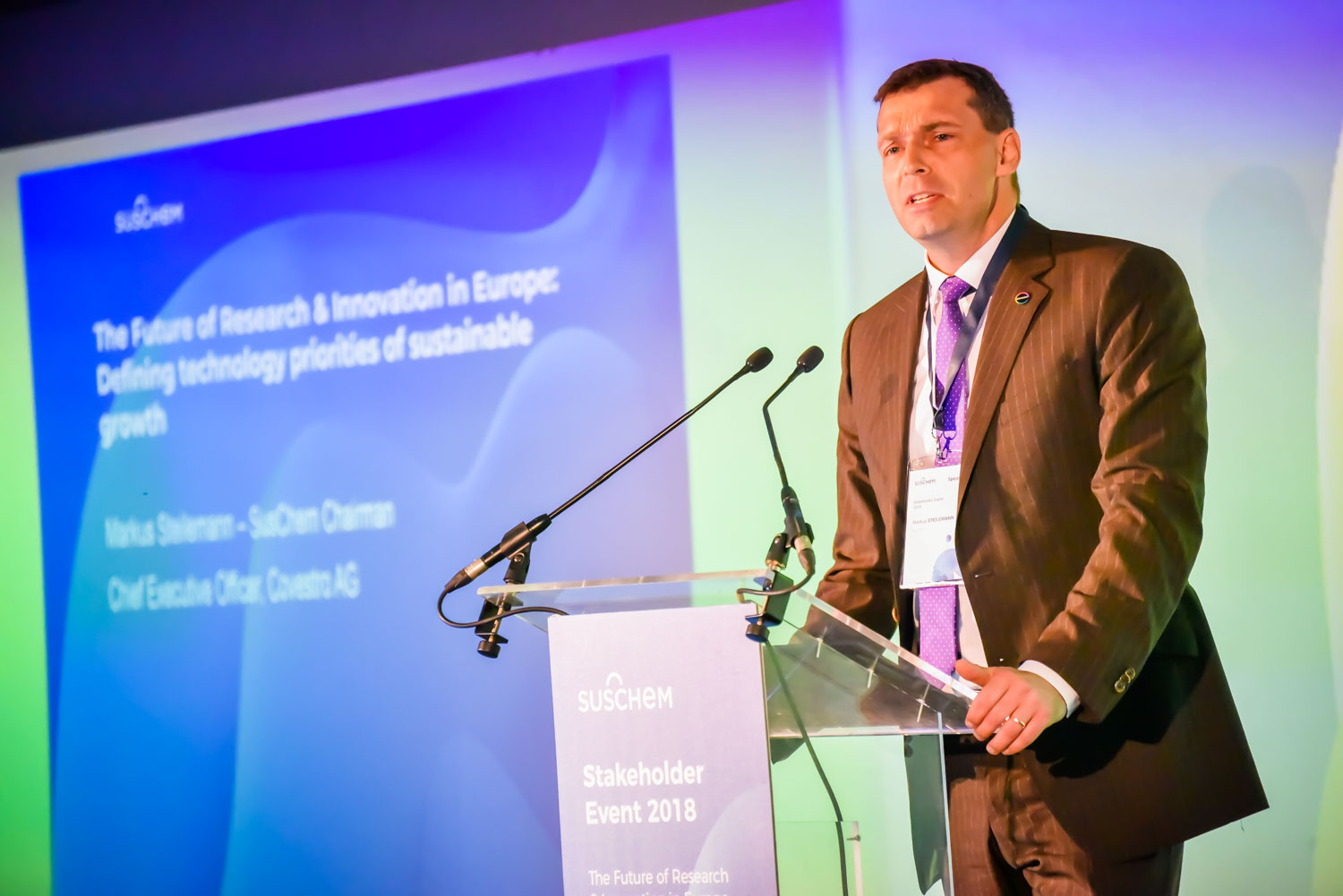
An opening keynote speech by Markus Steilemann, CEO of Covestro and SusChem chairman (pictured above), described the role of SusChem as: “responding to global challenges and EU priorities” by providing “innovation solutions based on sustainable chemistry.”

He also emphasised SusChem’s significant role in enabling a highly collaborative research and innovation environment by bringing together industry including small and medium-sized enterprises, academia and Research and Technology Organisations (RTOs) at a European level whilst connecting with regional and national programmes through its expanding network of National Technology Platforms (NTPs).

Steilemann called on all SusChem stakeholders to voice their priorities and help define the technology priorities for the next SusChem SIRA. The next SIRA will be a solid base for advising the European Commission on high-impact missions and priorities for Horizon Europe. SusChem will remain an active and engaged partner of the European Commission.

“We have demonstrated that SusChem enables the development of sustainable technologies that lead to sustainable products,” he concluded.

Horizon Europe
A second keynote speech was given by Ms. Signe Ratso, Deputy Director General at the Commission’s DG Research & Innovation (pictured below), focusing on the proposal for the next Research Framework programme: Horizon Europe.


Ratso sees Horizon Europe as our chance to shape the future: “Europe has world-class research and strong industries – our knowledge and skills are our main resources – but Europe fails to transform leadership into leadership in innovation and entrepreneurship.” Horizon Europe – although an “evolution rather than revolution” aimed to address that.

Key novelties in the programme proposal were the increased support for breakthrough innovation (via mission-oriented research), the ambition to create more impact, and a more strengthened international cooperation. Horizon Europe also aims to reinforce openness.

In terms of the ‘missions’ concept, Ratso underlined the need for missions to connect with citizens and be “bold and inspirational” while having measurable goals that could be achievable in around a ten-year time frame. Activities in missions should be across-sectors, involve actors from different disciplines and work along value chains. She invited all partners to work together on further shaping Horizon’s Europe missions and looked forward to SusChem’s input to the programme.

Defining technology priorities
One of the main focus points of the event was to start the consultation process to build the new SusChem Strategic Innovation and Research Agenda (SIRA). Two parallel breakout sessions covered advanced materials and advanced process technologies. Both sessions considered the role of Digital Technologies as an enabler for designing better performing materials and processes. More specifically, the sessions initiated the debate on technology priorities and looked to identify experts who could contribute to the development of the next SIRA.

The materials session focused on three thematic clusters: circularity for materials; energy storage, production and efficiency; and functionality and performance. The advanced process technology themes were: digital technologies for process design and control, waste as feedstock, fossil-based feedstock, biobased feedstock, and CO2 as feedstock. The sessions identified technology clusters that require further attention as well as the following broad issue areas: sustainability assessment; skills, consumer awareness, and education and training.


All the input gathered at #suschem2018 will be assessed and processed further to form the basis of the new SIRA together with additional expert input from SusChem working groups that are currently being set-up.

Expanding ecosystem
The SusChem National Technology Platforms discussed how they approached stakeholder engagement in their countries and gave examples of the successful formation of consortia and transnational collaborations. Moreover, they reflected on how to enhance their role even further together with the SusChem ETP. Representatives from nine of SusChem’s 17 NTPs were involved in the debate moderated by Susanne Coles (SusChem UK).

The session was also a great opportunity to present the three new national platforms – Bulgaria, Finland and Sweden - that were approved for membership by the SusChem board the day before the event. SusChem also welcomed Andreas Falk (SusChem Austria) as the new Chair of the NTPs network for the following year.


#suschem2018 concluded with a wide-ranging debate, led by Marco Mensink Director General of Cefic, which explored the priorities required to maintain Europe’s leading role in global innovation and how the structure of Horizon Europe can mobilise our innovation ecosystems. The panel included Peter Dröll, Director Industrial Technologies at Commission’s DG Research & Innovation, Prof. Ferdi Schüth, Vice-President of the Max-Planck-Society, Kateřina Šebková, Director of the Stockholm Regional Centre for Central and Eastern Europe, Martin Stephan, Deputy CEO of CARBIOS, and Olaf Wachsen, Head of Group Process Technology, Clariant.

Panel members called for the continuation of enduring partnerships and collaborations created through programmes like Horizon 2020, which were considered more valuable than the funding per se. They suggested that Horizon Europe could be seen as a part of the EU’s vision to reindustrialise Europe.  The continuation of Key Enabling Technologies (KETs) and the need to bring together all of the bright minds of Europe, were other prominent points stressed by the panel, no country can bring about change alone.

Future path
#suschem2018 has successfully set the course to develop the next SusChem SIRA. It has continued the vibrant dialogue with our platform’s stakeholders and the European Commission on future orientations for sustainable chemistry research and innovation to enable the development of technologies and that will meet EU global challenges.


The process continues at the next major SusChem event: our 2018 Brokerage event that will be held on 23 October 2018 at Hotel Le Plaza, Brussels and will cover later sustainable chemistry relevant calls for Horizon 2020. Save the date!

Tuesday, 19 June 2018

Spotlight on MAKE, CREATE and LEVERAGE at #suschem2018

Join us at the 2018 SusChem Stakeholder Event - #SusChem2018 - on 20 June 2018 your number one destination for innovation policy dialogue and debate this summer. The 2018 Stakeholder event takes place at the Thon Hotel City Centre in Brussels and will be a great opportunity to voice your priorities and help define SusChem’s input into the next EU Framework Funding Programme: Horizon Europe.

This year’s theme is "The Future of Research & Innovation in Europe: Defining Technology Priorities for Sustainable Growth" and will bring together global audiences, senior players from the chemical industry, academia, research technology organisations (RTOs) and EU institutions to address common innovation challenges and debate priorities crucial to the sustainability of the European chemical and biotechnology sectors.


At the event Stakeholder input will be collected through two carefully designed parallel breakout sessions: one on Advanced Materials (CREATE) and the other on Advanced Process Technologies (MAKE). Input from both sessions will contribute to our future strategic research and innovation agenda beyond 2020.These two technology areas are complimented by Digital Technologies (LEVERAGE) and will also feature at #suschem 2018. All three themes are described in the video above.

All three of these SusChem Key Enabling Technologies (KETs) featured in SusChem’s recent white paper on the potential for KETs in Horizon Europe. The white paper outlined the major technology developments and initiatives needed to ‘create’ advanced materials, ‘develop’ advanced process technologies and ‘leverage’ digital technologies.

See you at #suschem2018!

Wednesday, 13 June 2018

Spotlight on Digital Technologies at #SusChem2018

Join us at the 2018 SusChem Stakeholder Event - #SusChem2018 - your number one destination for innovation policy dialogue and debate this summer. The 2018 Stakeholder event takes place at the Thon Hotel City Centre in Brussels on 20 June 2018 and will give you the opportunity to voice your priorities and help define SusChem’s input into the next EU Framework Funding Programme: Horizon Europe.

This year’s theme is "The Future of Research & Innovation in Europe: Defining Technology Priorities for Sustainable Growth" and will bring together global audiences, senior players from the chemical industry, academia, research technology organisations (RTOs) and EU institutions to address common innovation challenges and debate priorities crucial to the sustainability of the European chemical and biotechnology sectors.

At the event Stakeholder input will be collected through two carefully designed parallel breakout sessions: one on Advanced Materials and the other on Advanced Process Technologies. Input from both sessions will contribute to our future strategic research and innovation agenda beyond 2020.These two technology areas are complimented by Digital Technologies and will also feature at #SusChem 2018.

Spotlight on Digital Technologies
The chemical industry is an enabler for the continuous development of smarter and more sustainable electronic devices and equipment in other industries. The chemical industry is itself being transformed and disrupted through digitalisation. We have a real opportunity to leverage the immense capabilities of information and communication technologies (ICT) to optimise our processes and improve our production efficiency. Watch our social spotlight video ‘LEVERAGE’ with Martin Winter from the SusChem Management Team.


Watch out for our other Social Media Spotlights on Advanced Materials (CREATE) and Advanced Processes (MAKE).

All three of these SusChem Key Enabling Technologies (KETs) featured in SusChem’s recent white paper on the potential for KETs in Horizon Europe. The white paper outlined the major technology developments and initiatives needed to ‘create’ advanced materials, ‘develop’ advanced process technologies and ‘leverage’ digital technologies.

Debate at #SusChem2018
All three SusChem KETs will be debated and discussed at #SusChem2018. Our keynote speakers include: Signe Ratso, Deputy Director-General – Directorate Research and Innovation (RTD), EU Commission; Joanna Dupont-Inglis, Director of Industrial Biotechnology at EuropaBio, and SusChem Board Member; Markus Steilemann, Chief Commercial Officer & Member of Management Board, Covestro and Chair of the SusChem Board; and Marco Mensink, Director General of Cefic, the European Chemical Industry Council.

Register today for a chance to define the technology priorities needed to shape Europe’s sustainable future. You can download a full list of speakers here.

Wednesday, 16 May 2018

Spotlight on Advanced Process Technologies at #SusChem2018

Join us at the 2018 SusChem Stakeholder Event - #SusChem2018 - your number one destination for innovation policy dialogue and debate this summer. The 2018 Stakeholder event takes place at the Thon Hotel City Centre in Brussels on 20 June 2018 and will give you the opportunity to voice your priorities and help define SusChem’s input into the next EU Framework Funding Programme: Horizon Europe.

This year’s theme is "The Future of Research & Innovation in Europe: Defining Technology Priorities for Sustainable Growth" and will bring together global audiences, senior players from the chemical industry, academia, research technology organisations (RTOs) and EU institutions to address common innovation challenges and debate priorities crucial to the sustainability of the European chemical and biotechnology sectors.

At the event Stakeholder input will be collected through two carefully designed parallel breakout sessions: one on Advanced Materials and the other on Advanced Process Technologies. Input from both sessions will contribute to our future strategic research and innovation agenda beyond 2020.

Spotlight on Advanced Process Technologies
Advanced Process Technology developments are crucial to the transition to a more circular, energy efficient, and carbon neutral industry and feature at #SusChem2018. Watch our social spotlight video 'MAKE' on Advanced Processes with Sophie Wilmet from the SusChem Management Team:


Watch out for future Social Spotlights on Advanced Materials (CREATE) and Digital Technologies (LEVERAGE).

All three of these SusChem Key Enabling Technologies (KETs) featured in SusChem’s recent white paper on the potential for KETs in Horizon Europe. The white paper outlined the major technology developments and initiatives needed to ‘create’ advanced materials, ‘develop’ advanced process technologies and ‘leverage’ digital technologies.

SusChem speakers
Our keynote speakers include: Signe Ratso, Deputy Director-General – Directorate Research and Innovation (RTD), EU Commission; Joanna Dupont-Inglis, Director of Industrial Biotechnology at EuropaBio, and SusChem Board Member; Markus Steilemann, Chief Commercial Officer & Member of Management Board, Covestro and Chair of the SusChem Board; and Marco Mensink, Director General of Cefic, the European Chemical Industry Council.

Register today for a chance to define the technology priorities needed to shape Europe’s sustainable future. You can download a full list of speakers here.