The SusChem News Blog is now hosted on the SusChem website in the News Room. You will be redirected there in 10 seconds
.

Showing posts with label digital technology. Show all posts

Monday, 11 February 2019

Data in Materials and Manufacturing

The impact and opportunities associated with digital technologies in the chemical and other process industries is an area of increasing importance for both SusChem and SPIRE. SusChem has already put the spotlight on digital technologies. Sustainable chemistry acts as an enabler for the continuous development of smarter and more sustainable electronic devices and equipment in other industries, while also being transformed and disrupted through digitalisation. This later topic was a major theme at the 2019 EU Industry Day event on 5 and 6 February where SusChem participated.

The European Commission’s EU Industry Days 2019 focused on key industrial challenges such as sustainability, digitalisation, investment and globalisation. The event demonstrated how EU industrial policy benefits European citizens and provided input for future policy making.

Martin Winter, Innovation Manager at Cefic and the lead contact for digital technologies for both SusChem and SPIRE was part of a panel discussion on ‘Data in Materials and Manufacturing’ on the second day of the event. 

There is a real opportunity to leverage the immense capabilities of information and communication technologies (ICT) to optimise processes and improve production efficiency within the chemical and process industries. Martin initially explained how data technologies including blockchain and artificial intelligence will become important for recycling and reuse of materials within the process industries to enable a more circular economy. 

3D-printed catalytic reactors
As an example of the potential impact of digital technologies in the chemical sector he described the SPIRE Horizon 2020 project ‘PRINTCR3DIT’. “This is the first EU-funded initiative on modelling the effect of 3D-printing technologies for both reactor and catalyst design in the chemical industries,” said Martin Winter. The project is part of a significant portfolio of digital technology projects managed by the SPIRE cPPP. 


He also emphasised the essential role of Public-Private-Partnerships (cPPPs) like SPIRE or Big Data Value PPP in bringing the relevant data-related innovation ecosystems together and accelerating the uptake of technologies from research into use in industry. Martin Winter presented the substantial portfolio of digital projects within SPIRE and emphasised the need for new digital skills for chemists and engineers working in the new digital era. 

Other speakers in the session highlighted the enormous opportunities that integrated data management could yield together with the barriers that are currently inhibiting their full exploitation. Interoperability was a major issue and much of the discussion centred around ontology – the formal naming and categorisation of data sets – as a key area of work to enable data transfer.

Martin Winter noted some issues in terms of value creation through advanced data analytics. In process industries better data availability, data storage, cybersecurity and advanced data analytics are becoming very important. He also called for a co-creation process to accelerate progress.

There is a need to fully leverage synergies between cPPPs. “SPIRE, Big Data Value and Cybersecurity PPPs must work together here,” he said. “If Europe is lagging behind in this area, it is very important that we avoid any possibility of duplication of work.”

Friday, 13 July 2018

SusChem and KETs in Horizon Europe

SusChem has updated and enlarged its position paper on the potential impact of Key Enabling Technologies (KETs) in the next EU Research and Innovation (R&I) Framework Programme: Horizon Europe. The paper, originally published in February, outlines SusChem’s views on KETs in relation to sustainable chemistry and now includes 11 case study examples derived from SusChem inspired FP7 and Horizon 2020 projects.

The paper 'Impact: Key Enabling Technologies in Horizon Europe' calls for strong support for EU future technology competitiveness and argues that sustainable chemistry is essential for the technological advance of many KETs from advanced materials to photonics and industrial biotechnology.

SusChem believes that that Horizon Europe should firmly embrace KETs as drivers of technology development for jobs and growth and the white paper focuses on their potential positive impact on society.

KETs of specific interest to SusChem, such as advanced materials, advanced process technologies and industrial biotechnology, are essential to address societal challenges and accelerate the development of a low-carbon economy, circular economy and enable the energy transition.

SusChem also recognises the need to integrate digital technologies into process technologies, materials development and new business models. SusChem believes that synergies between current KETs and new digital KETs can accelerate the creation of new markets, growth and jobs.

Create, develop, leverage
The SusChem White Paper details the major technology developments and initiatives needed to:
  • Create Advanced Materials for use in energy efficiency (e.g., light weight), renewable electricity production and energy storage (e.g., batteries elements), or smart functionalities responding to stimuli (e.g., self-repair).
  • Develop Advanced Process Technologies, including Industrial Biotechnology, for more sustainable production including through utilisation of alternative carbon feedstock (waste, biomass, CO2) and alternative energy sources.
  • Leverage Digital Technologies for use in advanced process control and materials modelling, to enable disruptive business models and to create new customer experiences.

Examples
All three areas give examples of how the KETs can make a difference to achieving societal policy goals and are illustrated by case study examples from completed SusChem projects.

The paper calls for on the European Commission to ensure strong support for KETs in Horizon Europe. You can download and read the report here.

Wednesday, 27 June 2018

#suschem2018 starts defining technology priorities for Horizon Europe

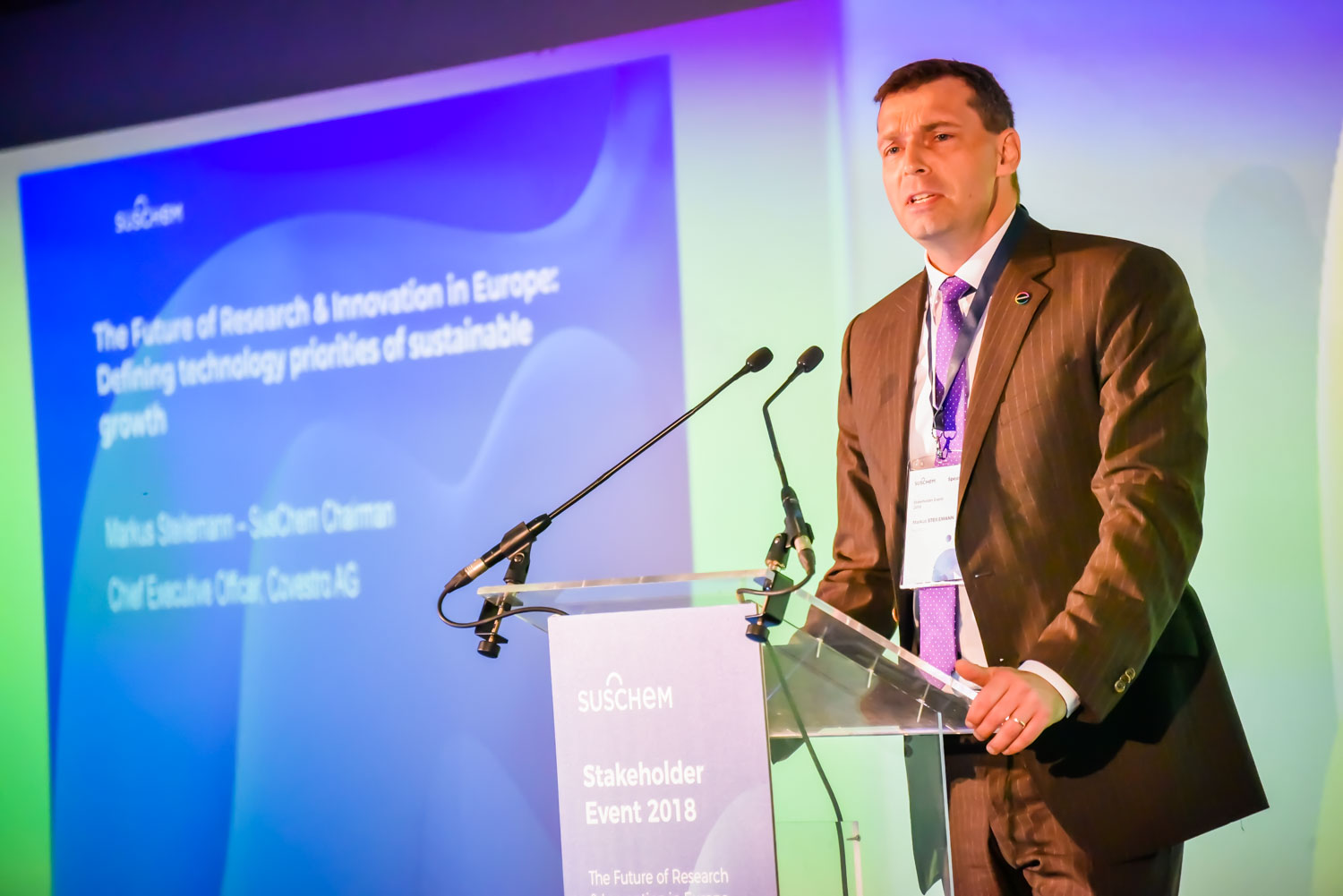
On 20 June, at its 16th Annual Stakeholder event (#suschem2018) in Brussels, the European Technology Platform for Sustainable Chemistry (SusChem) started the collaborative process to build a new Strategic Innovation and Research Agenda (SIRA) for Horizon Europe.

The SusChem stakeholder event was a great opportunity to underline SusChem’s role and vision under Horizon Europe. The keynote speech given by the European Commission presented the novel elements and opportunities in the new framework programme (2021-2027). Focusing on priorities for advanced materials, advanced processes and associated digital technologies, the initial task of identifying technology priorities was initiated. The SusChem innovation ecosystem was also boosted by the addition of three new National Technology Platforms (Bulgaria, Finland and Sweden). The day was completed with a lively and provocative panel discussion on how to leverage the strength of the innovation ecosystem as a whole to boost the competitive position of Europe in Research and Innovation.


An opening keynote speech by Markus Steilemann, CEO of Covestro and SusChem chairman (pictured above), described the role of SusChem as: “responding to global challenges and EU priorities” by providing “innovation solutions based on sustainable chemistry.”

He also emphasised SusChem’s significant role in enabling a highly collaborative research and innovation environment by bringing together industry including small and medium-sized enterprises, academia and Research and Technology Organisations (RTOs) at a European level whilst connecting with regional and national programmes through its expanding network of National Technology Platforms (NTPs).

Steilemann called on all SusChem stakeholders to voice their priorities and help define the technology priorities for the next SusChem SIRA. The next SIRA will be a solid base for advising the European Commission on high-impact missions and priorities for Horizon Europe. SusChem will remain an active and engaged partner of the European Commission.

“We have demonstrated that SusChem enables the development of sustainable technologies that lead to sustainable products,” he concluded.

Horizon Europe
A second keynote speech was given by Ms. Signe Ratso, Deputy Director General at the Commission’s DG Research & Innovation (pictured below), focusing on the proposal for the next Research Framework programme: Horizon Europe.


Ratso sees Horizon Europe as our chance to shape the future: “Europe has world-class research and strong industries – our knowledge and skills are our main resources – but Europe fails to transform leadership into leadership in innovation and entrepreneurship.” Horizon Europe – although an “evolution rather than revolution” aimed to address that.

Key novelties in the programme proposal were the increased support for breakthrough innovation (via mission-oriented research), the ambition to create more impact, and a more strengthened international cooperation. Horizon Europe also aims to reinforce openness.

In terms of the ‘missions’ concept, Ratso underlined the need for missions to connect with citizens and be “bold and inspirational” while having measurable goals that could be achievable in around a ten-year time frame. Activities in missions should be across-sectors, involve actors from different disciplines and work along value chains. She invited all partners to work together on further shaping Horizon’s Europe missions and looked forward to SusChem’s input to the programme.

Defining technology priorities
One of the main focus points of the event was to start the consultation process to build the new SusChem Strategic Innovation and Research Agenda (SIRA). Two parallel breakout sessions covered advanced materials and advanced process technologies. Both sessions considered the role of Digital Technologies as an enabler for designing better performing materials and processes. More specifically, the sessions initiated the debate on technology priorities and looked to identify experts who could contribute to the development of the next SIRA.

The materials session focused on three thematic clusters: circularity for materials; energy storage, production and efficiency; and functionality and performance. The advanced process technology themes were: digital technologies for process design and control, waste as feedstock, fossil-based feedstock, biobased feedstock, and CO2 as feedstock. The sessions identified technology clusters that require further attention as well as the following broad issue areas: sustainability assessment; skills, consumer awareness, and education and training.


All the input gathered at #suschem2018 will be assessed and processed further to form the basis of the new SIRA together with additional expert input from SusChem working groups that are currently being set-up.

Expanding ecosystem
The SusChem National Technology Platforms discussed how they approached stakeholder engagement in their countries and gave examples of the successful formation of consortia and transnational collaborations. Moreover, they reflected on how to enhance their role even further together with the SusChem ETP. Representatives from nine of SusChem’s 17 NTPs were involved in the debate moderated by Susanne Coles (SusChem UK).

The session was also a great opportunity to present the three new national platforms – Bulgaria, Finland and Sweden - that were approved for membership by the SusChem board the day before the event. SusChem also welcomed Andreas Falk (SusChem Austria) as the new Chair of the NTPs network for the following year.


#suschem2018 concluded with a wide-ranging debate, led by Marco Mensink Director General of Cefic, which explored the priorities required to maintain Europe’s leading role in global innovation and how the structure of Horizon Europe can mobilise our innovation ecosystems. The panel included Peter Dröll, Director Industrial Technologies at Commission’s DG Research & Innovation, Prof. Ferdi Schüth, Vice-President of the Max-Planck-Society, Kateřina Šebková, Director of the Stockholm Regional Centre for Central and Eastern Europe, Martin Stephan, Deputy CEO of CARBIOS, and Olaf Wachsen, Head of Group Process Technology, Clariant.

Panel members called for the continuation of enduring partnerships and collaborations created through programmes like Horizon 2020, which were considered more valuable than the funding per se. They suggested that Horizon Europe could be seen as a part of the EU’s vision to reindustrialise Europe.  The continuation of Key Enabling Technologies (KETs) and the need to bring together all of the bright minds of Europe, were other prominent points stressed by the panel, no country can bring about change alone.

Future path
#suschem2018 has successfully set the course to develop the next SusChem SIRA. It has continued the vibrant dialogue with our platform’s stakeholders and the European Commission on future orientations for sustainable chemistry research and innovation to enable the development of technologies and that will meet EU global challenges.


The process continues at the next major SusChem event: our 2018 Brokerage event that will be held on 23 October 2018 at Hotel Le Plaza, Brussels and will cover later sustainable chemistry relevant calls for Horizon 2020. Save the date!

Tuesday, 19 June 2018

Spotlight on MAKE, CREATE and LEVERAGE at #suschem2018

Join us at the 2018 SusChem Stakeholder Event - #SusChem2018 - on 20 June 2018 your number one destination for innovation policy dialogue and debate this summer. The 2018 Stakeholder event takes place at the Thon Hotel City Centre in Brussels and will be a great opportunity to voice your priorities and help define SusChem’s input into the next EU Framework Funding Programme: Horizon Europe.

This year’s theme is "The Future of Research & Innovation in Europe: Defining Technology Priorities for Sustainable Growth" and will bring together global audiences, senior players from the chemical industry, academia, research technology organisations (RTOs) and EU institutions to address common innovation challenges and debate priorities crucial to the sustainability of the European chemical and biotechnology sectors.


At the event Stakeholder input will be collected through two carefully designed parallel breakout sessions: one on Advanced Materials (CREATE) and the other on Advanced Process Technologies (MAKE). Input from both sessions will contribute to our future strategic research and innovation agenda beyond 2020.These two technology areas are complimented by Digital Technologies (LEVERAGE) and will also feature at #suschem 2018. All three themes are described in the video above.

All three of these SusChem Key Enabling Technologies (KETs) featured in SusChem’s recent white paper on the potential for KETs in Horizon Europe. The white paper outlined the major technology developments and initiatives needed to ‘create’ advanced materials, ‘develop’ advanced process technologies and ‘leverage’ digital technologies.

See you at #suschem2018!

Wednesday, 13 June 2018

Spotlight on Digital Technologies at #SusChem2018

Join us at the 2018 SusChem Stakeholder Event - #SusChem2018 - your number one destination for innovation policy dialogue and debate this summer. The 2018 Stakeholder event takes place at the Thon Hotel City Centre in Brussels on 20 June 2018 and will give you the opportunity to voice your priorities and help define SusChem’s input into the next EU Framework Funding Programme: Horizon Europe.

This year’s theme is "The Future of Research & Innovation in Europe: Defining Technology Priorities for Sustainable Growth" and will bring together global audiences, senior players from the chemical industry, academia, research technology organisations (RTOs) and EU institutions to address common innovation challenges and debate priorities crucial to the sustainability of the European chemical and biotechnology sectors.

At the event Stakeholder input will be collected through two carefully designed parallel breakout sessions: one on Advanced Materials and the other on Advanced Process Technologies. Input from both sessions will contribute to our future strategic research and innovation agenda beyond 2020.These two technology areas are complimented by Digital Technologies and will also feature at #SusChem 2018.

Spotlight on Digital Technologies
The chemical industry is an enabler for the continuous development of smarter and more sustainable electronic devices and equipment in other industries. The chemical industry is itself being transformed and disrupted through digitalisation. We have a real opportunity to leverage the immense capabilities of information and communication technologies (ICT) to optimise our processes and improve our production efficiency. Watch our social spotlight video ‘LEVERAGE’ with Martin Winter from the SusChem Management Team.


Watch out for our other Social Media Spotlights on Advanced Materials (CREATE) and Advanced Processes (MAKE).

All three of these SusChem Key Enabling Technologies (KETs) featured in SusChem’s recent white paper on the potential for KETs in Horizon Europe. The white paper outlined the major technology developments and initiatives needed to ‘create’ advanced materials, ‘develop’ advanced process technologies and ‘leverage’ digital technologies.

Debate at #SusChem2018
All three SusChem KETs will be debated and discussed at #SusChem2018. Our keynote speakers include: Signe Ratso, Deputy Director-General – Directorate Research and Innovation (RTD), EU Commission; Joanna Dupont-Inglis, Director of Industrial Biotechnology at EuropaBio, and SusChem Board Member; Markus Steilemann, Chief Commercial Officer & Member of Management Board, Covestro and Chair of the SusChem Board; and Marco Mensink, Director General of Cefic, the European Chemical Industry Council.

Register today for a chance to define the technology priorities needed to shape Europe’s sustainable future. You can download a full list of speakers here.

Friday, 25 May 2018

First Open Call for ‘CloudiFacturing’ announced

The first open call for involvement with the 'CloudiFacturing' project in the European Commission’s I4MS Funding Programme has been announced. This great funding opportunity, especially focused on SME participation, is for: Testing and implementation of the latest high-performance computing and modelling technologies.

The European Union's initiative ICT Innovation for Manufacturing SMEs (I4MS) connects SMEs, startups and mid-cap companies with European Digital Innovation Hubs, who can help companies to test and adopt the latest digital technologies.

CloudiFacturing - Cloudification of Production Engineering for Predictive Digital Manufacturing - is a European Innovation Action (IA) in the framework of Factories of the Future (FoF) PPP with the mission of optimising production processes and producibility, using Cloud/HPC-based modelling and simulation, and leveraging online factory data with advanced data analytics; thus, contributing to the competitiveness and resource efficiency of manufacturing companies, especially SMEs.

To pursue this mission, computationally demanding production engineering and simulation, as well as data analytics tools, are to be provided as Cloud services to ease accessibility and make their use more affordable. With the Open Call, I4MS is seeking innovative use cases in the context of the project’s mission.

Use case impact
The use cases should clearly state their industrial impact for the involved manufacturing companies, based on their expected benefit from exploiting computational engineering and production services and workflows powered by the CloudiFacturing technology.  

The call comprises:

  1. simulations of manufacturing processes or manufacturing tools,
  2. leveraging factory data to learn from it, and
  3. optimising manufacturing processes and/or the manufacturability of goods
The use cases need to be driven by the ultimate end user, preferably SMEs. Seven or more Application Experiments are planned to be funded in this call which has an overall European Commission contribution of roughly EUR 700 000.

The call opening date is 1 July 2018 and the closing date will be 30 September 2018. The duration of the successful funded experiments will be 12 months from 1 January to 31 December 2019.

More information including how to access the call through regional Digital Innovation Hubs can be found in this download document and/ or via this web link.

Tuesday, 20 February 2018

SusChem publishes views on Key Enabling Technologies (KETs) in FP9

In preparation for the next Research and Innovation (R&I) Framework Programme (FP9), the European Technology Platform for Sustainable Chemistry (SusChem) has today (19 February 2018), publishes a new paper outlining its position on what can be achieved by Key Enabling Technologies (KETs).

The paper 'Key Enabling Technologies in FP9' calls for strong support for EU future technology competitiveness and details the major technology developments and initiatives needed to:

  • Create Advanced Materials for use in energy efficiency (e.g., light weight), renewable electricity production and energy storage (e.g., batteries elements), or smart functionalities responding to stimuli (e.g., self repair).
  • Develop Advanced Process Technologies, including Industrial Biotechnology, for more sustainable production including through utilisation of alternative carbon feedstock (waste, biomass, CO2) and alternative energy sources.
  • Leverage Digital Technologies for use in advanced process control and materials modelling, to enable disruptive business models and to create new customer experiences.

The paper calls for on the European Commission to ensure strong support for KETs in the next Framework Funding Programme. You can download and read the paper here.

European Commission publishes its priorities for the EU Budget Post-2020

On 14 February the European Commission published a Communication outlining the various options and their financial consequences for the next long-term EU budget (the Multi-annual Financial Framework or MFF) after 2020. The Communication, entitled ‘A new, modern Multiannual Financial Framework for a European Union that delivers efficiently on its priorities post-2020’, was prepared ahead of an informal meeting of EU Leaders that takes place on 23 February 2018.

The Communication argues that the first step for reforming the EU budget is to define what Europe wants to do together and agree on priorities. Secondly, the EU needs the right instruments to be able to act quickly in response to external developments.

Commenting on the Communication, European Commission President Jean-Claude Juncker said: "Budgets are not bookkeeping exercises – they are about priorities and ambition. They translate our future into figures. So, let's first discuss about the Europe we want. Then, Member States must back their ambition up with the money to match. And whilst we all need to understand that business as usual is not an option for this upcoming discussion, I firmly believe that we can square the circle and agree on a budget where everyone will be a net beneficiary.”

The Commission is contributing to the MFF discussion in three ways: First, by providing the necessary facts about the EU budget, its benefits, achievements and added value. Second, by drawing up scenarios which illustrate the financial impact of various possible policy choices. And third, by showing the consequences for students, researchers, infrastructure projects and others should the adoption of the new EU budget be delayed.

EU added value for innovation 
The Communication covers numerous areas of interest to innovation and sustainability and argues that investment is increasingly focused on programmes directly managed at European level and in areas such as research and innovation, trans-European transport and energy networks, mobility programmes for young people and Europe's external action, and that the principle of European added value should shape the future MFF.

Research and innovation and digitisation – clear SusChem priorities - are high on the Commission’s list. The EU currently spends close to EUR 80 billion on the Horizon 2020 programme. The Commission states that maintaining or lowering this budget post 2020 would not address the problem of underfunding, while an increase by 50% to EUR 120 billion would create an estimated 420,000 additional jobs by 2040. Doubling the Framework Programme to EUR 160 billion would create an estimated 650,000 jobs by 2040.

For digitalisation the current EU spend for data infrastructure, connectivity and digital skills is around EUR 35 billion. The Commission notes that maintaining or even lowering current investment levels would risk compromising the EU’s ability to remain competitive while doubling the amounts invested in the digital economy to around EUR 70 billion would deliver strong progress.

Modernisation and financing
The paper also examines how the EU ‘can do more with less’ and sources of finance for the budget.
One option to improve the efficiency and impact of instruments aiming at investment support would be to integrate them into one single investment support instrument. This would further reinforce the European Fund for Strategic Investment and have a positive impact on investment levels, economic growth and employment across the EU. The Commission foresee that wider uptake could more than double the investments mobilised over the next MFF up to EUR two trillion.

Ideas for sources of finance for the MFF include a revamped EU Emissions Trading System (ETS) that could generate revenues up to EUR 105 billion over seven years; access to VAT-based resources, and a Common Consolidated Corporate Tax Base.

Other areas covered in the Communication include mobility of young people, specifically the ‘Erasmus+’ programme; Economic and Monetary Union; Cohesion Policy; the Common Agricultural Policy (CAP); external borders and defence.

Next steps
The European Commission will table its formal proposal for the next long-term EU budget in the coming months, at the latest in early May 2018. In the meantime, the Commission will continue listening to all stakeholders, including via the public consultations on the priorities of the EU that were launched in January 2018.

For more detailed information on the MFF process and to access ongoing stakeholder consultations on the shape of the MFF post 2020, please visit the DG Budget website.

Thursday, 14 April 2016

SusChem Stakeholder Event 2016: Sustainable Chemistry Innovation for Competitiveness


Registration is now open for this year’s SusChem Stakeholder event! Under the overarching theme ‘Sustainable Chemistry Innovation for Competitiveness’ the event will take place on 16 June 2016 at The Bloom Hotel in Brussels, Belgium.

The SusChem Stakeholder Event is the biggest annual event held by the European Technology Platform for Sustainable Chemistry (SusChem) and brings together the chemical industry, academia, Research Technology Organisations and EU policy representatives to address common challenges and debate priorities in the European chemical and biotechnology innovation sectors.

Following the extensive discussions at our successful 2015 Stakeholder event, significant progress has been made on five crucial innovation priorities areas that were identified at that event:
  • Sustainable bio-economy
  • ICT for processes
  • Water
  • Catalysis
  • Materials for energy
What’s happening?
This year’s event will include a number of exciting activities and present important new developments for the SusChem community, including two lively high-level panel debates to discuss the recently published European Commission Innovation Strategy packages on:
These two interactive panels will bring together strategy experts from the European Commission and captains of industry to discuss the hot topics surrounding these major policy packages such as:
  • Identifying new challenges in and opportunities for sustainable chemistry,
  • Identifying areas of consensus that align with the priorities of the European Commission and the European chemical industry, and
  • Defining news ways forward to ensure that the five crucial SusChem innovation priorities identified above are systematically considered in these two high-level policy initiatives.
We hope for a highly interactive debate and welcome your questions and expectations on the outcomes of the panels before the event (see below).

The SusChem event will also present the latest news and activities from our SusChem National Technology Platforms (NTPs).

Event objectives
The SusChem Stakeholder Event will be, as usual, a high-level initiative that aims to:
  • Improve dialogue between our stakeholders;
  • Identify innovation drivers for the future;
  • Present the European chemical industry as a solution provider to address societal challenges;
  • Promote a common view between the chemical industry and the European Commission to increase synergies and develop shared solutions on innovation priority areas.
Registration
A dedicated registration website has been set up for the event that includes links to discounted accommodation at the Hotel Bloom.

To ensure full, open and interactive discussions on current innovation priorities and to identify those that are missing from the European Commission packages, you are invited to submit your questions for the panels and also your expectations for outcomes from these two high-level panel debates as part of the registration process. You can submit your questions and comments when you register and there will also be a link for question submission sent with the registration confirmation email.

You can register here. For more information on registration, please contact the SusChem secretariat.


Monday, 1 February 2016

Save the date: Industrial Technologies - Creating a Smart Europe June 22-24

The Netherlands Presidency of the European Union will be hosting the European Conference Industrial Technologies 2016 to be held from 22 to 24 June 2016 at the RAI Conference Centre in Amsterdam.

Industrial Technologies 2016 will be the largest networking conference in the field of new production technologies, materials, nanotechnology, biotechnology and digital technologies in Europe with more than 1 250 high level delegates expected.

The conference's advisory board includes a number of SusChem stakeholders - not least SusChem's Chairman of the Board Dr Klaus Sommer.

"Innovation is the basis of Europe’s competitiveness. In particular piloting and demonstration facilities are important to bridge the gap between research and competitive business," says Dr Sommer. "New technologies play a key role in this effort, signified by e.g. the focus on Key Enabling Technologies."

"Europe would benefit from a stronger sense of community between innovation and technology players. The conference is a great opportunity to network but also to emphasize the importance together with the European Commission," concludes Dr. Sommer.

Creating a Smart Europe
The three day conference will bring together personalities involved in research, industry, education, finance and policy activities from  manufacturing and process industry and technology domains from all over Europe to identify priorities that are crucial to strengthen the European industrial innovation ecosystem and deliver ‘A Smart Europe’.

Reasons to attend include:
  • Inspiring keynotes and eye-opening site visits
  • Interaction to identify priorities for the policy agenda
  • Networking with European players in research, industry, finance and policy
Registration is now open and 'early bird' fees will apply until 15 April.

A provisional schedule for the conference is available. To keep up to date with developments for the conference visit the conference website and subscribe to the conference newsletter. You can also follow the conference on Twitter via @IndTech16.