The SusChem News Blog is now hosted on the SusChem website in the News Room. You will be redirected there in 10 seconds
.

Showing posts with label sustainable development. Show all posts

Wednesday, 14 September 2016

G20 backs Innovation for Sustainable Growth

At the recent G20 Summit in Hangzhou, China the world’s leading nations adopted the G20 2016 Innovation ActionPlan. The ambitious plan underlines the recognition by G20 leaders of the need to “further advance innovation and assist member countries to create innovative ecosystems” in order to foster innovation-driven growth. This approach is broadly welcomed by SusChem as a long-time advocate of the need for innovation to drive sustainable development. “Sustainable chemistry is a major driving force for innovation in Europe and beyond and essential for smart and sustainable growth across all sectors,” said Pierre Barthélemy, Executive Director, Research and Innovation at Cefic.

In their
communique
issued at the end of the summit, the G20 leaders highlight that “in the long run, innovation is a key driver of growth for both individual countries and the global economy as a whole” and commit to pursue pro-innovation strategies, policies and measures supporting investment in science, technology and innovation.

The G20 communique noted that “To achieve innovation-driven growth and the creation of innovative ecosystems, we support dialogue and cooperation on innovation, which covers a wide range of domains with science and technology innovation at its core” and “commit to pursue pro-innovation strategies and policies, support investment in science, technology and innovation (STI), and support skills training for STI - including support for the entry of more women into these fields - and mobility of STI human resources”.

Pierre Barthélemy Executive Director R&I, Cefic
Commenting on the communique Pierre Barthélemy (left) said: “To truly tackle and solve our current societal challenges, Europe’s innovation landscape needs to be driven by a holistic approach. Innovation is not only about new technology development, it’s also about new ways of working together, having a workforce with the necessary skill-set, the integration of technology and working along value chains. This is the European chemical sector’s view on innovation.”

“Through its products and processes, innovation from the chemical industry is a major driving force for innovation as a whole in Europe and is essential for smart and sustainable growth across all sectors,” he continued.

The G20 also stressed that “growth, to be strong, sustainable and balanced, must also be inclusive… we place sustainable development high on the G20 agenda” and “reaffirm our commitment to further align our work with the universal implementation of the 2030 Agenda for Sustainable Development.”

A 2016 G20 Innovation Report will also be produced and released. As well as the Innovation Action Plan the G20 also published a G20 Blueprint on Innovative Growth at the Summit.

Thursday, 29 January 2015

Save the date: BIO-TIC Final Conference 23 June

The SusChem inspired FP7 BIO-TIC project will be holding its final conference entitled ‘From bugs to business! Unlocking the Bioeconomy in Europe’ on the afternoon of 23 June 2015 in central Brussels. The conference will provide all you need to know about industrial biotechnology (IB) in Europe in one compact and easily digestible event. It will be the place for you to embark on the bioeconomy journey! Registration for the event is now open and is free of charge.

The conference: ‘From bugs to business! Unlocking the Bioeconomy in Europe’ will start at 13h30 and will close at 17h30 with a networking cocktail reception. The event will take place at the Royal Flemish Academy for Sciences and Arts in Brussels. The full programme will be confirmed soon and will consist of two parts:
  • Part 1: Setting the scene - which will use case studies gathered during the project to illustrate the state of industrial biotechnology in Europe today
  • Part 2: Making industrial biotechnology happen – during which expert panel sessions will focus on how the recommendations that have emerged from the work of BIO-TIC can be implemented
The half-day conference will enable you to:
  • Learn about the opportunities provided by this key enabling technology
  • Witness the state of play of industrial biotechnology in Europe with keynote speeches from companies and government bodies
  • Engage in discussions during dedicated panel debates on the implementation of recommendations to build a booming industrial biotechnology sector and the European bioeconomy
  • Discuss with policy makers, industrial players, entrepreneurs and academia during the networking cocktail
  • Explore industrial biotechnology products and tools in the exhibition space
In addition on the following day (24 June) there will be an opportunity for delegates to visit the Bio Base Europe Pilot Plant facility in Ghent.

More details of the conference will be published on the conference website and the twitter hashtag #bioeconomy4EU has been created for the event.

IB for development
As well as examining the potential for the impact of industrial biotechnology in Europe, the BIO-TIC final links in with the focus for the European Year of Development (EYD2015) during the month of June, which is ‘Sustainable Green Growth, Decent Jobs and Businesses.’


The green economy and the bioeconomy have particular relevance for developing countries, as many are vulnerable to external shocks such as climate change, natural disasters or food and fuel crises. Sustainable green growth should be able to simultaneously alleviate poverty, protect the natural environment and ensure decent work with labour rights and standards, social protection and social dialogue all upheld.

Businesses are job creators and lead innovation and change, they are key to ensuring decent work and forging responsible and sustainable development. At the end of the day, development is about making investment and economic activity work for everyone, while also protecting our planet.

This ethos is very much at the heart of what SusChem and projects like BIO-TIC are striving to enable.

About BIO-TIC
This conference marks the final stage of the BIO-TIC project. BIO-TIC was launched in 2012 with the vision to investigate hurdles and critical success factors to deploy industrial biotechnology in Europe. Find out more at the project’s website.


Thursday, 9 October 2014

BIO-TIC looks at CO2 based chemicals

BIO-TIC's second business case workshop took place in Lyon on September 24 as a side event of the Third CO2 Forum conference entitled: ‘Large Volume CO2 Utilization Enabling Technologies for Energy and Resource Efficiency, 3rd Edition, The CO2 Forum, International Sustainable CO2 Chemical and Biochemical Recycling’ organised by CPE Lyon. The objective of the BIO-TIC workshop was to discuss the use of CO2 as a feedstock for Industrial Biotechnology (IB) processes and more specifically to discuss the barriers that hamper the development of IB for CO2 utilization.

The potential to use greenhouse gas carbon dioxide (CO2) as a feedstock for producing new materials is a hot topic currently and could help to develop a true circular economy.

To define the opportunities and hurdles in the “CO2 to Chemicals” business case the BIO-TIC workshop explored the role of industrial biotechnology in:

  • Direct production of chemicals through the transformation of CO2
  • “Artificial leaves”, using CO2, water, sunlight and a (semiconductor) catalyst to produce glucose as a feedstock for industrial biotechnological processes to produce chemicals

Hurdles identified
The delegates, from both academic and industrial backgrounds, identified the main hurdles for CO2 bioconversion technologies and sketched out a set of recommendations and concrete actions to overcome these hurdles. Participants also stressed the need for a close collaboration between IB experts, the chemical industry and the owners of CO2 sources, since CO2 bioconversion will require some level of customization such as tuning the IB processes to match the characteristics of different CO2 emission sources.

Overall the discussions with participants provided the BIO-TIC project partners with additional, focused input for the next and final version of the roadmap on Industrial Biotechnology, to be released at the end of the project in July 2015.

“Although there are already a few concrete projects, such as the fermentation of syngas, the general view of participants was that CO2 Bioconversion technologies could become viable in the 2020-2030 timeframe,” commented Pierre Barthelemy, Research and Innovation Manager at Cefic. “The most advanced process, including artificial photosynthesis, will require more time to become significant and could only play a role after 2030.”

What is BIO-TIC? 
Funded by the European Commission, BIO-TIC was launched, as an FP7 project, with the aim to establish an overview of the opportunities and barriers to biotechnology innovation and propose approaches to address them.

Modern use of industrial biotechnology is critical in a bio-based economy. Deploying the full potential of biotech innovation will enable European industry to deliver high-value products to consumers and create new commercial opportunities. New feedstock demands will lead to synergies amongst SMEs and large industrial partners. New technological developments will boost European export of technology and facilities by bringing some of Europe’s top sectors together: chemical industry, engineering and renewables.

However to date, major hurdles continue to hamper the full exploitation of biotechnology in Europe. These hurdles may vary from technological bottlenecks to limited availability of venture capital and fragmented policy frameworks.

BIO-TIC seeks to define product segments and applications that promise significant potential for Europe’s industry and society by 2030. Five major “bio-business cases” have been identified that are EU-competitive and have the potential to introduce cross-cutting technology ideas. The event in Lyon was the second in a series of five workshops looking at these identified product segments and applications.

Based on these business cases, BIO-TIC will develop three in-depth “bio-roadmaps”. These focus on the market potential, R&D priorities and non-technological hurdles of IB innovation. In particular, the market roadmap will provide market projections up to 2030. The technology roadmap will focus on setting R&D priorities and identifying needs for pilot and demonstration of plant activities. And, last but not least, the non-technological barriers roadmap will identify regulatory and non-technological hurdles that may inhibit industrial biotech innovation reaching new market opportunities. The second draft version of the roadmaps is already online while the final version will be released in July 2015.

All the BIO-TIC roadmaps can be downloaded from the BIO-TIC Partnering Platform. You can find more information on the BIO-TIC FP7 project here.

Thursday, 18 July 2013


SusChem is now leading the newly created “Industry Expert Group on Barriers to Innovation” in the European Innovation Partnership on Water. This group is charged with supporting a task force preparing a diagnosis report on barriers to innovation in the water sector. Composed of selected personnel with years of expertise in the field, the Expert Group will voice the industry’s position and preferences in overcoming the many hurdles impeding innovation in the sector.
The Expert Group is formed by associations and companies with strong stakes in the water sector:  the municipality of Kalundborg in Denmark, Dow Iberica, EuropaBio (EU)/BiosSciences KTN, Abengoa Water, ESTEP, Cefic, Tecnicas Reunidas/ETP SMR, VITO, SusChem Spain, Solutex, TNO, Arkema, Cyprus Universtity of Technology, Kemira, Dechema, Copenhagen Capacity, WssTP and SusChem.

The aim of the report is to present a real diagnosis of the current European situation and to suggest actions to be taken to accelerate innovation in water. The support of the Expert Group from the industrial sector ensures that the final report will take account of every obstacle to innovation so that proper solutions can be adopted.

SusChem’s role in the Expert Group confirms its strong commitment to contribute to innovation in water – a key area for chemistry in Europe in the years to come.

What is the EIP on Water?
European Innovation Partnerships aim to speed up innovations that contribute to solving societal challenges, enhance Europe's competitiveness and create jobs and growth.
As part of the Partnerships, the EIP Water aims to

·         speed up development of water innovation

·         contribute to sustainable growth and employment

·         stimulate uptake of water innovations by market and society
The EIP Water will develop tools to support water-related innovation. These tools will not necessarily be linked to the priorities of the EIP Water, but they will also be available to any party dealing with water and innovation.

Friday, 31 May 2013

Got ideas for a Sustainable Future?

YourFormula.eu – the Sustainability blogging platform - is running a great new competition: “Your ideas for a sustainable future”. The competition aims to encourage young people living in the EU to share their views on how chemistry can ensure that the way we live on our planet and use its resources becomes more sustainable. The best entry wins an iPad!


The YourFormula.eu competition is aimed at students and young professionals and is all about “chemistry for a sustainable future” – so we hope to see some creative “SusChem-style thinking”!

In 2050, more than 9 billion people will live on our planet. If we don’t change our behaviours, we will need the resources of three of our planets to meet the demands of this soaring population.

Innovation
Through innovation based on chemistry, we can provide solutions to this shortfall in key areas such as food production, energy, water, health and climate change.

Interested!? Then check out: “What is chemistry’s role in building a sustainable future?” and get thinking about what contribution sustainable chemistry will be making to a better future for everyone. Why not take a look at the SusChem website for some ideas and inspiration?

YourFormula is looking for original and creative thinking and your opinions. Entries can be submitted as:

  • A Youtube video;
  • A slideshow presentation, or
  • An image (such as a poster, an infographic or an advertisement).

Entries are sought from students and young professionals aged between 18 to 30 from the EU. You can submit entries directly onto the site and the contest runs until 15 July.

The best entry will be selected via a combination of a judging panel and the number of times entries are ‘liked’. ‘retweeted’ and otherwise shared via social media. The winner gets an iPad Mini.

To know more about YourFormula visit the website. You can also follow YourForumula on Twitter and on Facebook.

Tuesday, 30 April 2013

ICIS Innovation Awards 2013


ICIS Chemical Business has recently launched their Innovation Awards for 2013. And SusChem coordinator Dr. Jacques Komornicki will be part of the judging panel this year. The ICIS Innovation Awards were launched in 2004 by European Chemical News and are celebrating their tenth anniversary this year. The awards have grown in popularity with each succeeding year and SusChem has been proud to have contributed to their judging panels on many occasions.

Innovation is a key driver for growth and profitability in the chemical sector. And the ICIS Innovation Awards are designed to recognise the best in chemical innovation.

The awards are open to any chemical company or collaborative effort between industry and academia anywhere in the World. The judging panel will be looking for innovative projects that solve problems or provide solutions for the company or its customers or that demonstrate an innovative approach to business, the environment and sustainability.

"I am really pleased to be part of this year's ICIS Innovation awards judging panel," said Jacques. "And am looking forward to seeing some truly innovative and sustainable entries."

Jacques (pictured left) has extensive experience of both managing international, interdisciplinary research and development projects and translating business goals into R&D objectives and planning. These are skills that will come useful in the judging process.

Jacques joined Cefic as Innovation manager and SusChem coordinator in September 2012 following an industrial career, his last position being Global R&D Director 'Oxygenated Products' at the Arkema Centre de Recherche Rhône-Alpes (CRRA) in Lyon, France.

He has a masters degree in Chemical Engineering from ESPCI Paris Tech and he gained his PhD in Chemistry at the Paris VI University in 1981 with his thesis on the “Application of Micro-Emulsions to Liquid-Liquid Metals Extraction”.

Other members of the 2013 judging panel include Dr Klaas Kruithof director of research, development and innovation at AkzoNobel’s Performance Coating business, Gianni Girotti who heads up R&D at ENI Versalis’s new green chemistry division and Dr. Neil Checker a partner at the Roland Berger consultancy – the overall sponsor of this year’s ICIS Innovation Awards.

How to enter?
Past ICIS awards winners have included the largest multinational and the smallest ‘micro’ SME – but the common denominator for success has always been the quality of the innovation.

This year there are five prize categories to choose from:

  • Best Product Innovation
  • Best Innovation by a Small or Medium-sized Enterprise (SME)
  • Best Business Innovation
  • Best Innovation for Sustainability
  • Innovation with Best Environmental Benefit

An overall winner will be picked from the winners of the five individual categories. In 2012 the overall winner was Dow Chemical for its INFUSE olefin block copolymers entry and 2011 saw Teijin Group win with its mass production technology for carbon-fibre reinforced composites. Will 2013 be your year for success?

To get involved this year just visit to the ICIS Awards website, select the award category you want to enter, complete the simple online application form, upload any supporting materials and click ‘submit’.

A confirmation of receipt of your entry will be sent to you by email and the closing date for entries is 3 July. A short list of entries will be published on 12 August and the winners revealed on 21 October. Good luck!

For more information about the ICIS Chemical Business Innovation Awards or for specific queries contact John Baker at ICIS.


Friday, 15 March 2013

What Does a Sustainable Economy Look Like?


Sustainability has been at the heart of SusChem’s vision and mission since its formation in 2004. But what would a sustainable economy look like? This question is pretty important when you are making significant investments in innovation and research. In this special SusChem News article Mike Pitts (right), Sustainability Manager at the UK’sTechnology Strategy Board (TSB), looks at the issue and describes a new tool, Horizons, developed by TSB to help organisations to think about sustainability and their future.

Multiple factors
A multitude of factors drive increasingly rapid change in markets yet, in general, the chemical industry is only comfortable in thinking about technological and economic trends. We have been trained to make molecules and tend towards business models based on making more ‘stuff’ and selling as much of it as possible.

At last year’s Annual SusChem Stakeholder Event I looked forward to 2050 and laid out why these business models are unsustainable and will have to change. The chemical industry has to develop to be the delivery agent for a sustainable economy, but what do we mean by that?

Our society and growth need to operate within environmental boundaries and build on fundamental social and political foundations, while ensuring that we deliver the essential needs for humanity to survive and thrive. It was this basis that led the Technology Strategy Board (the UK Government’s agency to accelerate business innovation) to map out what factors described this situation.


New Horizons
The result was launched earlier this week and is called Horizons. Horizons is a framework describing environmental and social factors that drive market changes; changes that must be taken into account to ensure that major investments on 15-20 year timescales and beyond are less likely to fail.

Horizons resulted from extensive work with the leading sustainability NGO Forum for the Future and it has been tested widely with experts and on our own TSB strategy and programmes. It is a powerful tool to bring the sustainability debate into discussions on markets and to prompt thinking about the opportunities and risks inherent in business plans.

For this reason we want to share the Horizons tool widely. The tool is now available in a beta version; we are still adding new content, case studies and functionality, but the factors, presented as a series of cards, will not change.

These cards are designed to act as prompts for discussion and with supporting information help highlight how these factors are relevant to the markets and supply chains for your organisation. Environmental cards such as pollution, ozone layer and renewable resources are clearly important to the chemical industry, but what about biodiversity? Equally social drivers such a skills and information have affected the industry, but are issues such as trust, equity and accountable governance going to be as, or more, important?

SusChem value
SusChem has shown the value of building in sustainability thinking to innovation and for many chemical businesses these drive the fastest growing parts of their portfolio. There are many examples on Chemistry Innovation’s Sustainable Design Resource of these types of sustainable chemistry innovations.

Horizons will grow over time into a valuable resource for applying sustainability thinking to innovation and we welcome your feedback on how we can make it work better for you.

More information
Dr Mike Pitts is Sustainability Manager for the Technology Strategy Board. For more information on the Horizons Sustainability Tool visit the dedicated website or contact Mike by email. You can follow both Mike and Horizons on Twitter. 


Friday, 25 May 2012

SusChem at Green Week 2012

The 12th edition of Green Week, Europe’s biggest annual conference on environmental policy, took place 22 to 25 May in Brussels and with this year’s theme of ‘Water - Every Drop Counts – The Water Challenge’ SusChem was a prominent participant.

The message from Green Week was clear: water is a valuable resource that needs to be used properly and sparingly. We must make sure that we have enough for all of its uses and we must avoid polluting our rivers, seas and oceans. Along with all other natural resources, water is one of the most vital for our continued existence on this planet.

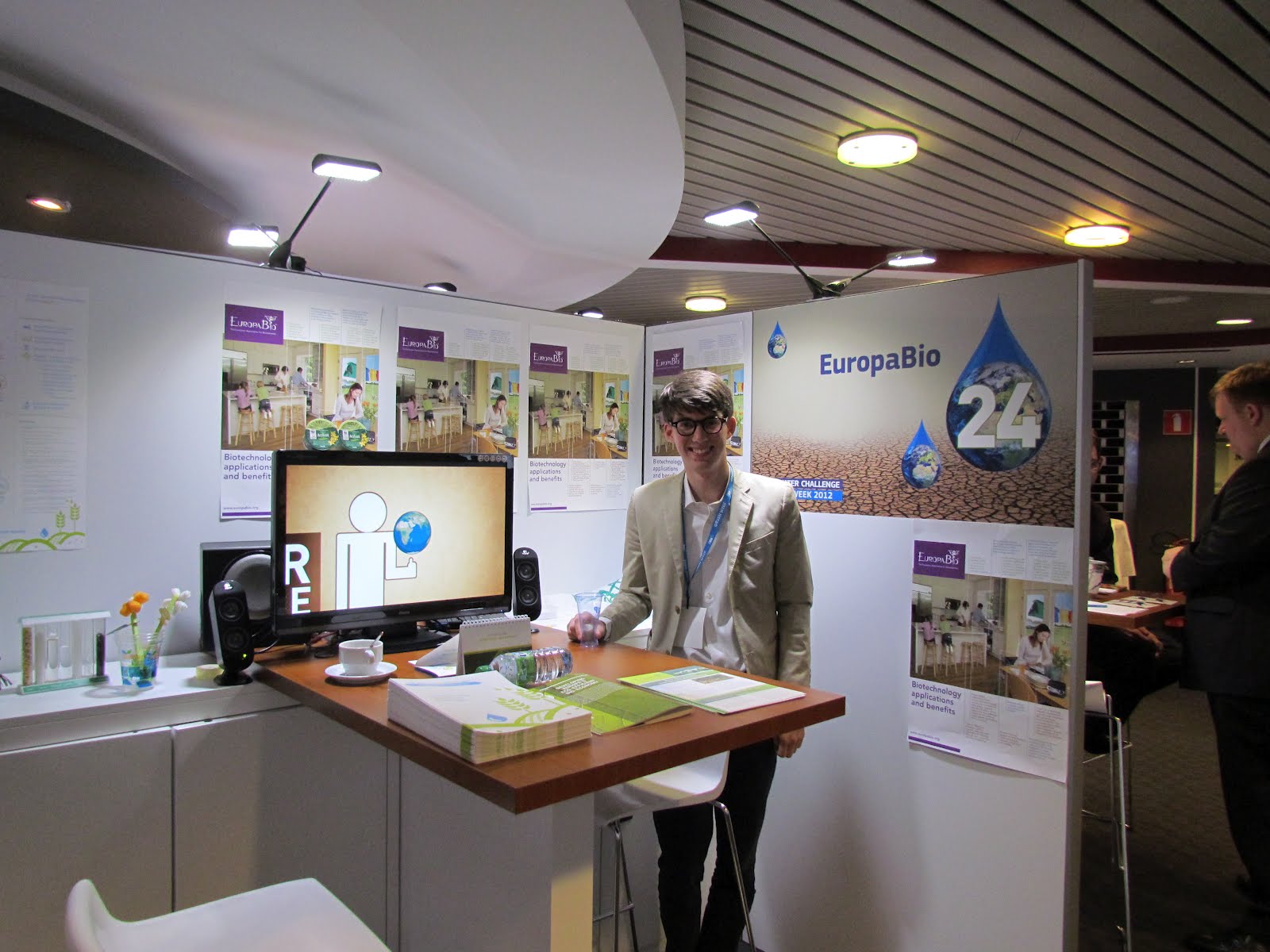
SusChem founding partners Cefic (above) and EuropaBio (below) both had stands in the exhibition area together with partner organisations such the Water Technology Platform (WssTP).

ChemWater event
SusChem, WssTP and the European Membrane House (EMH) held an important workshop as part of Green Week on 24 May for the ChemWater FP7 project. The all-day event focused on identifying new tools and methodologies, technology gaps and the needs of other sectors that will be required to reach a water sustainable process industry vision by 2050.

The workshop attracted a good number of participants (see below) and the outputs will be used to revise the ChemWater vision, and as a basis for the European R&D Agenda, in programmes including Public-Private-Partnerships (PPP), European Innovation Partnerships (EIP), and Horizon 2020.

In particular the output of the ChemWater project will be directly linked to the recently adopted EIP on Water, and will provide information to set the priorities for research and innovation in its Strategic Implementation Plan and therefore the reference for future calls. The aim of the EIP on Water is to position Europe as the world leader in sustainable water management by boosting innovation.

Participants got an update on the potential timetable for the Water EIP. The implementation plan was likely to start the drafting process in August with the aim of adoption by December 2012 and the first calls from the EIP being announced in January 2013. Up to €40 million was available for funding of FP7 projects under the EIP and to accommodate the call process the deadline for these FP7 project submissions would be extended into April 2013.

Global tool
Another feature of the workshop was a presentation on the World Business Council for Sustainable Development (WBCSD) Global Water Tool. This tool helps companies and organizations map their water use and assess risks relative to their global operations and supply chains.

Find out more about the WBCSD Global Water Tool – and assess own organisation’s water situation – by downloading the tool for free from the WBCSD website.

Other highlights
Two other highlights caught SusChem’s eye at the Green Week exhibition.

Firstly the wealth of knowledge on Water issues to be found in the European Commissions Joint Research Centre (JRC). JRC has just published the first of a series of Science for Water thematic reports. You can find out more here.

Secondly the United Nations European Ad Competition on Water has produced some fantastic images and ideas. See the top 30 finalists in this competition here.

Tuesday, 15 May 2012

Eco-industries and Life Cycle Thinking

SusChem and Cefic were at the European Commission’s Joint Research Centre (JRC) Eco-industries conference in Brussels today (15 May). Sessions covered air quality, waste management, renewables, energy efficiency and water management. SusChem activities in the water sector including the forthcoming European Innovation Partnership (EIP) were presented.

Before the start of the conference, the Cefic-SusChem stand in the exhibition area was visited by Research Commissioner Maire Geoghegan-Quinn (centre below) and Paul Rubig MEP (left) who talked with Gernot Klotz, Cefic Executive Director of Research and Innovation. A short video including the Commissioner's visit (at ~1'58") is embedded at th end of this blog article.

Opening the conference, Commissioner Geoghegan-Quinn said: “The eco-industry is already a major player and promises great things for our society and our economy. The Europe 2020 Strategy identifies these [eco-industry] sectors as key contributors to sustainable growth and the shift towards a resource efficient, greener and more competitive low carbon economy.” Her full speech can be found here.

Water management
Describing the chemical sector’s vital role in driving innovation in the session on water management Gernot Klotz (below) stated that “solving the water challenge was critical to enable the growth of the future bioeconomy.”

Chemistry is involved in improvements for water quality, quantity and energy efficiency. Cefic has recently launched a water issues website that explains the impact of chemical innovation on improving water resources.

The launch of the EIP on Water is very welcome and the chemical and water sectors are working very closely together to ensure that the challenge on water in Europe is addressed.

Life Cycle Thinking
Reinforcing the drive to eco-industries a new report also published today by the JRC provides key information for policy makers and business managers on how to assess the environmental impacts of products and services. It will help to pave the way towards a resource-efficient Europe and aims to help design more sustainable products. Two objectives that SusChem, in particular through its SPIRE PPP initiative, is working to achieve.

Life Cycle Thinking is key to making substantial improvements in the environmental performance of goods and services. This concept looks at the environmental impact of production, distribution and consumption activities from cradle to grave, quantifying the environmental impact of products from the extraction of natural resources to product recycling or waste disposal.

The Commission’s 2011 Communication on a resource-efficient Europe, a flagship initiative under the Europe 2020 Strategy, takes these developments to the next stage, as it promotes taking a life-cycle approach to reducing the environmental impacts of resource use in the EU. It is clearly important that a consistent analytical approach is used.

Wednesday, 9 May 2012

Tools and Methods for Sustainable Water Use in the Process Industry

ChemWater, the FP7 project involving SusChem, the Water Technology Platform (WssTP) and the European Membrane House (EMH) is holding an important workshop as part of the European Commission’s Green Week. The workshop that takes place on 24 May will focus on new tools and methodologies, identify technology gaps and consider the needs of other sectors that are required to reach a water sustainable process industry by 2050.

During the ChemWater workshop participants will identify gaps that will prevent the achievement of the vision established by a previous workshop on March 2012. And the results of the 24 May workshop will be used as a basis for the European R&D Agenda, in programmes including Public-Private-Partnerships (PPP), European Innovation Partnerships (EIP), Horizon 2020, etc.

The 24 May workshop is an opportunity for participants to bring forward their ideas for these research and innovation programmes. In the morning the vision developed at the previous workshop will be described, additional aspects sought in small group discussions, and the World Business Council for Sustainable Development (WBCSD) Global Water Tool will be presented. This tool helps companies and organizations map their water use and assess risks relative to their global operations and supply chains.

After lunch aspects of the proposed Water EIP will be outlined, new methods for collaboration discussed, a spectrum of challenges identified and appropriate requirements for tools developed.

If you wish to participate in the discussions and want to attend the workshop, then please send an email preferably before May 15th to Inge Huiskes at TNO indicating your name and affiliation.

ChemWater at Green Week

The objective of the ChemWater project is to build a vision and a roadmap on sustainable water use in the chemical industry that could be applied to other sectors. Roadmaps will support identification of technology and knowledge gaps and roadblocks, and will give direction to future challenges and opportunities. The roadmaps will provide a framework for coordination of development of activities across sectors.

The output of the ChemWater project will be directly linked to the imminent European Innovation Partnership on Water, and will provide information to set the priorities for research and innovation in the Strategic Implementation Plan of this EIP and therefore the reference for future calls. The aim of the EIP on Water is to position Europe as the world leader in sustainable water management by boosting innovation.

The venue for this official “Green Week 2012 satellite event” is the Hotel Silken Berlaymont situated close to the main Brussels venue: the Charlemagne building. The 12th edition of Green Week, Europe’s biggest annual conference on environmental policy, takes place from 22 to 25 May in Brussels and this year the theme is ‘Water’.

Green Week 2012 is expected to attract several thousands participants from government, business and industry, non-governmental organisations, academia and the media.

Tuesday, 8 May 2012

European Chemicals Sector publishes first-ever Sustainability Report

Today (8 May) Cefic launched its sustainable development vision at a special event at the European Parliament in Brussels. The European chemical industry is determined to play a key role in ensuring that by 2050 the world population of over nine billion people can live within the resources of the planet.

The evening event marked the publication of Cefic’s first-ever sustainability report: ‘The Chemical Industry in Europe: Towards Sustainability'.

The report presents a vision of how the chemicals industry will help meet future challenges and was unveiled in the European Parliament (below) at a special event hosted by MEPs Karl-Heinz Florenz and Vittorio Prodi. The report provides 17 key performance indicators that serve as a benchmark of ongoing industry sustainability initiatives that the sector can measure future progress against.

Cefic President Giorgio Squinzi, outlining the report’s vision, said: “All of the industry’s activities will be directed towards enabling a future where people have access to the necessities of a healthy life, to economic prosperity and to societal progress.”

Three pillars

The 70-page report details the three “pillars” of sustainability - planet, people and profit – and includes case studies drawn from across Europe that illustrate contributions to sustainability, including energy-efficient water purification, lightweight materials for cars and better building insulation.

Carl Van Camp, Cefic Sustainability Strategy Group chairman, said: “[The chemical industry has] a good track record when it comes to sustainability, and remains committed to programmes like Responsible Care. We are a partner in ensuring that the REACH chemicals legislation works and stand ready to have a lead role in EU-led public-private projects such as key enabling technologies.”

Initiatives such as SusChem – and its predecessor programme SusTech – have played and will continue to play a key role in the chemical sector’s commitment to enabling sustainable development.

The European chemical industry is in no doubt that sustainability is not an option but an absolute necessity, not only for the industry itself, but for all businesses and society as a whole. Cefic hopes that the report will stimulate a genuine dialogue on what can be achieved if industry, academia, government and society at large work together.

Sustainable start point

The Cefic report will serve as a starting point in developing a sustainability framework for the European chemicals industry. It will also help the trade group identify flagship initiatives to increase and improve the sector’s contribution to the sustainability policy agenda, which includes environmental, health and safety, and chemicals management practices.

Squinzi concluded: “Sustainability is about a mindset change in the way we work and high-tech products the chemicals industry makes. The flagship initiatives are one way in which stakeholders expect us to continue to drive the technological breakthroughs that society will need.

“We can help ensure a sustainable future by working with stakeholders, having a well-trained workforce in place, and through strong business performance that attracts further investments.”

The full report can be downloaded direct from the Cefic website.

Tuesday, 17 April 2012

Chemistry & biotechnology sector unveils concrete measures to connect European innovators

SusChem Press Release

Today (17 April) in Brussels, the European Technology Platform for Sustainable Chemistry (SusChem), a forum that unites industry and academia, announced plans to evolve into a Europe-wide network that captures the full benefit of Europe’s strengths in research and a well-connected network for innovation in the chemical and biotechnology value chain.


Europe boasts a world-leading chemical and biotechnology sector which will make a substantial impact on future growth and job creation. While maintaining a strong research agenda, the plan aims to exploit Europe’s strengths and help bring to market products and services that will shape the lives of 500 million citizens. The keystone of this strategy lies in a collaborative approach that is open, cross-disciplinary, cross-sector and inclusive. The move comes at a pivotal time as the EU Innovation Union strategy is making major strides in promoting public-private collaborations across Europe.

Developing into a European Technology and Innovation Platform (ETIP) will equip SusChem with a broad stakeholder base to ensure that research is effectively turned into innovative products and services that will shape Europe’s future. The ETIP will function in close collaboration with public parties at EU and national levels, to effectively bridge the innovation ‘valley of death’ and synchronize actions around societal challenges.

Describing the plans, SusChem Board chairman, and Sr Vice-President Bayer Technology Services Klaus Sommer stressed that the move to become a European Technology and Innovation platform is not just a semantic one: “SusChem has built a track record of connecting key industrial partners and offering technologies and products that are vital to many industries. This very specific role across the value chain makes us forefront contributors in major European innovation initiatives such as resource and energy efficiency, raw materials, water and urban living.”

SusChem is also a leading proposer of one of the first innovation-driven Public-Private-Partnerships to be developed in the European Union: the Sustainable Process Industry through Resource and Energy Efficiency (SPIRE) initiative. This cross-sectorial proposal aims to reduce fossil energy intensity in industrial processes by up to 30% and reduce non-renewable, primary raw material intensity by 20%.

“SPIRE is a groundbreaking and one-of-its-kind proposal that combines high ambitions and strong industrial support,” explains Klaus Sommer. “Through this partnership, we could make a giant leap to enhance Europe’s competitiveness while tackling environmental issues. These tough challenges are very specific to Europe and only a united and committed approach can get us there – and the chemical and biotechnology industry is ready to play a leading role in this race”.

A necessary step to bridge the innovation ‘valley of death’
SusChem will continue to drive its research activities during Horizon 2020, a major instrument implementing the EU Innovation Union. The multi-stakeholder platform fully supports the objectives of the proposed Framework Programme for Research due to run from 2014 to 2020. However its successful implementation will depend largely on key elements such as a greater emphasis on large-scale demonstration and proof of concept testing. Only through clear partnerships along the value chain and a coordinated approach can Europe successfully bridge the so-called innovation “valley of death” and ensure its excellent research efforts are converted into world-class, competitive products and services.

About SusChem
SusChem is a European Technology Platform that brings together stakeholders from many different backgrounds to boost sustainable chemistry with a focus on technology, research and innovation issues. It was founded in 2004 by Cefic and EuropaBio.

SusChem has already been successful in promoting and facilitating sustainable chemistry research and innovation activities during the current European Commission Research Framework Programme (FP7). The platform has inspired new sustainable chemistry and biotechnology research projects that have obtained several hundred million Euros of strategic funding for over the past five years.

Visit the SusChem website at: www.suschem.org. Follow us on Twitter: @suschem

For more information contact Annie Mutamba.

Friday, 16 March 2012

New Reports Highlight Need for Water Innovation Partnership

Reports from the Joint Research Centre (JRC) and the European Environment Agency (EEA) published reports during the 6th World Water Forum, taking place from 12 – 17 March in Marseille, France, highlight the urgent need for improving the efficient use of water in Europe. This is an area in which SusChem is very active.

The new assessment of available water resources published by JRC reveals that large areas in Spain and Eastern Europe have on average less than 200 mm of freshwater available every year while the demand for water is three to ten times higher. The report 'Current Water Resources in Europe and Africa' (download here - 12MB+) shows variations in yearly freshwater generation from 10 mm to over 500 mm for Europe (see map). The report outlines existing uncertainties and points to further research efforts needed for improved water management.

EEA seeks efficiency
Europe needs to redouble efforts in using water more efficiently to avoid undermining its economy, according to the report from the EEA. Inefficient water has a significant impact on the resources needed by ecosystems and people, both vital assets for European productivity and security. The report 'Towards Efficient use of water resources in Europe’ makes the case for an integrated water management, starting with better implementation of existing legislation.

"Water resources are under pressure in many parts of Europe, and it is getting worse," said EEA Executive Director Jacqueline McGlade. "Agriculture, energy production, industry, public water supply and ecosystems are all important, and all competing for this limited resource. With climate change making water supply less predictable, it is extremely important that Europe uses water more efficiently for the benefit of all its users. Water resources should be managed as effectively as any other natural asset owned by countries."

Inefficient use of water also leads to higher energy use, with extra financial and environmental costs, according to the report. While the energy needed to pump and treat freshwater into drinking water is typically around 0.6 kWh/m3, desalination of seawater adds approximately 4 kWh/m3. Several European countries use desalination technology, most notably Spain, which is among the highest users of desalination globally.

What is SusChem doing?
The chemical industry as one of the biggest water consumers can lead the development of integrated water strategies through technologies that reduce water consumption, reduce use of fresh water resources (through cascade use of urban, industrial and rural areas), and optimise waste water management.

The industry is also one of the biggest providers of water treatment materials and technologies. Our experience will allow us to develop new approaches to improve other sectors’ water management and public sector water requirements. But no one sector can tackle this challenge alone. Water is used intensively in agricultural and industrial sectors and for public use, so there is a need for integrated solutions within a symbiotic approach.

SusChem is working to boost innovation in water related topics to contribute to improved use and treatment of water and further develop a sustainable water policy.

To achieve these solutions SusChem is working with partners, including the Water Supply and Sanitation Technology Platform (WssTP), to develop the proposed European Innovation Partnership on Water.

The European Innovation Partnership on Water has ambitious objectives including:
  • reducing private water consumption
  • increasing water efficiency in irrigation
  • decreasing the water footprint of all industries
  • minimising water loss in distribution systems and
  • reducing the energy used in the water sector
The innovation initiative also aims to increase the reuse of water, introduce low water consumption processes into industry and promote new techniques such as nanofiltration. In addition it will examine eco-systems, land-use management and adaptations to climate change.

Tuesday, 13 September 2011

Wetsus talks sustainable water technology

The 7th annual Wetsus congress will be held in the northern Dutch city of Leeuwarden on October 3 and 4. The theme for this year’s congress is ‘Cooperation in innovation, a global requirement?’

The congress is split into two halves with the first day covering international cooperation initiatives on water technology including the involvement of public-private partnerships. In the afternoon, parallel sessions cover the major challenges for water and how educational and human resource issues interface with water issues.

The second day is devoted to developments in water science and technology, again in parallel sessions, including the structure of water, invisible threats to water supply, safety of non-piped systems, water reuse, agricultural water treatment, getting value from waste water, desalination and energy from water.

Registration for the first day of the congress is free, but a €175 fee (free for students) is charged for the October 4 sessions.

Centre of excellence
Wetsus is a centre of excellence for sustainable water technology. It creates a unique environment and strategic cooperation for development of profitable and sustainable state of the art water treatment technology. This multidisciplinary collaboration between some 70 companies and 13 research institutes in Wetsus results in innovations that contribute significantly to the solution of global water problems.

More information on registration and programme content can be found on the Wetsus website.

Sunday, 29 May 2011

SusChem at EuroNanoForum 2011

SusChem will be reporting from the EuroNanoForum 2011 taking place in Budapest 30-31 May and also take a look at the NanoFutures session on Wednesday morning (June 1).

Over 1000 participants are expected at this biannual event. The 2011 event promises to be the biggest so far and the European nanotechnology event this year. It will reveal how nanotechnology can contribute to addressing the grand societal challenges of our time. The event covers research breakthroughs, industrial innovations and societal aspects of nanotechnology.

In addition to plenary sessions, four parallel conference sessions will cover the impact of nanotechnology on energy, health, electronics, the evironment and biotechnology amongst very many more sessions in an extensive programme. A large exhibition is also part of ENF2011.

The NanoFutures initiative brings together an number of technology platforms (including SusChem) to assess how nanotechnologies can support sustainable development.

You can follow SusChem reports from ENF2011 via the SusChem twitter stream http://twitter.com/suschem and we will also post blogs from Budapest.