The SusChem News Blog is now hosted on the SusChem website in the News Room. You will be redirected there in 10 seconds
.

Showing posts with label green week. Show all posts

Friday, 6 June 2014

BIO-TIC Workshop on CO2 based chemicals

BIO-TIC has announced the date of its second ‘bio-business workshop’. The theme will be the “CO2-based chemicals business case” and the workshop takes place in Lyon, France on 24 September. This is the second workshop out of a series of five workshops looking at product segments and applications in the bioeconomy that BIO-TIC have identified as having significant potential for European industry and society by 2030.

The potential to use greenhouse gas carbon dioxide (CO2) as a feedstock for producing new materials is a hot topic currently and could help to develop a true circular economy. SusChem speakers presented on this and related topics at Green Week this week (5 June).

The “CO2-based chemicals business case” workshop will precede the major “Large-volume CO2 Utilization: Enabling Technologies for Energy and Resource Efficiency, 3rd Edition, The CO2 Forum, International Sustainable CO2 Chemical and Biochemical Recycling” Conference organised by CPE Lyon. This means that many leading experts in the field will already be in Lyon, increasing the effectiveness and participation in the workshop and the benefits of attending both events. The BIO-TIC event will be organised as an official satellite event and registration for the event will be opening soon!

Why attend the workshop? 
Input from the market and experts in industry and research are vital to build a basis for BIO-TIC’s roadmaps. Therefore, the BIO-TIC team is working to engage with multiple stakeholders across different value chains with activities on a range of technological domains from chemistry and engineering to health and the environment.

To define the opportunities and hurdles in the “CO2 to Chemicals” business case, the BIO-TIC workshop will explore the role of industrial biotechnology in:

  • Direct production of chemicals through the transformation of CO2 (see some possible chemical targets below)
  • “Artificial leaves”, using CO2, water, sunlight and a (semiconductor) catalyst to produce glucose as a feedstock for industrial biotechnological processes to produce chemicals


The objectives of the workshop are to:

  • Identify technological, non-technological and market hurdles for the uptake of industrial biotechnology as a basis for use of CO2 as a feedstock;
  • Develop recommendations and solutions to overcome the identified hurdles;
  • Contribute to the development, testing and fine-tuning of the BIO-TIC roadmap;
  • Bring together industrial biotechnology end users (downstream) with technology providers (upstream), innovation agencies and decision makers to stimulate interconnected discussion and knowledge exchange platforms and processes; and
  • Collect data to develop draft indicators to measure the socio-economic and environmental impact of industrial biotechnology and the use of renewables-based products in the European Union

The BIO-TIC workshop will take place from 12:00 to 18:00 on 24 September 2014 at CPE Lyon - Ecole Supérieure de Chimie Physique Electronique de Lyon and will be free to attend.

For more information about our workshop download the BIO-TIC – CO2 workshop flyer or contact the BIO-TIC secretariat.

Enabling CO2 Utilization
How can we transform large volumes of CO2 into materials and fuels needed for quality of life and sustainable development? How does the field of CO2 recycling contribute to the current policy objectives in the field of climate change mitigation?

The CO2 Forum on 25 to 26 September will address the latest answers to these questions with leading international academics, industrialists and policymakers to assess the emerging chemical, bio-engineering, and process innovations based on renewable energy sources.

CO2 chemical and biochemical recycling is a desirable environmental solution and a viable business and research opportunity. The CO2 Forum aims at reinforcing such position by bringing together relevant policymakers, corporate business, and academia researchers in an open 2-day conference for an update on three main topics:

  • Current policy and environmental context (including CO2 taxation, CO2 regulation, and socio economic analyses)
  • Business opportunity (“negative cost” chemical)
  • Scientific and technologic innovation with sustainable energy source 

For more details on the CPE CO2 Forum visit the conference website.

What is BIO-TIC? 
Funded by the European Commission, BIO-TIC was launched, as an FP7 project, with the aim to establish an overview of the opportunities and barriers to biotechnology innovation and propose approaches to address them.

Modern use of industrial biotechnology (IB) is critical in a bio-based economy. Deploying the full potential of biotech innovation will enable the European industry to deliver high-value products to consumers and create new commercial opportunities. New feedstock demands will lead to synergies amongst SMEs and large industrial partners. New technological developments will boost European export of technology and facilities by bringing some of Europe’s top sectors together: chemical industry, engineering and renewables.

However to date, major hurdles continue to hamper the full exploitation of biotechnology in Europe. These hurdles may vary from technological bottlenecks to limited availability of venture capital and fragmented policy frameworks.

BIO-TIC seeks to define product segments and applications that promise significant potential for Europe’s industry and society by 2030. We have now identified five major “bio-business cases” which are EU-competitive and have the potential to introduce cross-cutting technology ideas.

These are:

  • Bio-plastics Polyhydroxyalkanoates (PHA) and polylactic acid (PLA) 
  • Building blocks 
  • Bio-fuels 
  • Bio-surfactants 
  • CO2-based chemicals 

Based on these business cases, we are developing three in-depth “bio-roadmaps”. These will focus on the market potential, R&D priorities and non-technological hurdles of IB innovation. In particular, the market roadmap will provide market projections up to 2030. The technology roadmap will focus on setting R&D priorities and identifying needs for pilot and demonstration of plant activities. Last but not least, the non-technological barriers roadmap will identify regulatory and non-technological hurdles that may inhibit industrial biotech innovation reaching new market opportunities. The second draft version of the roadmaps is already online while the final version will be released in July 2015.

All the BIO-TIC roadmaps, can be downloaded from the BIO-TIC Partnering Platform and for more information about the BIO-TIC FP7 project visit the project website.

Tuesday, 3 June 2014

Green Week 2014: Chemical Innovation and the Circular Economy


SusChem will be taking an active role in Europe’s biggest annual conference on environmental policy that launches today (3 June). The Green Week 2014 conference takes place from 3 to 5 June in Brussels. And its themes for 2014 – the circular economy and resource efficiency – are topics where SusChem is already taking a lead.

The Green Week 2014 programme is full of SusChem relevant sessions and SusChem will be present throughout the week.

In particular session 6.3 on ‘Business and Resource Efficiency’ on Thursday morning from 11:30 addresses how businesses can improve resource efficiency, enhance competitiveness, reduce costs and contribute to better resource management. The session will showcase good practice and the potential for scale-up from companies participating in initiatives including the SPIRE (Sustainable Process Industry through Resource and Energy Efficiency) PPP.

During the session Pádraig Naughton, Innovation Manager - Resource and Energy Efficiency at Cefic (right), will talk about SPIRE and resource efficiency initiatives at the Dow Chemical company.

In his contribution Pádraig will be emphasising the underlying principle of the circular economy: that it cannot be achieved without wide-scale collaboration and cooperation. “There is a need to extend beyond company boundaries to regions, national and European levels,” says Pádraig. “We need to work with partners along the value chain, within and across sectors.”

SPIRE initiative
This is, of course, where initiatives like the SPIRE PPP, which is bringing together eight industry sectors to tackle resource and energy efficiency issues in a major pan-European cross-sectorial effort, are so important.

“An understanding and close cooperation with adjacent industries is required to maximize the benefits from waste and by-products, which could enable increased process efficiency in chemical processes,” says Pádraig.

Pádraig will also talk about other ongoing initiatives in the chemical industry and related sectors including developments at Dow’s Terneuzen complex in south-west Netherlands and a number of Cefic-SusChem FP7 funded projects including Chemical Regions for Resource Efficiency (R4R) and BIO-TIC.

A value chain approach is essential for success to ensure that the supply circle is closed and suppliers and all value chain partners, including consumers, enable the recycle and reuse of waste as a production resource. This means that cross-sectorial partnerships, such as SPIRE, must ensure that innovation is enabled and implemented across all elements of society. The innovation chain must connect research to customers to consumers to government and regulatory policymakers.

Technological and business solutions are being developed in local and EU-wide initiatives that can enable a circular economy, but there are policy, trade and image barriers that need to be addressed. “For example, cross-border transfer of waste remains a challenge which needs to tackled at EU level,” explains Pádraig.

Industrial symbiosis
The concept of industrial symbiosis will be an important part of the circular economy and will be included in the priorities in the new SusChem Strategic Innovation and Research Agenda (SIRA) to be launched for wider consultation at the SusChem Stakeholder event on 11 – 12 June.

Industrial symbiosis occurs where waste and side streams are used in an integrated concept for complete resource management at, for example, an industrial park, site or region. The strategic challenge of industrial symbiosis is to increase resource efficiency and turn waste, including chemical sector by-products and carbon dioxide (CO2), into resources. This will address issues including resource flows (materials and energy) to identify opportunities to reuse these resources, resource efficiency (i.e. new tools to optimize resource efficiency in manufacturing) and CO2 reuse (new products from reusing CO2).

#useCO2
Following the session on ‘Business and Resource Efficiency’ on the afternoon of 5 June these is also a session that directly addresses the use of CO2 as a potential raw material for industry.

Session 7.1 ‘Carbon dioxide – today’s waste, tomorrow’s raw material?’ will look at a range of emerging processes that are looking to use CO2 to produce chemicals, materials and fuels. This is an area where SusChem and SPIRE are already heavily engaged in the European Commission’s new research and innovation programme Horizon 2020.

The SusChem SIRA will further outline our thinking in this and other areas and the practical research and innovation activities that are required to turn the concepts of a circular society and radically improved resource efficiency into a reality.

Green Week 2014 will be taking place with events throughout Europe and Brussels. The venue for the main Green Week conference will be the Egg Conference Centre, Rue Bara, in Brussels. Visit the Green Week website for more details.

Friday, 30 May 2014

Green Week 2014: SusChem working for the Circular Economy

Green Week is Europe’s biggest annual conference on environmental policy and takes place next week from 3 to 5 June in Brussels. Its themes for 2014 – the circular economy and resource efficiency – are topics where SusChem and its major European public private partnerships - the SPIRE PPP and the Biobased Industries JTI – are already taking a lead.

The 2014 edition of Green Week will take place at The Egg Conference Centre, Rue Bara, in Brussels. SusChem, SPIRE and the Biobased Industries JTI are all supporting initiatives that can deliver a working circular economy in Europe, improve resource and energy efficiency and reduce waste. SusChem representatives will be speaking during the Green Week conference.

SusChem fully supports the concept of a circular economy as one of the logical solutions for a resource-constrained world. In the circular economy almost nothing is wasted, the re-use and remanufacturing of products is standard practice, and sustainability is a core element in the fabric of society.

Delivering a circular economy
These elements of a circular economy are all concepts that SusChem has embraced since its formation in 2004 and has supported with practical research and innovation projects.

Current SusChem inspired projects funded under FP7 in this area include Chemical Regions for Resource Efficiency (R4R), the Critical Raw Materials Innovation Network (CRM_InnoNet), BIO-TIC. And SusChem is also very engaged with issues around reducing fresh water use by industry.

And, of course, the SPIRE PPP is all about dramatically increasing resource and energy efficiency across a wide range of process industries.

Our SusChem stakeholder event in mid June will discuss the priorities in our new 2014 SusChem Strategic Innovation and Research Agenda (SIRA). The SIRA will further outline our thinking in this area and the practical research and innovation activities that are required to turn the concepts of a circular society and radically improved resource efficiency into reality.

During 2014 the European Commission is setting out new proposals enabling Europe to unlock the potential of the circular economy, underlining the need to change our way of thinking about design. There will also be a focus on better waste management, and on how it can help the EU use its resources more efficiently. SusChem looks forward to working with the Commission to enable this potential to be fulfilled.

Spain starts early!
In fact for SusChem Green Week has already started with an official Green Week satellite event: The Third Forum on Sustainable Chemistry: Innovative and Competitive Companies (SCICC) that took place in Tarragona, Spain on 28 and 29 May. Tarragona is home to the largest chemical cluster in the Mediterranean and Southern Europe. The event was organised by SusChem Spain.

In line with the main themes of Green Week 2014, the Forum focused on the concept of the circular economy as an economic system based on reuse of resources, energy and resource efficiency – areas where the contribution of sustainable chemistry is essential.

Speakers in the opening plenary on Wednesday 28 May included SusChem board member Gernot Klotz of Cefic, who spoke on how the chemical industry is effectively supplying the roots for sustainable growth in Europe, and Lorenzo Valles of the European Commission who outlined the role that the SusChem inspired SPIRE PPP will be playing to deliver increased energy efficiency and sustainable resources.

Other sessions covered topics such as ‘efficiency and design’, ‘resource efficiency’, ‘energy efficiency and process intensification’, and ‘by-product valorisation’. This last session included presentations on the potential use of CO2 as a feedstock for the chemical industry.

The forum closed with some concluding remarks by SusChem Europe chairman Dr Klaus Sommer.

The main purpose of SCICC was to promote the debate and the sharing of knowledge on new processes and chemical products that are more efficient, safe and environmentally friendly and can form the basis of a truly circular economy. A great start to Green Week 2014!

Friday, 25 May 2012

SusChem at Green Week 2012

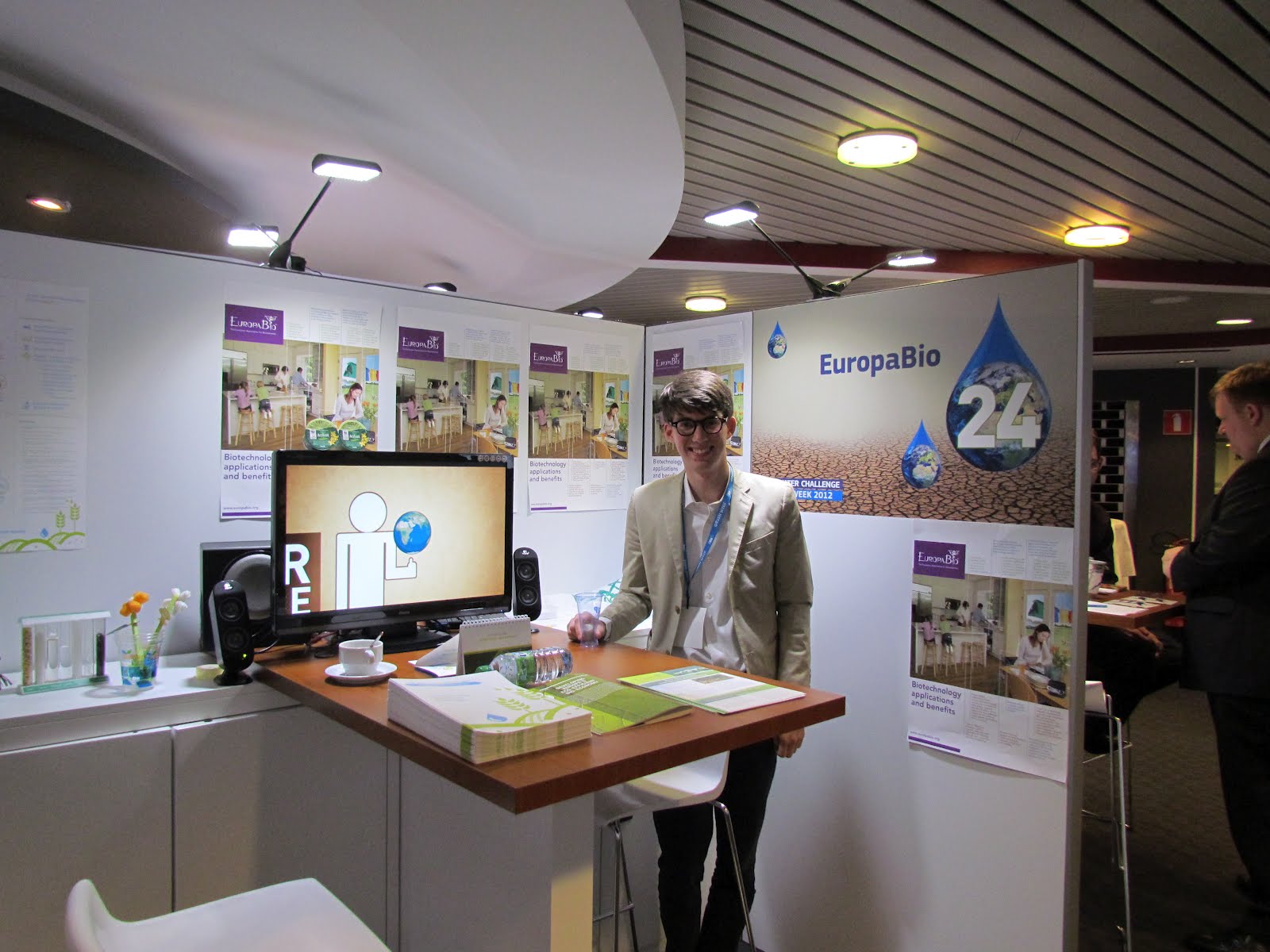
The 12th edition of Green Week, Europe’s biggest annual conference on environmental policy, took place 22 to 25 May in Brussels and with this year’s theme of ‘Water - Every Drop Counts – The Water Challenge’ SusChem was a prominent participant.

The message from Green Week was clear: water is a valuable resource that needs to be used properly and sparingly. We must make sure that we have enough for all of its uses and we must avoid polluting our rivers, seas and oceans. Along with all other natural resources, water is one of the most vital for our continued existence on this planet.

SusChem founding partners Cefic (above) and EuropaBio (below) both had stands in the exhibition area together with partner organisations such the Water Technology Platform (WssTP).

ChemWater event
SusChem, WssTP and the European Membrane House (EMH) held an important workshop as part of Green Week on 24 May for the ChemWater FP7 project. The all-day event focused on identifying new tools and methodologies, technology gaps and the needs of other sectors that will be required to reach a water sustainable process industry vision by 2050.

The workshop attracted a good number of participants (see below) and the outputs will be used to revise the ChemWater vision, and as a basis for the European R&D Agenda, in programmes including Public-Private-Partnerships (PPP), European Innovation Partnerships (EIP), and Horizon 2020.

In particular the output of the ChemWater project will be directly linked to the recently adopted EIP on Water, and will provide information to set the priorities for research and innovation in its Strategic Implementation Plan and therefore the reference for future calls. The aim of the EIP on Water is to position Europe as the world leader in sustainable water management by boosting innovation.

Participants got an update on the potential timetable for the Water EIP. The implementation plan was likely to start the drafting process in August with the aim of adoption by December 2012 and the first calls from the EIP being announced in January 2013. Up to €40 million was available for funding of FP7 projects under the EIP and to accommodate the call process the deadline for these FP7 project submissions would be extended into April 2013.

Global tool
Another feature of the workshop was a presentation on the World Business Council for Sustainable Development (WBCSD) Global Water Tool. This tool helps companies and organizations map their water use and assess risks relative to their global operations and supply chains.

Find out more about the WBCSD Global Water Tool – and assess own organisation’s water situation – by downloading the tool for free from the WBCSD website.

Other highlights
Two other highlights caught SusChem’s eye at the Green Week exhibition.

Firstly the wealth of knowledge on Water issues to be found in the European Commissions Joint Research Centre (JRC). JRC has just published the first of a series of Science for Water thematic reports. You can find out more here.

Secondly the United Nations European Ad Competition on Water has produced some fantastic images and ideas. See the top 30 finalists in this competition here.

Wednesday, 9 May 2012

Tools and Methods for Sustainable Water Use in the Process Industry

ChemWater, the FP7 project involving SusChem, the Water Technology Platform (WssTP) and the European Membrane House (EMH) is holding an important workshop as part of the European Commission’s Green Week. The workshop that takes place on 24 May will focus on new tools and methodologies, identify technology gaps and consider the needs of other sectors that are required to reach a water sustainable process industry by 2050.

During the ChemWater workshop participants will identify gaps that will prevent the achievement of the vision established by a previous workshop on March 2012. And the results of the 24 May workshop will be used as a basis for the European R&D Agenda, in programmes including Public-Private-Partnerships (PPP), European Innovation Partnerships (EIP), Horizon 2020, etc.

The 24 May workshop is an opportunity for participants to bring forward their ideas for these research and innovation programmes. In the morning the vision developed at the previous workshop will be described, additional aspects sought in small group discussions, and the World Business Council for Sustainable Development (WBCSD) Global Water Tool will be presented. This tool helps companies and organizations map their water use and assess risks relative to their global operations and supply chains.

After lunch aspects of the proposed Water EIP will be outlined, new methods for collaboration discussed, a spectrum of challenges identified and appropriate requirements for tools developed.

If you wish to participate in the discussions and want to attend the workshop, then please send an email preferably before May 15th to Inge Huiskes at TNO indicating your name and affiliation.

ChemWater at Green Week

The objective of the ChemWater project is to build a vision and a roadmap on sustainable water use in the chemical industry that could be applied to other sectors. Roadmaps will support identification of technology and knowledge gaps and roadblocks, and will give direction to future challenges and opportunities. The roadmaps will provide a framework for coordination of development of activities across sectors.

The output of the ChemWater project will be directly linked to the imminent European Innovation Partnership on Water, and will provide information to set the priorities for research and innovation in the Strategic Implementation Plan of this EIP and therefore the reference for future calls. The aim of the EIP on Water is to position Europe as the world leader in sustainable water management by boosting innovation.

The venue for this official “Green Week 2012 satellite event” is the Hotel Silken Berlaymont situated close to the main Brussels venue: the Charlemagne building. The 12th edition of Green Week, Europe’s biggest annual conference on environmental policy, takes place from 22 to 25 May in Brussels and this year the theme is ‘Water’.

Green Week 2012 is expected to attract several thousands participants from government, business and industry, non-governmental organisations, academia and the media.

Wednesday, 28 March 2012

ChemWater at Green Week 2012

A ChemWater event has just been officially labeled as a 'Green Week 2012 satellite event' by the European Commission’s DG Environment. The event – jointly organised by SusChem and the European Water Technology Platform (WssTP) – will take place on 24 May at the Hotel Silken Berlaymont.

The ChemWater event is entitled ‘ChemWater: Efficient and Sustainable Management of Water in the Process Industry’. Clearly, Europe must use its water resources more effectively to avoid future shortages driven by climate change and other factors. The process industries, especially the chemical industry, will play an essential role, both as a major user of water and a key solution provider to the sector.

ChemWater is a European Commission funded FP7 project launched in May 2011 that is working to define, coordinate and implement joint European strategies on sustainable materials, processes and emerging technology development relevant to water issues. It will work to enhance and optimise the industrial water management cycle across relevant European Technology Platforms and connect with other existing initiatives at European, national and regional level.

The project was initiated by SusChem and WssTP and will last 30 months. The partners in the project are all stakeholders in one or both of the technology platforms and are drawn from industry and academia. ChemWater will provide significant support for the proposed European Innovation Partnership on Water.

Green Week 2012
The 12th edition of Green Week, Europe’s biggest annual conference on environmental policy, takes place from 22 to 25 May in Brussels and this year the theme is ‘Water’.

Under the banner ‘Every Drop Counts – The Water Challenge’ Green Week 2012 will use over 40 separate conference sessions to address global and European environmental issues around water.

Water is a valuable resource that needs to be used properly and sparingly. We must make sure that we have enough for all of its uses and we must avoid polluting our rivers, seas and oceans. Along with all other natural resources, water is one of the most vital for our continued existence on this planet. Green Week 2012 offers a unique opportunity for debate and exchanges of experience and best practice.

Green Week 2012 is expected to attract several thousands participants from government, business and industry, non-governmental organisations, academia and the media.

For more information on the ChemWater event at Green Week 2012 contact Antonia Morales Perez at Cefic.

Tuesday, 24 May 2011

Green Week 2011 - Resource Efficiency

The 11th edition of Green Week, the biggest annual conference on European environment policy, kicks off today (24 May) and runs until Friday (27 May) at the Charlemagne building in Brussels. The 2011 theme is “Resource Efficiency – Using less, living better”.

Resource efficiency is, of course, a topic of major interest to SusChem and the technology platform will be contributing to a Green Week session on "Green Chemistry finding Green Solutions" organised by The European Association for Chemical and Molecular Sciences (EuCheMS). The session takes place on Thursday 26 May from 11:30 to 13:00 in the Salon Rouge

One of the goals of the International Year of Chemistry 2011 (IYC2011) is to underline the critical role chemistry plays in a sustainable future. Resource efficiency in Europe means not only making production as sustainable as possible, it means making consumption as sustainable as possible.

Roadmap
EuCheMS is preparing a Roadmap for the Chemical Sciences, the roadmap identifies major societal challenges and outlines critical gaps in knowledge that are limiting technological progress. The Roadmap then identifies where the chemical sciences have a role to play in meeting these challenges. The event will look at the positive contribution of green chemistry to improving resource efficiency and innovation in Europe.

Prof Michael Roeper of BASF will describe EuCheMS's Roadmap for the Chemical Sciences, with an emphasis on the section dedicated to Resource Efficiency and will highlight how SusChem is contributing to a more sustainable future - in particular through its proposals for European Innovation Partnerships (EIPs).

Other speakers include Dr Wim Thielemans of the University of Nottingham who will present the principles of Green Chemistry and Dr Mike Pitts from the UK's Chemistry Innovation Knowledge Transfer Network (CIKTN) and a member of SusChem UK, who will focus on how product and process innovation can deliver sustainable growth.

Exhibition
In parallel to the four-day conference Green Week hosts an extensive exhibition. SusChem partner organsiations taking stands this year include Cefic, EuropaBio and the Water Technology Platform (WssTP).

Cefic will also highlight resource efficiency from the perspective of the chemical industry during Green Week, describing the challenges and opportunities presented by the global need for a more efficient use of energy and natural resources.

The Green Week conference and exhibition is organised by the European Commission and is open to the public. Full programme details can be found on the conference website and over 5000 participants have registered for the week.