Today (19 June 2018), the European Technology Platform for Sustainable Chemistry (SusChem) is publishing two white papers outlining the future research and innovation requirements for Battery Energy Storage technologies and the technology and non-technology requirements for integrating Polymer Composites fully into the Circular Economy.
The two papers are designed to stimulate debate on future research and innovation programmes, including Horizon Europe, in the two areas. Both papers have been produced by expert teams for SusChem and give a view of the current market, the technologies and the opportunities and challenges ahead.
In both cases a through-the-value-chain holistic European innovation programme is needed, an approach that SusChem has championed before in response to other complex societal challenges.'
Battery Storage
The ‘Battery Energy Storage’ paper investigates the current state of battery storage technologies in Europe, the main challenges, and suggests actions for the future. The paper builds on the views of stakeholders in the European battery value chain and, in particular, the chemical industry and raw material suppliers.
“The increase of Renewable Energy Sources has highlighted the next challenge: storage of energy when demand is lower than the supply. Among the different technologies, batteries have the highest cost reduction potential now. The growing need for European energy independence and security pushes for more 'in-house' developments and installation. European players should focus on developing battery cell production capacity in Europe in order to complete the value chain and allow a full integration, from material to final batteries,” comments Anne.-Chloe Devic, coordinator of the SusChem Materials Working Group.
Composites for circularity
The ‘Polymer Composites Circularity’ paper examines the technology and non-technology requirements to ensure that these advanced materials, that are featuring in an increasing number of applications, can be successfully integrated into the circular economy.
“The growing demand of polymer composites, together with the increase in number of applications raises the question: what will happen to all the composite waste that is generated either from production or end-of-life parts? Although significant efforts have been made in Europe, including the Circular Economy Package and, in particular, its Plastics Strategy, the fibre-reinforced polymer space is not really included in the focus as yet, Developing and ensuring a systematic circular ecosystem for these materials needs to be a priority,” commented Anne-Chloe Devic
The two papers will be available and discussed at the SusChem Annual Stakeholder event (#suschem2018) to be held on 20 June in Brussels.
You can download the two papers here:
Both papers were authored by the SusChem Materials Working Group in collaboration with international consultants Bax & Company.
Showing posts with label renewable energy. Show all posts
Tuesday, 19 June 2018
Tuesday, 24 April 2018
VERAM Final Conference showcases 2050 Roadmap for Raw Materials
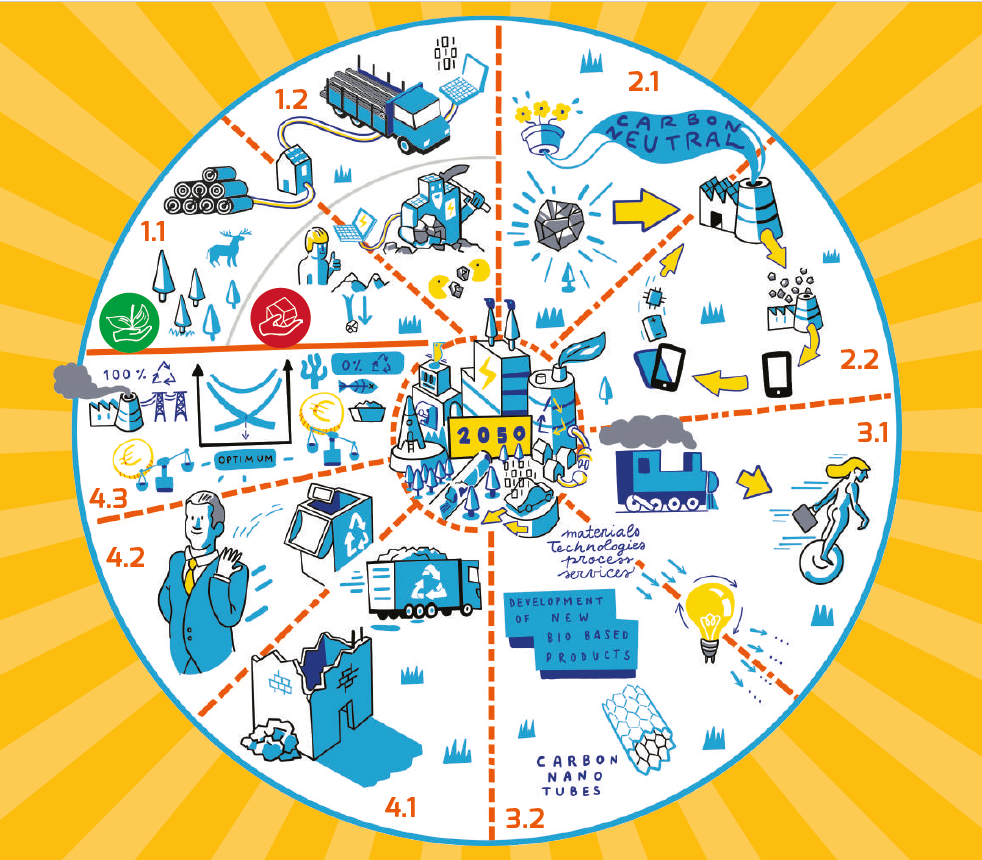
The Final Conference of the VERAM Horizon2020 project took place in Brussels on 17 April 2018. This project brought together diverse stakeholders – including five European Technology Platforms (ETPs): Sustainable Minerals Resources, Forest, Construction, Sustainable Chemistry and Advanced Materials – to produce a medium-term (2030) Vision and a longer-term (2050) Strategic Research and Innovation Roadmap for raw materials. The conference discussed the work of the project, its methodologies and its results including the report ‘Research and Innovation Roadmap: A Sustainable and Competitive Future for European Raw Materials’.
The VERAM approach covered all raw materials: both the biotic (for example forestry & natural rubber) value chain and the metal, minerals and aggregates value chain. It looked to reinforce and underpin greater sustainability, economic resilience and technology leadership in the EU. The Vision 2030-2050 sees increased EU production to ensure a base load supply of materials, development of globally competitive sustainable technologies, investment both in and outside Europe to ensure access to resources, the creation of new jobs across the raw materials sector, and contributing to the replacement of jobs lost in other parts of the economy and through automation. It was clear that there will remain a need for primary material resources despite the expected transition to a more circular economy.
Four priorities, 178 action areas
Four priority areas were identified and form the core of the Roadmap considerations:
- Fostering a sustainable supply of raw materials to feed new and existing value chains
- Resource-efficient processing for raw materials
- Raw materials in new products and applications, and
- Closing material loops by maximising the recycling of products, buildings and infrastructure.
The VERAM roadmap includes analysis of the five ETPs’ Strategic Innovation and Research Agendas (SIRAs), the European Innovation Partnership (EIP) on Raw Materials SIRA, public consultations and workshops.
The project also had established an inventory of current Member State, EU and global raw materials policies and R&D funding calls and had surveyed EU Member State funding bodies with 13 Member States providing insights. The inventory database is available on the VERAM web portal.
This highly inclusive process resulted in the formulation of some 178 Research & Innovation Areas (RIAs) across the four identified priorities. Remarkably within the RIAs over 50% overlapped between the two categories of raw materials: biotic on one side and metals, minerals and aggregates on the other side.
Multiple speakers at the final conference applauded the work of the project; not least the integration of diverse input from such a wide range of major stakeholder highlighting the importance of raw materials issues to European competitiveness, jobs and growth. However, it was also noted that the sectors needed to do more to integrate societal interests.
This JRC video shows how lack of raw materials could inhibit the low carbon economy.
Wide dissemination
It is now vital that the results of the project are disseminated as widely as possible to ensure the recommendations and ideas are brought to fruition as soon as possible. The report will be presented to funding authorities at European, national and regional levels, including initiatives such as the BioBased Industries Joint Undertaking (BBI JU) and the Sustainable Process Industries for Resource and Energy efficiency (SPIRE) PPP, to ensure inclusion of VERAM ideas in forthcoming research and innovation calls.
Labels:
BBI JU,
ESCTP,
etp smr,
EuMaT,
forestry,
low carbon economy,
raw materials,
renewable energy,
SPIRE,
suschem,
sustainable chemistry,
Veram
Tuesday, 10 May 2016
SusChem Stakeholder 2016: Solutions for the Energy Union
This year’s SusChem stakeholder event takes place on 16 June in Brussels. One of the major areas for discussion at the stakeholder event will be energy and the contribution that sustainable chemistry can make to energy efficiency, new sustainable energy sources and the transition to a low-carbon economy. This article outlines some of the issues that will inform the debate in this area during the stakeholder event and for which we are seeking your input in advance.
The chemical industry needs energy in its processes and has a strong track record in reducing energy consumption through innovation and manufacturing excellence. In fact, since 1990, the chemical sector has effectively decoupled production from greenhouse gas (GHG) emissions.
The European Commission’s Energy Union strategy, adopted in February 2015, dedicates one of its five dimensions to research, innovation and competitiveness. The integrated Strategic Energy Technology (SET) Plan plays a central role in a new European energy Research and Innovation approach designed to accelerate the transformation of our energy system.
Sustainable chemistry solutions
Advances in sustainable chemistry are key elements in achieving the objectives of the European Commission’s Energy Union and SET-Plan. SusChem’s Strategic Innovation and Research Agenda (SIRA) dedicates a chapter to the challenge of, and solutions for, Secure, Clean and Efficient Energy. The chapter covers energy efficiency in chemical processes and proposed solutions that are key to the competitiveness of the chemical industry. It also describes how the industry’s technologies and products contribute to energy efficiency and clean energy productions and storage for the wider society.
Examples of innovations that will contribute to further improving energy and resource efficiency in the chemical sector include:
The chemical industry is a key solution provider in virtually all value chains, with technologies and advanced materials that enable Europe to be a world leader in renewable energy such as:
In order for the chemical industry to make an effective impact on the development of a low carbon economy, support for technology development (including to achieve breakthroughs) and an appropriate policy framework (to ensure market uptake) will be required.
A sustainability based approach for policy development involving the integration of all aspects of sustainability (environment, economy, social) and integration of lifecycle concept is essential to evaluate the impact of innovative technologies and the development of an effective strategy and policy framework.
Coherence and stability over time for the policy framework is critical to contribute fully to a sustainable economy and address climate goals This means that a variety of policies have to be developed in coordination such as those on energy, primary and secondary resources. Policy coherence in content and timing, as well as policy stability over time, is essential to establish a regulatory framework that enables investment in sustainable, resource efficient and innovative technologies. Uncertainty and extended timelines for policy decisions have negative consequences on the confidence of private investments in new, cleaner technologies. The regulatory framework is an essential element to ensure European leadership in innovation toward a low carbon economy.
Stakeholder discussions
A highly interactive debate is expected at the Stakeholder event on 16 June and your questions and expectations on the outcomes for the panel debates, in particular on energy issues, are welcome in advance.
Registration for the 2016 SusChem Stakeholder event is now open. The event will take place on 16 June 2016 at the Hotel Bloom in Brussels, Belgium. The dedicated registration website includes links to discounted accommodation at the Hotel Bloom.
You are invited to submit your questions and comments and also your expectations for outcomes as part of the registration process. You can submit your questions and comments when you register and there will also be a link for question submission sent with the registration confirmation email.
For more information on registration, please contact the SusChem secretariat.
The chemical industry needs energy in its processes and has a strong track record in reducing energy consumption through innovation and manufacturing excellence. In fact, since 1990, the chemical sector has effectively decoupled production from greenhouse gas (GHG) emissions.
The European Commission’s Energy Union strategy, adopted in February 2015, dedicates one of its five dimensions to research, innovation and competitiveness. The integrated Strategic Energy Technology (SET) Plan plays a central role in a new European energy Research and Innovation approach designed to accelerate the transformation of our energy system.
Sustainable chemistry solutions
Advances in sustainable chemistry are key elements in achieving the objectives of the European Commission’s Energy Union and SET-Plan. SusChem’s Strategic Innovation and Research Agenda (SIRA) dedicates a chapter to the challenge of, and solutions for, Secure, Clean and Efficient Energy. The chapter covers energy efficiency in chemical processes and proposed solutions that are key to the competitiveness of the chemical industry. It also describes how the industry’s technologies and products contribute to energy efficiency and clean energy productions and storage for the wider society.
Examples of innovations that will contribute to further improving energy and resource efficiency in the chemical sector include:
- Increased energy efficiency of process technologies through advanced high performance catalysis, process intensification, and advanced process modelling and control.
- Better utilisation of alternative sources of carbon such as biomass, waste, and industrial gaseous effluents (including CO2).
- Industrial symbiosis making connections with and across industries for improved energy and resource efficiency via better valorisation of heat, improved water management and use of materials from waste and side streams.
The chemical industry is a key solution provider in virtually all value chains, with technologies and advanced materials that enable Europe to be a world leader in renewable energy such as:
- Advanced materials for sustainable production of renewable electricity including new composites for wind turbine blades and materials for photovoltaic technologies including recyclability of materials.
- Advanced materials and technologies for renewable energy storage including materials for advanced batteries, chemical energy storage through advanced materials and process technologies (hydrogen and CO2 based energy carriers via power-to-gas and power-to-liquid technologies), and novel thermal storage of energy via phase change materials or via reversible thermochemical reaction.
- In addition sustainable chemistry provides energy efficiency solutions for buildings such as advanced materials for thermal insulation, highly energy efficient lighting, and phase change materials for thermal storage. Chemistry is also key to better energy efficiency in water treatment, for example by development of advanced membranes for water purification.
- Chemistry is also key to more sustainable transport systems by providing lightweight materials, materials for more fuel efficient tyres, advanced materials and process technologies for battery production and sustainable alternative fuels for transport including CO2 based fuels such as methanol, methane, gasoline and kerosene.
In order for the chemical industry to make an effective impact on the development of a low carbon economy, support for technology development (including to achieve breakthroughs) and an appropriate policy framework (to ensure market uptake) will be required.
A sustainability based approach for policy development involving the integration of all aspects of sustainability (environment, economy, social) and integration of lifecycle concept is essential to evaluate the impact of innovative technologies and the development of an effective strategy and policy framework.
Coherence and stability over time for the policy framework is critical to contribute fully to a sustainable economy and address climate goals This means that a variety of policies have to be developed in coordination such as those on energy, primary and secondary resources. Policy coherence in content and timing, as well as policy stability over time, is essential to establish a regulatory framework that enables investment in sustainable, resource efficient and innovative technologies. Uncertainty and extended timelines for policy decisions have negative consequences on the confidence of private investments in new, cleaner technologies. The regulatory framework is an essential element to ensure European leadership in innovation toward a low carbon economy.
Stakeholder discussions
A highly interactive debate is expected at the Stakeholder event on 16 June and your questions and expectations on the outcomes for the panel debates, in particular on energy issues, are welcome in advance.
Registration for the 2016 SusChem Stakeholder event is now open. The event will take place on 16 June 2016 at the Hotel Bloom in Brussels, Belgium. The dedicated registration website includes links to discounted accommodation at the Hotel Bloom.
You are invited to submit your questions and comments and also your expectations for outcomes as part of the registration process. You can submit your questions and comments when you register and there will also be a link for question submission sent with the registration confirmation email.
For more information on registration, please contact the SusChem secretariat.
Tuesday, 8 December 2015
Taking a Leaf out of Nature’s Book
Mimicking photosynthesis may be the key to unlocking a future energy scene dominated by renewables. But nature’s simple process still holds many secrets. In light of the high-level Cefic breakfast debate on advanced materials and energy challenges that took place at the 7th European Innovation Summit, we asked science writer Ben Skuse to delve into how breakthroughs in materials may help resign fossil fuels to the past through the development of novel technologies and perhaps – eventually – artificial leaves.
The development of novel processes using waste carbon dioxide - up to and including the ultimate goal of artificial photosynthesis - feature in the SusChem Innovation and Research Agenda.
Photosynthesis is a wonder of nature. It transforms energy from the light that the Sun bathes the Earth in to energy‐rich sugars. Simply put, it takes carbon dioxide and water, and converts them to glucose and oxygen.
There are two stages to this process. The first – water splitting – converts water into oxygen and a protein. In the next step, the protein reacts with CO2 to produce biomass. So far, scientists have only managed to master the former, splitting water using electrolytic processes to create hydrogen gas instead of biomass. But even on its own this feat was a huge achievement, paving the way for hydrogen fuel cell vehicles being actively commercialised today by the likes of Daimler and Toyota, and for the power industry taking hydrogen energy storage seriously as an option to deal with intermittent renewable power generation.
Hydrogen has some limitations
While hydrogen has one of the highest energy densities of any fuel, it is also the lightest of all elements. This means its storage requires very large volumes or very high pressures, resulting in issues of safety. Furthermore, the high cost of developing infrastructure and the energy intensity of the water splitting process offer sceptics a strong argument that hydrogen may not be the future for energy storage or the automotive industry.
“Hydrogen has some limitations,” confirms Sophie Wilmet, Cefic Innovation Manager. Sophie believes CO2 conversion technologies might provide a good alternative for large-scale storage of renewable energy using existing infrastructure. “CO2 can be used to address the energy storage challenge brought about by the rise in renewables, as well as for alternative fuels for transport.”
Carbon as a resource
Although not using direct photoconversion of CO2, a number of technologies are being actively explored to transform CO2 from a reviled waste product to a useful resource, as Sophie explains: “From CO2 you can produce basic and added-value chemicals”.
For example, a process co-developed by RWTH Aachen University and Covestro, formerly Bayer MaterialScience, has led to the construction of a plant that will be opened in 2016 in Dormagen, Germany, capable of producing up to 5000 metric tons per year of polyols, a polyurethane intermediate. About 20% of the content of the polyols will be from waste CO2 captured from a nearby ammonia plant, with the final material a flexible foam for mattresses.
Another innovator is Icelandic company Carbon Recycling International (CRI), whose renewable methanol reduces carbon emissions by more than 90% compared to fossil fuels. The fuel is produced from CO2 and hydrogen that comes from renewable sources of electricity. The world's first liquid renewable transport fuel production facility from non-biological sources of energy, CRI has a 4000 metric ton per year production capacity.
Further novel ideas include using large volumes of waste CO2 from industrial processes to produce syngas (BASF); converting waste gases from iron and steel mills into ethanol and other important chemicals, such as acetic acid, acetone, isopropanol, n-butanol or 2,3 butanediol (Siemens/LanzaTech); and creating a closed carbon cycle using renewable energy, CO2 and water to provide sustainable fuels for vehicles and decentralised electricity generation (sunfire).
Mimicking nature
Capable of absorbing CO2 at the very low concentrations (400 parts per million) found in the air, absorbing energy from low-photon count sunlight, and photosynthetic cell self-repair, the ‘technology’ within plants is far more advanced than anything devised by humankind so far.
However, with aeons to perfect the technique, it comes as something of a surprise that energy conversion in plants is not actually particularly efficient: “For most plants the photosynthetic and storage efficiency is an average of 1%,” explains Dr Junwang Tang, Reader in Energy from University College London, UK. Why is photosynthesis so inefficient? “The natural process is capable of utilising 100% of photons but green plants give up that potential to protect themselves – nature doesn’t need so much energy.”
As a result, if society were to mimic photosynthesis unaltered, there would not be enough land on Earth to cycle the carbon required for a sustainable future. Instead, researchers are aiming to enhance the process from a number of angles. “We have learnt how nature stores CO2 and we have realised that we can probably do better,” exclaims Junwang.
Direct photoconversion
A major roadblock in developing such technology is finding photocatalysts that can absorb as much of the solar spectrum as possible while still being efficient. As plants only use a fraction of the visible range, great potential lies in the untapped electromagnetic spectrum, so photocatalysts that respond to different regions are being investigated. Other researchers are exploring doping, nanomaterials and co-catalyst surface-loading to improve the photocatalytic response of promising materials.
However, with numerous other hurdles to climb before real-world application, Sophie expects there to be a long wait before artificial leaves are realised: “It still requires development in terms of new concepts, designs of photoelectrodes and integration of the system,” she explains. “For Cefic, it’s part of our overall long-term strategy, but more like a second- or third-generation technology that will not have impact by 2020.”
Even though tangible impact from direct photoconversion seems a long way off, Europe’s competitors are keen to advance the state of the art now, with a number of multi-million Euro projects funded in Japan, a Joint Centre for Artificial Photosynthesis set up in the US and well-funded initiatives in many other parts of the world.
As a result, Junwang believes Europe’s highly able yet currently fragmented and small community of scientists working in the area needs to be brought together: “Europe is very strong in fundamental understanding of artificial and natural photosynthesis, but countries like Japan, USA and China are investing heavily in this technology through well-funded projects. If we don’t invest more – just like has happened with graphene – other countries will heavily patent the field.”
The Cefic breakfast debate
The Cefic breakfast debate took place at the 7th European Innovation Summit in the European Parliament on 8 December. The event was hosted by Jerzy Buzek, MEP and covered the wide-ranging topic of 'Advanced Materials and breakthrough opportunities for the energy transition’.
The development of novel processes using waste carbon dioxide - up to and including the ultimate goal of artificial photosynthesis - feature in the SusChem Innovation and Research Agenda.
Photosynthesis is a wonder of nature. It transforms energy from the light that the Sun bathes the Earth in to energy‐rich sugars. Simply put, it takes carbon dioxide and water, and converts them to glucose and oxygen.
There are two stages to this process. The first – water splitting – converts water into oxygen and a protein. In the next step, the protein reacts with CO2 to produce biomass. So far, scientists have only managed to master the former, splitting water using electrolytic processes to create hydrogen gas instead of biomass. But even on its own this feat was a huge achievement, paving the way for hydrogen fuel cell vehicles being actively commercialised today by the likes of Daimler and Toyota, and for the power industry taking hydrogen energy storage seriously as an option to deal with intermittent renewable power generation.
Hydrogen has some limitations
While hydrogen has one of the highest energy densities of any fuel, it is also the lightest of all elements. This means its storage requires very large volumes or very high pressures, resulting in issues of safety. Furthermore, the high cost of developing infrastructure and the energy intensity of the water splitting process offer sceptics a strong argument that hydrogen may not be the future for energy storage or the automotive industry.
“Hydrogen has some limitations,” confirms Sophie Wilmet, Cefic Innovation Manager. Sophie believes CO2 conversion technologies might provide a good alternative for large-scale storage of renewable energy using existing infrastructure. “CO2 can be used to address the energy storage challenge brought about by the rise in renewables, as well as for alternative fuels for transport.”
Carbon as a resource
Although not using direct photoconversion of CO2, a number of technologies are being actively explored to transform CO2 from a reviled waste product to a useful resource, as Sophie explains: “From CO2 you can produce basic and added-value chemicals”.
For example, a process co-developed by RWTH Aachen University and Covestro, formerly Bayer MaterialScience, has led to the construction of a plant that will be opened in 2016 in Dormagen, Germany, capable of producing up to 5000 metric tons per year of polyols, a polyurethane intermediate. About 20% of the content of the polyols will be from waste CO2 captured from a nearby ammonia plant, with the final material a flexible foam for mattresses.
Another innovator is Icelandic company Carbon Recycling International (CRI), whose renewable methanol reduces carbon emissions by more than 90% compared to fossil fuels. The fuel is produced from CO2 and hydrogen that comes from renewable sources of electricity. The world's first liquid renewable transport fuel production facility from non-biological sources of energy, CRI has a 4000 metric ton per year production capacity.
Further novel ideas include using large volumes of waste CO2 from industrial processes to produce syngas (BASF); converting waste gases from iron and steel mills into ethanol and other important chemicals, such as acetic acid, acetone, isopropanol, n-butanol or 2,3 butanediol (Siemens/LanzaTech); and creating a closed carbon cycle using renewable energy, CO2 and water to provide sustainable fuels for vehicles and decentralised electricity generation (sunfire).
Mimicking nature
Capable of absorbing CO2 at the very low concentrations (400 parts per million) found in the air, absorbing energy from low-photon count sunlight, and photosynthetic cell self-repair, the ‘technology’ within plants is far more advanced than anything devised by humankind so far.
However, with aeons to perfect the technique, it comes as something of a surprise that energy conversion in plants is not actually particularly efficient: “For most plants the photosynthetic and storage efficiency is an average of 1%,” explains Dr Junwang Tang, Reader in Energy from University College London, UK. Why is photosynthesis so inefficient? “The natural process is capable of utilising 100% of photons but green plants give up that potential to protect themselves – nature doesn’t need so much energy.”
As a result, if society were to mimic photosynthesis unaltered, there would not be enough land on Earth to cycle the carbon required for a sustainable future. Instead, researchers are aiming to enhance the process from a number of angles. “We have learnt how nature stores CO2 and we have realised that we can probably do better,” exclaims Junwang.
Direct photoconversion
A major roadblock in developing such technology is finding photocatalysts that can absorb as much of the solar spectrum as possible while still being efficient. As plants only use a fraction of the visible range, great potential lies in the untapped electromagnetic spectrum, so photocatalysts that respond to different regions are being investigated. Other researchers are exploring doping, nanomaterials and co-catalyst surface-loading to improve the photocatalytic response of promising materials.
However, with numerous other hurdles to climb before real-world application, Sophie expects there to be a long wait before artificial leaves are realised: “It still requires development in terms of new concepts, designs of photoelectrodes and integration of the system,” she explains. “For Cefic, it’s part of our overall long-term strategy, but more like a second- or third-generation technology that will not have impact by 2020.”
Even though tangible impact from direct photoconversion seems a long way off, Europe’s competitors are keen to advance the state of the art now, with a number of multi-million Euro projects funded in Japan, a Joint Centre for Artificial Photosynthesis set up in the US and well-funded initiatives in many other parts of the world.
As a result, Junwang believes Europe’s highly able yet currently fragmented and small community of scientists working in the area needs to be brought together: “Europe is very strong in fundamental understanding of artificial and natural photosynthesis, but countries like Japan, USA and China are investing heavily in this technology through well-funded projects. If we don’t invest more – just like has happened with graphene – other countries will heavily patent the field.”
The Cefic breakfast debate
The Cefic breakfast debate took place at the 7th European Innovation Summit in the European Parliament on 8 December. The event was hosted by Jerzy Buzek, MEP and covered the wide-ranging topic of 'Advanced Materials and breakthrough opportunities for the energy transition’.
Subscribe to:
Posts (Atom)