The SusChem News Blog is now hosted on the SusChem website in the News Room. You will be redirected there in 10 seconds
.

Showing posts with label low carbon economy. Show all posts

Thursday, 12 July 2018

Save the Date: SusChem #Brokerage2018 will take place on 23 October

SusChem has confirmed that the SusChem 2018 Brokerage Event will be held on Tuesday 23 October 2018 at Hotel Le Plaza in Brussels. SusChem #Brokerage2018 will cover published calls relevant to the sustainable chemistry community in the remaining two years of the Horizon 2020 programme.


Save the date – 23 October 2018 now! More information on the Brokerage event will be available via the SusChem website – www.suschem.org – soon and relayed via our social media channels.

Horizon 2020 programme 2018-2020
An outline of the last phases of Horizon 2020 programme was published by the European Commission in October 2017.

Focus area of high interest for sustainable chemistry include:

  • 'Building a low Carbon, Climate-resilient Future' (EUR 3.3 billion budget), will aims to align research and innovation investments with the climate change objectives of the Paris Climate Agreement as well as with the United Nations' Sustainable Development Goals (SDGs).The focus area will support the development of solutions to achieve carbon neutrality and climate resilience by the second half of the century. Over EUR two billion will be invested in the four strategic priorities identified in the Accelerating Clean Energy Innovation Communication, namely renewables, energy efficiency in buildings, electro-mobility and energy storage solutions – with an emphasis on the next generation of batter technologies. SusChem has recently published its views on the innovations required in this area – link to battery paper.
  • 'Connecting economic and environmental gains – the Circular Economy' (EUR 941 million budget) will support the Commission's ambitious Circular Economy package and make a strong contribution to sustainable development goals, climate action, resource efficiency, jobs and growth, and industrial competitiveness.
  • 'Digitising and transforming European industry and services' (EUR 1.7 billion budget) will address the combination of digital technologies with innovations in other technological areas, as emphasised in the Digital Single Market strategy. This field offers huge opportunities for increasing industrial competitiveness, to create growth and jobs and to address a range of societal challenges.

Tuesday, 29 May 2018

Two Carbon Valorisation Events in July

Carbon valorisation is clearly a hot topic with a number of reports published this month and two events on CO2 valorisation/ #useCO2/ CCU events are scheduled for July.

Club CO2
The first event is an International CO2 Utilisation Symposium organised by the Club CO2 in France on Monday 2 July 2018 in Paris. Entitled An “International overview of CO2 Utilisation”, the symposium will break out into two events. The first one will be a Forum on the “International status of CCU”, which has the objective to have a wide overview of CCU developments.  The second event will be a workshop tackling the question: “Which tools to enhance CCU?”

Club CO2 is pursuing its involvement in the promotion of CO2 utilisation (CCU) as a means of reducing the carbon footprint of the economy. Recycled CO2 can be used as a raw material in the manufacture of high added value products, materials or energy.

For the Symposium agenda, click here. And you can register here. For more information contact the Club CO2 secretariat.

CarbonNext
The second meeting is the final event of the SPIRE project CarbonNext that will be held on 17 July 2018 in Brussels.

CarbonNext has been evaluating the potential use of CO2/CO as carbon-feedstock for the process industry in Europe. After two years of intensive work, the project consortium will share the major outcomes and results of the project. The CarbonNext final conference will feature speakers from industry, academia as well as policy makers from the European Commission. The main results from CarbonNext will be accompanied by presentations from industrial representatives to show the relevance and transfer of scientific results and industrial needs and to discuss ecological challenges and the economic potential behind the identified opportunities.

Learn more about the whole carbon value chain – from mapping of CO/CO2 all over Europe, identified processes and products where alternative carbon sources can be used – and get in touch with an interdisciplinary network of CCU / #useCO2 stakeholders.

A link for registration can be found on the conference webpage and registration closes on 6 July 2018.

New Reports on Carbon Capture and Utilisation Technologies published

Can carbon capture and utilisation (CCU) technologies contribute to mitigating climate change? And if so, how can we choose between the various competing technologies for investment? These are some of the issues explored in the fourth scientific opinion of the European Commission’s Group of Chief Scientific Advisers. The Scientific Opinion of the Scientific Advice Mechanism High Level Group (SAM HLG) on Novel Carbon Capture and Utilisation Technologies was published on 23 May.

CCU (aka #useCO2) technologies remove CO2 from the atmosphere and use sustainable chemistry and energy to convert it into various useful products such as fuel, building materials or plastics. The area is of intense interest to SusChem and in the subject of numerous initiatives including the recently launched Pheonix Initiative (see below). However, at present, there are no accurate, reliable methods to determine the climate mitigation potential of these technologies and this has hindered investment in and deployment of these technologies.

The opinion draws on the best available scientific and technical evidence from across Europe. The separate related Evidence Review Report prepared by SAPEA (Science Advice for Policy by European Academies) was also published on 23 May.

The Scientific Advice Mechanism (SAM) Group of Chief Scientific Advisers was established on 16 October 2015 to support the Commission with high quality, timely and independent scientific advice for its policy-making activities.

Low carbon, LCA
The advisers observe that for CCU technologies to contribute to climate change mitigation, the energy used in CO2 conversion must be of low carbon origin. In addition, and because the converted carbon may be held in the product for a variable amount of time and not always permanently, the assessment of the climate mitigation potential of the technologies also depends on a life cycle assessment (LCA) approach that takes into account the fate of carbon once released from the product.

Commenting on the opinion Carlos Moedas, Commissioner for Research, Science and Innovation, said: “We need to be ready to take advantage of all possible proven innovative opportunities in the fight against climate change. The opinion will help policy-makers, in the EU and around the globe, to know if and how to make best use of these technologies.”

The opinion was drafted at the request of Miguel Arias Cañete, Commissioner for Climate Action and Energy. He said: “We are determined to meet our commitments to curb climate change, and for that we have to explore every possible avenue. This scientific opinion provides a roadmap for specifying how carbon capture and utilisation can be part of this effort.”

Recommendations
The Scientific Advisers recommend:

  • The development of a rigorous cross-sectorial and systemic methodology that includes a simplified Life Cycle Assessment to enable the calculation of the climate mitigation potential of various CCU technologies. This should be rolled out beyond the EU, for example through the UN’s Framework Convention on Climate Change.
  • The development and agreement of funding criteria for candidate CCU projects, requiring them to be feasible and green, to be superior to existing alternatives, to demonstrate additional benefits beyond climate mitigation, and to be ready to integrate with existing systems.
  • That the EC develops a regulatory and investment framework to enable CCU deployment.
  • As well as the SAPEA Evidence Review Report, the opinion drew on a comprehensive review of scientific literature, a wide-ranging consultation with relevant scientific experts and policy, industry and civil society stakeholders.

Mission Innovation
The opinion was published in the week of the third ministerial meeting of Mission Innovation in Malmö, Sweden. Countries and organisations participating in Mission Innovation, including the European Commission on behalf of the EU, have joined forces to accelerate the clean energy revolution.

The week of the meeting also saw the publication of a summary of the Mission Innovation Carbon Capture, Utilisation, and Storage (CCUS) Expert’s Workshop held in late September 2017 in Houston, Texas. The Workshop brought together 260 of the world’s leading CCUS experts from academia and industry to evaluate the most promising R&D avenues for enhancing CCUS processes.
The goals of the Workshop were to assess current gaps in CCUS technologies and to identify the most promising directions for basic research (Priority Research Directions, or PRDs) that are needed to achieve long-term global carbon management.

The report, ‘Accelerating Breakthrough Innovation in Carbon Capture, Utilisation, and Storage’ includes the 30 PRDs established by experts at the Workshop. These PRDs encompass opportunities for understanding and improving materials, chemical processes, and other scientific and technical areas required to develop the next-generation technologies needed for efficient, cost-effective management of carbon emissions. The PRDs were created from panel discussions covering four subcategories: Carbon Capture; Carbon Utilisation; Carbon Storage; and Cross-Cutting CCUS Topics.

Phoenix report
Finally, at the beginning of May a summary report on the first PHOENIX European Stakeholder workshop that took place on 22 March was published.

At the workshop, that was held in Frankfurt, participants discussed the future of CO2 valorisation in the European context with a strong focus on demonstration and subsequent implementation of technologies. The summary as well as the guiding questions for the workshop are now available to download from the Pheonix website.

Tuesday, 24 April 2018

VERAM Final Conference showcases 2050 Roadmap for Raw Materials

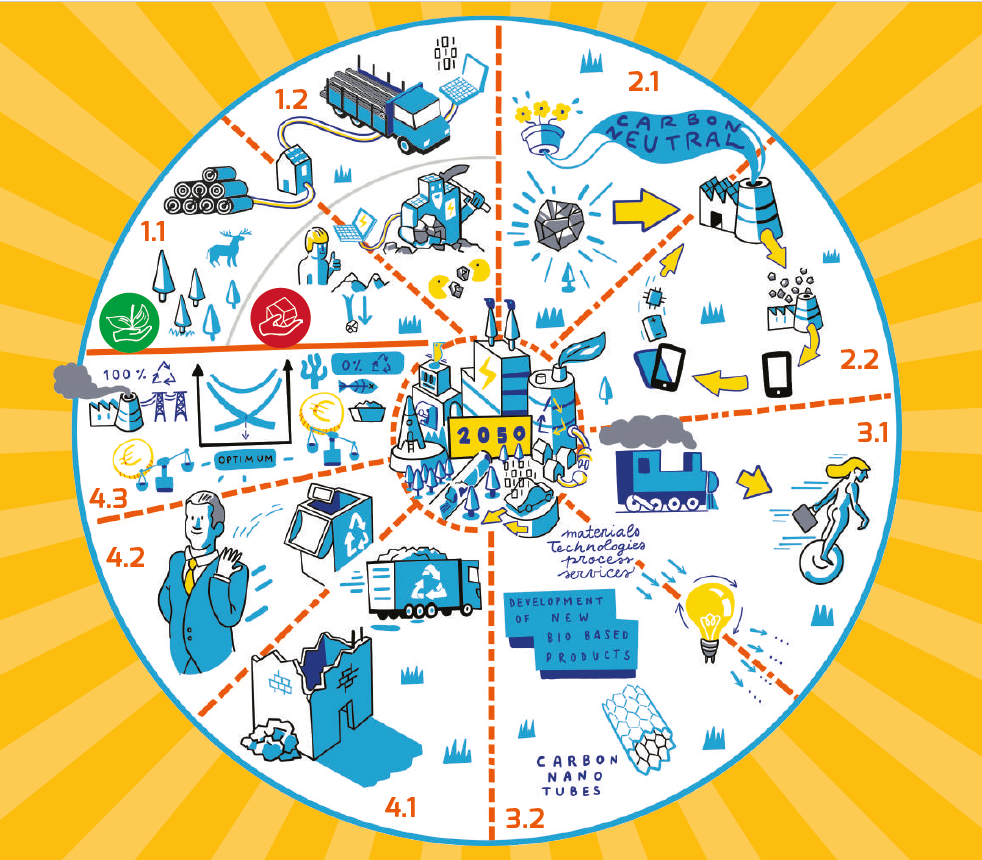
The Final Conference of the VERAM Horizon2020 project took place in Brussels on 17 April 2018. This project brought together diverse stakeholders – including five European Technology Platforms (ETPs): Sustainable Minerals Resources, Forest, Construction, Sustainable Chemistry and Advanced Materials – to produce a medium-term (2030) Vision and a longer-term (2050) Strategic Research and Innovation Roadmap for raw materials. The conference discussed the work of the project, its methodologies and its results including the report ‘Research and Innovation Roadmap: A Sustainable and Competitive Future for European Raw Materials’.

The VERAM approach covered all raw materials: both the biotic (for example forestry & natural rubber) value chain and the metal, minerals and aggregates value chain. It looked to reinforce and underpin greater sustainability, economic resilience and technology leadership in the EU. The Vision 2030-2050 sees increased EU production to ensure a base load supply of materials, development of globally competitive sustainable technologies, investment both in and outside Europe to ensure access to resources, the creation of new jobs across the raw materials sector, and contributing to the replacement of jobs lost in other parts of the economy and through automation. It was clear that there will remain a need for primary material resources despite the expected transition to a more circular economy.
  
Four priorities, 178 action areas
Four priority areas were identified and form the core of the Roadmap considerations:
  1. Fostering a sustainable supply of raw materials to feed new and existing value chains
  2. Resource-efficient processing for raw materials
  3. Raw materials in new products and applications, and
  4. Closing material loops by maximising the recycling of products, buildings and infrastructure.
The VERAM roadmap includes analysis of the five ETPs’ Strategic Innovation and Research Agendas (SIRAs), the European Innovation Partnership (EIP) on Raw Materials SIRA, public consultations and workshops.

The project also had established an inventory of current Member State, EU and global raw materials policies and R&D funding calls and had surveyed EU Member State funding bodies with 13 Member States providing insights. The inventory database is available on the VERAM web portal.


This highly inclusive process resulted in the formulation of some 178 Research & Innovation Areas (RIAs) across the four identified priorities. Remarkably within the RIAs over 50% overlapped between the two categories of raw materials: biotic on one side and metals, minerals and aggregates on the other side.

Multiple speakers at the final conference applauded the work of the project; not least the integration of diverse input from such a wide range of major stakeholder highlighting the importance of raw materials issues to European competitiveness, jobs and growth. However, it was also noted that the sectors needed to do more to integrate societal interests.

This JRC video shows how lack of raw materials could inhibit the low carbon economy.

Wide dissemination
It is now vital that the results of the project are disseminated as widely as possible to ensure the recommendations and ideas are brought to fruition as soon as possible. The report will be presented to funding authorities at European, national and regional levels, including initiatives such as the BioBased Industries Joint Undertaking (BBI JU) and the Sustainable Process Industries for Resource and Energy efficiency (SPIRE) PPP, to ensure inclusion of VERAM ideas in forthcoming research and innovation calls.

Wednesday, 19 July 2017

Can the EU Chemical Industry go Carbon Neutral by 2050?

The chemical industry’s ambition is to play a leading role in the transformation of the European economy to a sustainable low-carbon and circular economy by creating innovative climate and energy friendly solutions, both for its own processes and for many other industries through chemical products. A new report 'Low carbon energy and feedstock for the European chemical industry' from SusChem founding partners Dechema and released via the European Chemical Industry Council (Cefic) explores how the chemical industry can become carbon neutral by 2050. 

The Dechema study analyses the technological options available for the chemical industry and outlines the conditions necessary to facilitate the transition of the European chemical industry to carbon neutrality.

As well as giving a first full overview of all available technologies for the main chemical production processes, it describes what is needed to refurbish the industrial base we know today in Europe, in a world of shale gas and low oil prices:
  • Abundant low-carbon electricity in much larger volumes and at competitive prices;
  • Availability of alternative feedstocks (e.g. bio-based raw materials, CO2 or industrial waste gases).
  • An enabling fiscal structure to modernise ageing production facilities and equipment or build new plants;
  • Government or public-private support to scale-up technologies and share investment risk for those technologies that are first of a kind or high risk
  • Innovation and research into new chemical technologies that help overcome these challenges.
  • Enabling business models to enhance cross-sectoral collaboration to find sustainable ways to re-use CO2
Role for SusChem and SPIRE
The report concludes that, in order to achieve the EU’s 2050 objectives, an ambitious research and innovation programme will be essential to improve the potential of required advanced technologies, and public-private-partnership efforts will be critical to enable fast deployment and risk sharing for the investments needed. 

In addition, industrial symbiosis opportunities and sustainable materials recycling options should be further explored in order to improve energy and resource efficiency beyond sectorial boundaries. 

Clearly these areas where SusChem and SPIRE are currently working hard to advance sustainable chemistry and sustainable process industry technologies.

Energy intensive
The chemical industry has already halved its energy intensity and greenhouse gas emissions since 1990, but producing chemicals remains one of the most energy intensive industrial processes. Making the sector carbon neutral while retaining its competitiveness in a full circular economy in Europe is a significant challenge, which cannot be solved by the industry on its own.

In an interview with Politico Energy Marco Mensink, Cefic Director General, said that the fact that the industry is looking at how to cut carbon emissions shows that it’s embracing the need for change, “I think we have always taken the position that we are very energy-intensive and that there are huge challenges to become energy neutral,” he said. “But this is a different stance.” Why? Because the attitude of the sector is changing, because the Paris climate agreement has become a reality, and because time is ticking, he added.

The main findings of the report are that the implementation of the technologies investigated in the study would allow for a very significant reduction of CO2 emissions in 2050 (up to 210 Mt annually under the maximum scenario). And including the production and use of fuels related to the pathways considered in the study, the additional CO2 abatement potential in 2050 exceeds the chemical sector’s current emissions even under the intermediate scenario.

Commenting on the report, Marco Mensink said: “Many promising low-carbon technologies are available at a relatively advanced stage of development. The industry will need to find the way to overcome the investment, raw material and energy challenges for them to be implemented on a large scale in Europe.” 

Kurt Wagemann, Executive Director of DECHEMA added: “The implementation of the technologies investigated in this study would allow for a very significant reduction of CO2 emissions of the chemical industry by 2050 even under the least ambitious scenario.”

However, such a transition to carbon neutrality will entail huge challenges for the European chemical industry including availability of low carbon energy, availability of alternative feedstock, investments in new assets that far exceed the typical level of investments in the recent years, uncompetitive production costs. 

The report
The report Low carbon energy and feedstock for the European chemical industry looks into technology options and pathway scenarios to ensure a low-carbon, yet competitive European chemical industry by 2050. The study focuses on the main chemical building blocks used in upstream large volume production processes (ammonia, methanol, ethylene, propylene, chlorine and the aromatics benzene, toluene and xylene), which represent about two-thirds of all GHG emissions in the chemical sector.

Friday, 15 July 2016

Horizon Prize for #useCO2 and more

The European Commission has recently announced three new topics for its novel Horizon Prizes including one for ‘CO2 reuse’ - an area of great interest to SusChem that features in the SusChem Strategic Innovation and Research Agenda (SIRA). All the three new Horizon Prizes aim to encourage innovation and find solutions to challenges in the area of energy.

The Commission’s Horizon Prizes are 'challenge' prizes that offer a cash reward to whoever can most effectively meet a defined challenge. Their aim is to stimulate innovation and come up with solutions to problems that matter to European citizens.

Worth a total of €3.25 million and funded under the Horizon 2020 programme, in addition to developing products that help cut emissions by reusing carbon dioxide (CO2) the prizes will reward innovative approaches to integrating solar energy into historical buildings, and using renewable energy in hospitals.

Launching the three new prizes Carlos Moedas, Commissioner for Research, Science and Innovation, said: "Protecting our rich cultural heritage and providing state-of-the-art hospitals need not be at odds with our goal for a sustainable, affordable and low-carbon energy future. These prizes will help mobilise the talent needed to find new ways to deploy existing technologies to achieve these goals, and the innovative reuse of CO2 will help to tackle climate change, one of the major societal challenges worldwide."

The chemical activation and use of CO2 has been a topic of great interest to SusChem for many years and SusChem closely follows progress in CO2 utilisation and regularly tweets on developments using the #useCO2 hashtag. For example Covestro recently announced the opening of its DREAM useCO2 facility and we have covered EU-funded projects, such as SCOT and BIO-TIC, which look to make use of waste CO2. The SCOT project recently held its end of project meeting.

The topic also features in the SusChem Strategic Innovation and Research Agenda (SIRA).

Prize details
The €1.5 million Horizon Prize CO2 reuse will be awarded to the developer of an innovative product that reuses carbon dioxide (CO2), making a genuine contribution to achieving net emissions reductions.

The €1 million Horizon Prize Low carbon hospital will contribute to finding solutions for using 100% renewable energy sources for heat and power generation in hospital buildings. The award will go to an innovative solution integrating several technologies into one energy system, which can guarantee uninterrupted energy supply.

The €750 000 Horizon Prize Photovoltaics meets history addresses the technical constraints in integrating photovoltaic energy sources in historical urban districts. The prize will be awarded to the most suitable architectural and aesthetical design for a photovoltaic energy system which at the same time presents an optimal technical solution.

Contestants can apply until 26 September 2018 for the Photovoltaics meets history contest and until 3 April 2019 for the two others. Applicants have total freedom in the approach they take to deliver the breakthrough solution. The rules of the contests are available on the Horizon Prizes website.

What are Horizon Prizes?
First a technological or societal challenge, for which no solution has been found, is defined and an award is promised for the delivered breakthrough solution. The criteria for the specific award outlines what the solution must be capable of proving, however the means to reach the solution are not prescribed, leaving entrants total freedom to come up with the most promising and effective solution.

You can find out more about the Horizon Prize process in the video below.


Horizon Prizes are not like the Nobel Prize or the Sakharov Prize that celebrate outstanding achievements performed in the past. Challenge prizes like the Horizon Prizes and the US X-Prizes support and accelerate change in the world and can be an important driver for innovation.

In March 2014, the European Commission announced the winner of its first ever challenge prize to encourage inventors to overcome one of the biggest barriers to using vaccines in developing countries: the need to keep them stable at any ambient temperature. The €2 million prize was awarded to German biopharmaceutical company CureVac GmbH for progress towards a novel technology to bring life-saving vaccines to people across the planet in safe and affordable ways.

Thursday, 28 January 2016

Six Model EU Regions to lead way towards Sustainable Chemical Industry

The European Commission has selected six 'model regions' to lead the way towards a sustainable EU chemical industry. The announcement (on 26 January 2016) of the selection of the six model regions in the field of sustainable chemicals production kicks off the European Sustainable Chemicals Support Service which met for the first time this week. And Cefic and SusChem will be helping to deliver support to the selected regions.

The six 'model demonstrator regions' in Europe are Andalusia (Spain), Groningen-Drenthe (The Netherlands), Kosice (Slovakia), Scotland (United Kingdom), South and Eastern Ireland (Ireland) and Wallonia (Belgium).

The regions have been selected from 28 applicants from EU regions, and will receive advisory support from the 'European Sustainable Chemicals Support Service' (ESCS) – a consortium led by the European Commission and CIRCE (the Research Centre for Energy Resources and Consumption). Cefic and SusChem will work with CIRCE and other partners to provide support to the six selected regions.

The aim of the initiative is to encourage investments in sustainable chemicals production in Europe that will contribute to the development of the circular economy, for example by taking advantage of domestically available feedstock such as biomass, waste or CO2.

Cefic and SusChem have been very supportive of collaboration within and between chemical regions based on concepts such as Industrial Symbiosis. This was demonstrated by Cefic-SusChem participation in the Chemical Regions for Resource Efficiency (R4R) FP7 project and expressed in the SusChem position paper on Circular Economy (see below). Participation in this tender continues and expands this support.

Call background
In a call for the expression of interest in September 2015, the Commission asked for applications from regional organisations interested in developing ambitious strategies to support sustainable chemicals in Europe. The final aim is to attract new investments in industrial projects in the chemicals sector, thereby also contributing to the industry policy objective of raising the GDP share of manufacturing in Europe. The call also intended to lead to further development of coherent policies, such as those related to the circular economy and low carbon economy, industrial symbiosis as well as removing investment bottlenecks.

The applications submitted clearly show the commitment of many regions in Europe to move towards circular economy and low carbon economy models, by using renewable resources for chemicals production. Experiences from the initiative will be shared with other interested European regions, to boost cooperation between the chemicals sector and other sectors, like agriculture, forestry, energy intensive industries, waste management and recycling.

SusChem and the circular economy
Since its inception in 2004 SusChem has inspired numerous research and innovation activities that address major European societal issues. SusChem’s solutions are based on sustainable enabling technologies developed by the chemical industry and its partners in academia, research and technology organisations, and other industrial players from a wide variety of different value-chains and sectors. Many of these technologies are essential to the implementation of a sustainable circular economy.

In October 2015 SusChem published a position paper on the Circular Economy. You can download the paper here.

The paper has three main messages:

A sustainability-based approach is needed
The integration of all aspects of sustainability is essential to the development of a circular economy in order to effectively ensure a positive impact on society while minimising environmental impact and maintaining economic growth.

Technology development is required for a sustainable circular economy
A circular economy cannot be achieved only through implementation of new regulations, services and business models.  Advanced technologies are essential to enable a better use of existing resources along the whole life cycle to develop new production and recycling paths – and the expertise of the chemical industry as a material supplier is highly valuable and important here. In particular SusChem believes that the principle technology developments should take place in the following three areas:
  • Utilisation of sustainable alternative feedstock including  secondary raw materials, ligno-cellulosic biomass, waste or CO2 from industrial flue gases. 
  • Design of sustainable materials enabling eco design of ‘products’ that are easy to recycle while maintaining or improving performance.
  • Improved efficiency for production processes to maximise the use of all resources entering the system including primary and secondary raw materials, water, and energy.
These technologies are more fully described in the SusChem’s 2015 Strategic Innovation and Research Agenda (SIRA) and should be supported through the appropriate European funding instruments.

Coherence and stability over time for the policy framework is critical for European leadership
To contribute fully to a sustainable economy, the circular economy policy should be developed in coordination with other related policies such as the Energy Union Package. Policy coherence, as well as policy stability over time, is essential to establish a regulatory framework that enables investment in sustainable, resource efficient and innovative technologies in Europe and ensures European leadership in sustainable/clean technologies.

Tuesday, 10 November 2015

Sustainable Chemistry for a Sustainable World

From 30 November to 11 December 2015, world leaders will meet in Paris at the Conference of the Parties (COP-21) of the United Nations Framework Convention on Climate Change (UNFCCC). Their objective will be to seek agreement on a global framework to reduce global greenhouse gas (GHG) emissions, strengthen climate resilience and mobilise global political will to address the global climate challenge. This is a challenge that requires the contribution of a sustainable chemistry sector.

In early November leaders of Cefic, the European chemical industry association, published a signed letter in the Financial Times expressing firm support for government’s efforts to secure a strong, globally binding climate change agreement at COP21 in Paris. The full text of the letter to The Financial Times is reproduced below.

The letter clearly stated that the chemical industry does and will continue to support efforts by European governments and institutions to achieve a competitive, low carbon economy. However the leaders stressed the importance of the word “competitive” in that sentence: only a competitive, sustainable European chemical industry can contribute to the achievement of a low carbon economy through its essential innovations.

SusChem and a sustainable chemical industry
“The chemical industry is key in addressing the climate change challenge.  It is a critical supplier of novel materials and advanced technologies to many value chains and therefore a crucial partner in achieving a competitive, low-carbon economy,” comments Pierre Barthélemy Cefic’s Executive Director, Research and Innovation.

Sustainability is an overriding priority for the chemical industry and the industry can do much to change societal production and consumption patterns. In particular the sector can promote resource efficient products and is a key enabler for the advanced innovative products and services that can deliver sustainable solutions throughout the economy. Together with supply chain partners, the chemical industry takes a holistic approach to sustainability. With a skilled workforce, a sustainable chemical sector can develop and produce innovative products, services and solutions for a growing global population, while striving to conserve our planet’s resources and respecting the environment.

And SusChem-inspired initiatives and actions are a key part of this.

“Addressing the climate change challenge depends strongly on technological innovation to reduce the energy and feedstock footprint of our society," says Pierre Barthélemy. "SusChem proposes numerous solutions based on enabling technologies that can foster a more sustainable economy and ensure a positive impact on our society and the environment, including the transition to a more circular economy.”

Cefic statement
Jean-Pierre Clamadieu, CEO Solvay and Cefic President elaborates more on the importance of sustainability and the chemical industry in the video below.


You can find out much more about the European Chemical Industry’s approach and view on COP-21, including more video interviews with chemical industry leaders, here.

An open letter to the European Council, European Commission and European Parliament
The European chemical industry backs strong global climate change agreement at COP21
"We, leaders of the European chemical industry, applaud the diplomatic efforts to achieve an ambitious and globally-binding agreement in the Paris climate negotiations next month. Climate action is needed worldwide, to truly protect future generations from this global problem.
Today, the chemical industry is a pillar of the European economy: a €551 billion industry in 2014 with a significant trade surplus of €43.5 billion, providing over 1 million direct jobs and nearly 2.5 million indirect jobs in Europe.
We believe the chemical industry is also a pillar of tomorrow’s low carbon economy.
We represent a creative industry, whose greenhouse gas emissions have fallen by 54% on 1990 levels while production grew by 70%. So, we want to set the record straight that Cefic does, and will continue to, support efforts by European governments and institutions to achieve a competitive, low-carbon economy.
Chemistry is often all but invisible yet essential to consumers’ everyday lives: from health and hygiene to transport, construction and computing. Chemical innovation enables current and future climate change solutions, including renewable energy, energy storage and thousands of products to improve energy efficiency, such as in vehicles and buildings. In future years, chemical companies around the world will develop many more of these innovative and important solutions.
For now, Europe’s chemical industry is facing the reality of ever fiercer global competition. It must remain competitive in order to continue being innovative.
Climate change policy leadership in Europe should not come at the expense of ‘investment leakage’ – the effect of regional imbalances in climate regulations and associated cost differences that lead to the relocation of carbon emissions but not to an overall global reduction. For this reason we would warmly welcome a successful outcome in next month’s climate negotiations. Meanwhile Europe’s policymakers also need to make certain that measures are in place ensuring energy-intensive industries are not exposed to investment leakage in any scenario. European deindustrialisation is not and should never be seen as a viable option on the journey to decarbonisation.
We wish success to all involved in the negotiations in Paris next month."